1. Why plants need a transport system
A small single-celled organism such as Amoeba can get everything it needs by diffusion straight across its cell membrane: its surface-area-to-volume ratio is so high that no specialised transport is needed.
A large multicellular plant is the opposite. Its roots are in the soil, picking up water and dissolved mineral ions. Its leaves are in the air, producing sugars by photosynthesis. The two are tens of centimetres or even tens of metres apart, far too far for diffusion alone to move substances at a useful rate. A plant therefore needs a transport system: a network of tubes that moves water, mineral ions and sugars between the parts of the plant that need or supply them.
In a plant this transport system is the vascular system, made of two types of tube running side by side through the roots, stem and leaves:
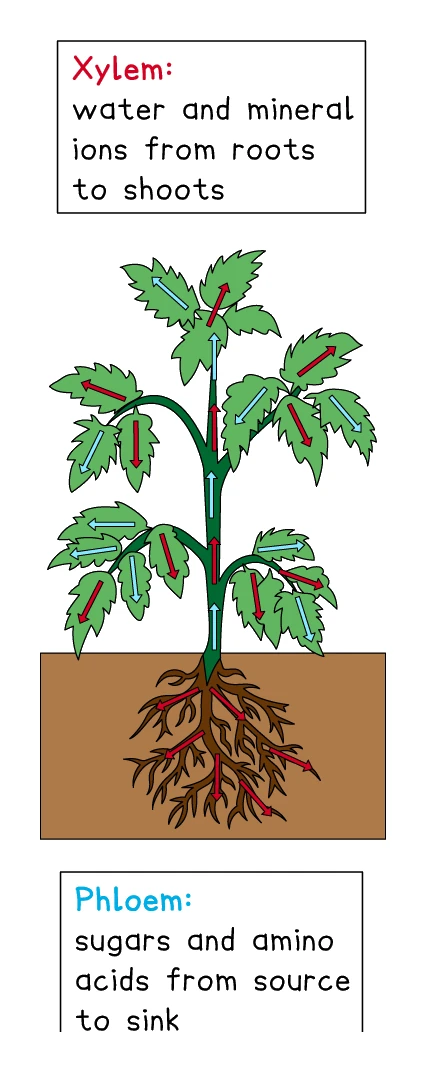
- The moves water and mineral ions from the roots upwards to the rest of the plant.
- The moves sucrose and amino acids from the leaves (where they are made) to wherever they are needed for growth or storage.
2. Xylem and phloem: structure and function
Xylem
The xylem is the plant's plumbing for water and dissolved minerals. It carries water from the roots upwards to the leaves, where the water is used for photosynthesis and replaces the water lost in transpiration.
Key features of xylem:
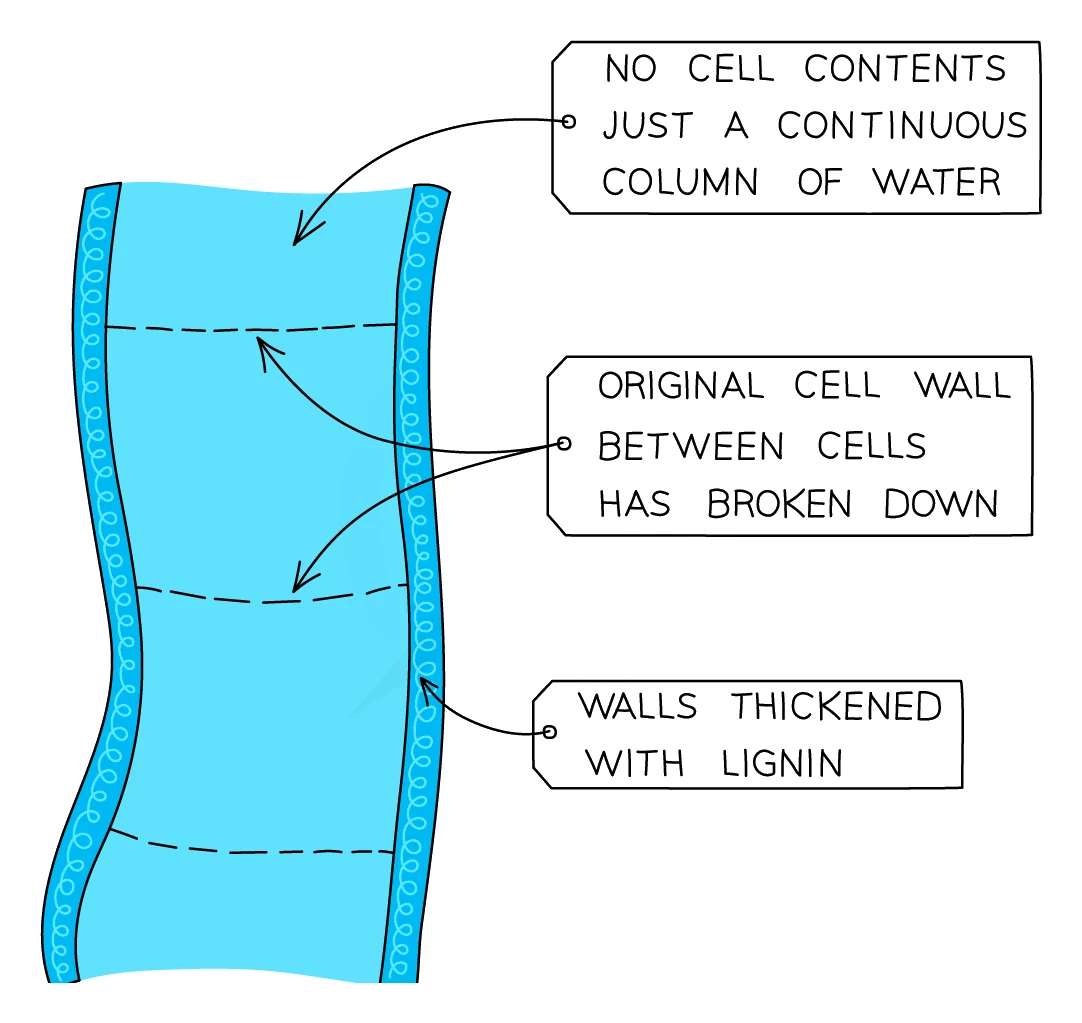
- Made of dead cells stacked end-to-end with the cross-walls removed, forming a long hollow tube (a bit like a stack of empty pipes with the lids taken off).
- The cell walls are reinforced by a tough waterproof material called lignin. Lignin gives xylem its strength and waterproofing, which is why wood (mainly xylem) is so strong.
- Because the cells are dead, the xylem cannot push water; the water moves up by being pulled from above as the leaves transpire (covered in section 4) and by root pressure pushing from below.
- Xylem only carries substances in one direction: upwards from roots to leaves.
What the xylem transports:
- Water from the roots up to every cell that needs it.
- Mineral ions dissolved in the water, such as nitrate (for amino acids and proteins) and magnesium (for chlorophyll).
Phloem
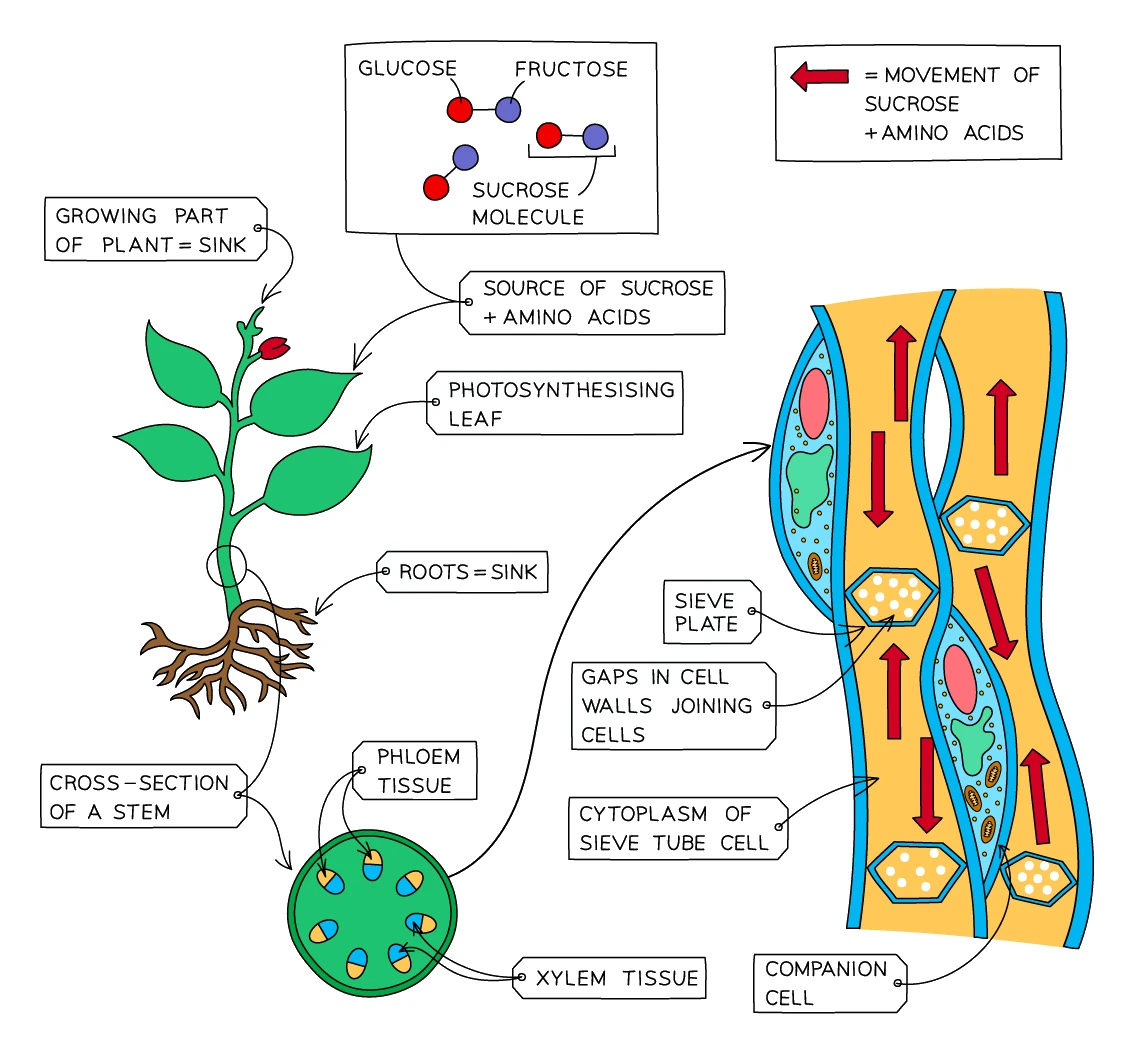
The phloem carries the products of photosynthesis from the leaves (where the plant makes them) to anywhere else in the plant that needs them. This movement is called .
Key features of phloem:
- Made of living cells joined end-to-end, with sieve-like cross-walls between them (called sieve plates) full of small pores that sugars can pass through.
- Cells are connected to neighbouring companion cells that supply the energy for translocation (active transport needs ATP, so the companion cells contain many mitochondria).
- Phloem can carry substances in both directions at the same time, depending on where each substance is needed. Sugars made by photosynthesis in summer might go to the roots for storage; in spring, the same phloem will carry stored sugars from the roots back up to fuel new leaf growth.
What the phloem transports:
- Sucrose (the form in which sugars are transported), made by combining glucose with fructose. Sucrose is more chemically stable than glucose and does not interfere with respiration in the transport cells.
- Amino acids, used everywhere in the plant for protein synthesis.
Side-by-side comparison
| Feature | Xylem | Phloem |
|---|---|---|
| What it carries | Water and dissolved mineral ions | Sucrose and amino acids |
| Direction of flow | Upwards only (roots → leaves) | Both ways (source → sink) |
| Cells alive or dead? | Dead | Living |
| Wall material | Lignin (waterproof, rigid) | Cellulose, with sieve plates between cells |
| Energy required? | No (water is pulled by transpiration) | Yes (active transport, supplied by companion cells) |
| Common name for the process | The transpiration stream | Translocation |
Exam tip
Phloem carries sucrose, not glucose
When a question asks what the phloem carries, for example what an insect feeding on phloem sap takes in, the credited answers are sucrose (or "sugars") and amino acids. Glucose and starch are rejected and water is ignored, so name the transport sugar, not the sugar made in photosynthesis. The tissues need the same care: in a leaf-adaptation answer the tissue that brings water to the cells is the xylem, and "phloem" written there is ignored. Keep the pairing fixed: xylem for water and mineral ions, phloem for sucrose and amino acids.
3. Absorption of water and minerals by the roots
The root hair cell
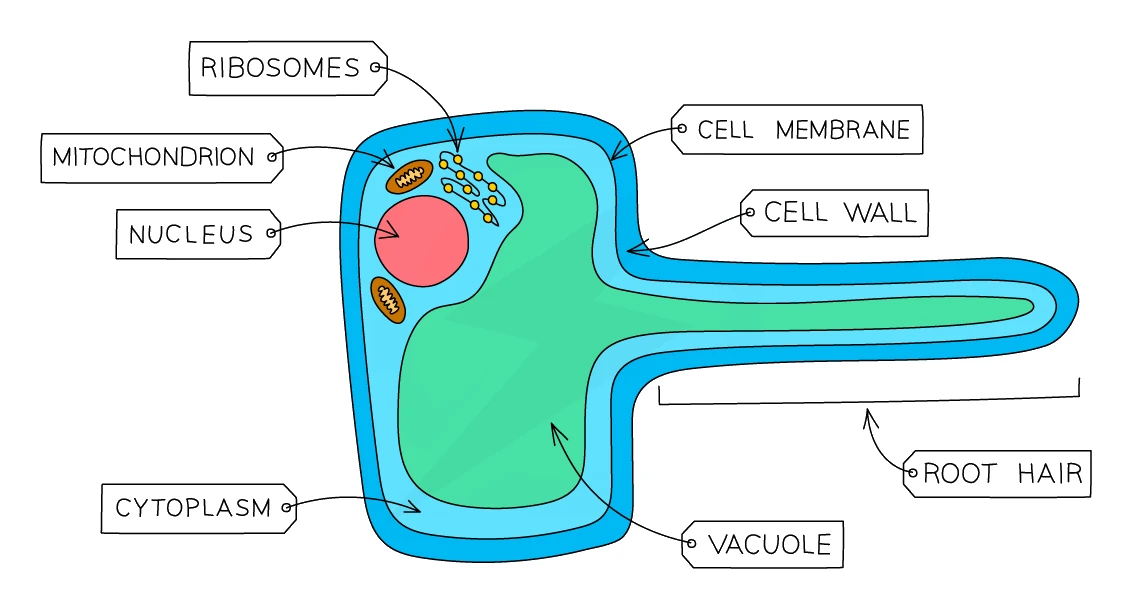
Water and dissolved minerals enter the plant through specialised cells in the roots called root hair cells. Each root hair cell is a single epidermal cell with a long thin extension that sticks out into the soil. Thousands of these hairs cover the surface of every young root, just behind the tip.
Root hair cells are wonderfully adapted for their job:
- Long, thin extension sticking out into the soil, which hugely increases the surface area of the root in contact with soil water. More surface means more water and minerals can be absorbed at once.
- Very thin cell wall so water and ions can move quickly across into the cell.
- No chloroplasts (the root is underground in the dark; chloroplasts would be useless).
- Large permanent vacuole containing a solution of sugars and salts. This makes the inside of the cell more concentrated than the soil water, providing a steep water-potential gradient for osmosis.
- Many mitochondria to supply ATP for the active transport of mineral ions against their concentration gradient.
How water enters the root (osmosis)
Soil water typically has very few dissolved substances. The cytoplasm and vacuole of the root hair cell, in contrast, contain a high concentration of dissolved sugars and salts. Water therefore moves from the soil (high water potential) into the root hair cell (lower water potential) by osmosis through the partially permeable cell membrane.
How mineral ions enter the root (active transport)
Mineral ions such as nitrate and magnesium are present in soil water at very low concentrations but are needed inside the root in much higher concentrations. The plant cannot rely on diffusion, because diffusion would move ions the wrong way (from high to low). Instead, the root hair cells use active transport: protein pumps in the cell membrane use energy from ATP (made by the mitochondria) to pump ions into the cell against their concentration gradient.
This is why root hair cells contain so many mitochondria. Killing a plant root (or starving it of oxygen by waterlogging the soil) shuts down its mitochondria, stops active transport, and the plant quickly suffers a mineral deficiency.
The route of water across the root
Once water has entered the root hair cell, it travels across several layers of cells to reach the xylem at the centre of the root:
root hair cell → root cortex cells → xylem vessels in the centre of the root → up the stem → leaf mesophyll cells
The water moves from one cell to the next by osmosis, always travelling from higher water potential to lower water potential. Once it reaches the xylem, it is pulled up the plant by the (section 4).
4. Transpiration
Transpiration is the evaporation of water vapour from the surface of a plant's leaves, mostly through the in the lower epidermis
Plants lose huge amounts of water this way: a single large oak tree can transpire over 400 litres of water on a hot day. At first this looks wasteful, but transpiration actually does several useful jobs at the same time:
- It pulls water up the xylem from roots to leaves (the stream), bringing fresh water to every photosynthesising cell.
- It transports mineral ions dissolved in the water, distributing them around the plant.
- It cools the leaf on a hot day, in the same way that sweat cools your skin: when water evaporates from the leaf surface, it carries thermal energy away with it.
- It keeps the cells in the leaf turgid, which keeps the leaf firm and properly shaped for catching light.
- It supplies water for photosynthesis in the mesophyll cells.
How the transpiration stream works
The mechanism is a pulling chain that stretches from the soil to the sky:
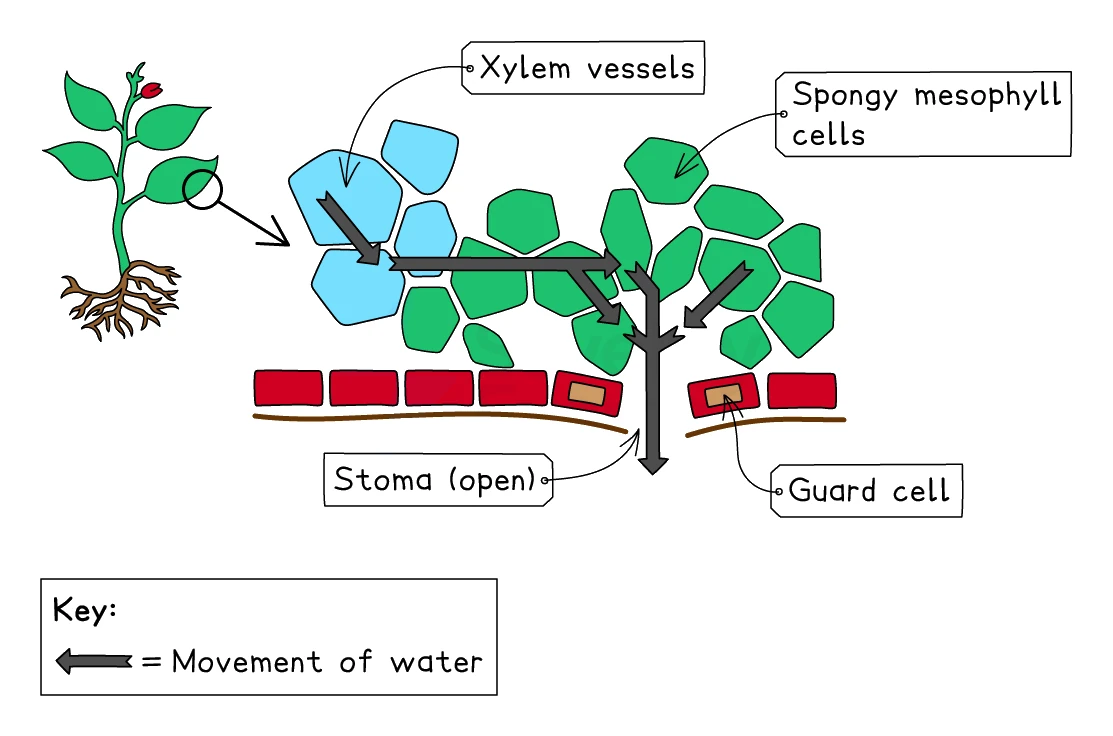
- Water evaporates from the wet surfaces of the spongy mesophyll cells inside the leaf, leaving as water vapour through the stomata.
- As water leaves each mesophyll cell, that cell pulls in fresh water from its neighbour by osmosis (because losing water lowers its water potential).
- Cells closer to the xylem then pull water from the xylem.
- The water column in the xylem is a continuous unbroken thread of water molecules held together by cohesion (hydrogen bonds between water molecules). When the top of the column is pulled, the whole column moves up.
- At the bottom of the plant, fresh water from the soil is pulled into the root hair cells by osmosis to replace what has been lost.
So transpiration at the leaves drives water uptake at the roots. Water flows up the xylem in a continuous stream.
Common exam question
How water gets from the soil to the leaves
Question: Describe how water travels from the soil to the leaves of a plant, or explain the role of stomata in moving water through it (2–4 marks).
Asked in 2 of the 23 papers, both on Paper 2. The four-mark version lists six points, one mark each: root hair cells absorb water by osmosis, from the dilute soil solution into the more concentrated cell; water moves up the xylem; it is pulled by the transpiration stream; and the pull exists because water evaporates and is lost from the stomata. Any four of them score.
The two-mark version needs both halves of the mechanism: water evaporates and diffuses out through the stomata, setting up the transpiration stream, and that loss draws water up from the roots through the xylem into the leaf, creating a water potential gradient. Saying only that water leaves through the stomata earns the first mark; the second needs the pull on the water below.
Stomata: open by day, closed by night
Stomata are tiny pores in the leaf surface (mostly on the underside), each surrounded by a pair of bean-shaped guard cells that control whether the pore is open or closed.
- In daylight, the guard cells take in water by osmosis and become turgid. Their unusual shape means that as they swell, they bend outwards, opening the stoma. Gases can move in and out freely, allowing photosynthesis to happen.
- At night, the guard cells lose water and become flaccid. They flop back together and close the stoma, reducing water loss when photosynthesis is not happening anyway.
- If the plant is short of water, the guard cells close the stomata even during the day to limit water loss. This stops photosynthesis but saves the plant from wilting.
Common exam question
Why the lower leaf surface loses more water
Any question comparing the two surfaces of a leaf, whether leaves with one surface coated in petroleum jelly lose different amounts of mass, or why a spray that cuts water loss goes on the upper surface only, turns on where the stomata are. Asked in 2 of the 23 papers, both on Paper 2.
The credited idea is that most stomata are on the lower surface and the upper surface has few or none, plus a waxy cuticle. So a leaf with its lower surface blocked loses little water, one with only its upper surface blocked loses almost as much as an uncovered leaf, and one with both surfaces covered loses least. State the pattern in the results, then give the stomata as the reason: they are separate marks. In the coating question, treating only the upper surface leaves the stomata unblocked, so carbon dioxide can still diffuse in for photosynthesis, and the upper surface is where most light falls.
Worked example
Calculating the number of stomata per mm²
The diagram shows a square of the lower epidermis of a leaf. Each side of the square represents 200 µm of leaf surface, and 6 stomata lie inside it. The whole lower surface of the leaf has an area of 40 cm². Calculate (a) the number of stomata per mm² and (b) an estimate of how many stomata the whole lower surface carries.
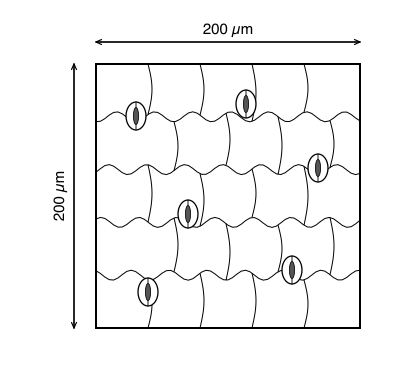
Solution:
- Convert the side length to millimetres: 200 µm = 200 ÷ 1000 = 0.2 mm
- Area of the square = 0.2 × 0.2 = 0.04 mm²
- Stomata per mm² = 6 ÷ 0.04 = 150 stomata per mm²
- Convert the leaf area to mm²: 1 cm² = 100 mm², so 40 cm² = 4000 mm²
- Total on the lower surface = 150 × 4000 = 600 000 stomata (an estimate, because the count in one square is taken as typical of the whole leaf)
This calculation has been set in 3 of the 23 papers, always for three marks. A correct answer with no working earns all three; if the final figure is wrong, the steps still score, with a mark in one scheme or another for the stomata count, the area, and dividing the count by the area. One scheme still gave two marks to an answer out by a power of ten.
5. Factors that affect the rate of transpiration
The rate of transpiration depends on how quickly water vapour can leave the leaf and how steep the water-vapour gradient is between the inside of the leaf and the air outside. Four environmental factors matter most:
| Factor | Effect when increased | Why |
|---|---|---|
| Light intensity | Transpiration increases | Brighter light makes the guard cells open the stomata wider, so more water vapour can escape |
| Temperature | Transpiration increases | Warmer water molecules have more kinetic energy; they evaporate faster and diffuse out more quickly |
| Wind speed (air movement) | Transpiration increases | Moving air sweeps water vapour away from the leaf as soon as it leaves the stomata, keeping the concentration gradient steep |
| Humidity | Transpiration decreases | High humidity means lots of water vapour is already in the air, so the gradient between leaf and air is shallow and diffusion slows down |
A dry, hot, sunny, windy day is therefore the worst combination for water loss. A still, cool, humid, dark night is the best for keeping water in the plant.
Common exam question
Explaining why a factor changes the rate of transpiration
Question: Explain why a change in light intensity, temperature or air movement changes the rate of water loss (2–3 marks), or pick the conditions that give the fastest transpiration (1 mark).
Asked in 4 of the 23 papers. Light: brighter light opens more stomata, and opens them wider, so more water is lost; a plateau means all the stomata are already open. Temperature: cooler leaves give the water molecules less kinetic energy, so they move less and evaporate and diffuse out more slowly. Wind: moving air blows the water vapour away and removes the humid air around the leaf, keeping the concentration gradient steep, so water diffuses out faster. The multiple-choice version wants low humidity with high temperature.
Each step is a separate mark: "stomata open in the light" alone is one mark of two, and "the wind blows the water away" one of three. Finish with the effect on the gradient or on the water lost.
6. Core practical: investigating transpiration with a potometer
A potometer is a piece of apparatus that measures how fast a plant cutting is taking up water. Since almost all of the water taken up is then lost through transpiration, the rate of water uptake is a very close measure of the rate of transpiration.
Apparatus: the bubble potometer
The bubble potometer is a sealed glass tube system with a leafy shoot at the top, a horizontal scaled capillary tube at the bottom, and a reservoir for refilling. A single air bubble sits in the capillary tube and gets pulled along as the shoot draws up water. The distance the bubble moves in a fixed time is the measure of water uptake.
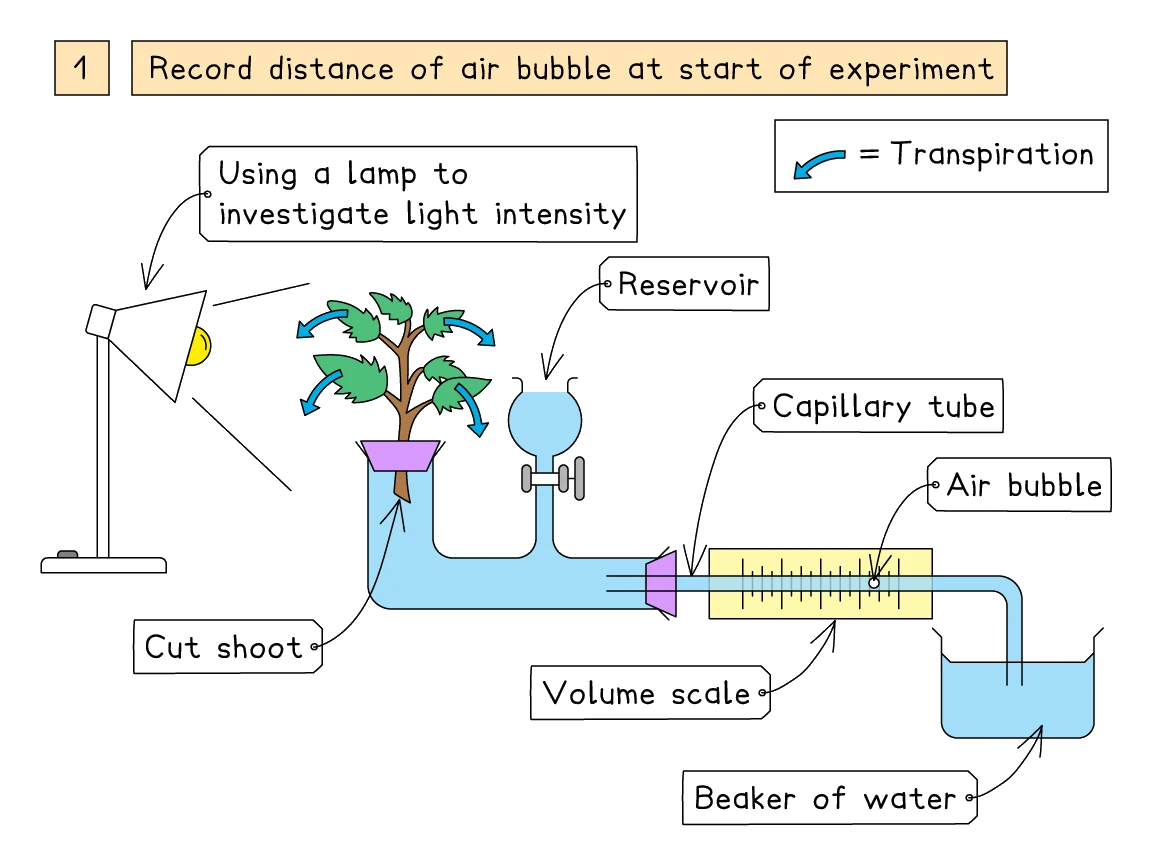
You also need:
- A freshly cut leafy shoot
- A stopwatch
- A lamp (for the light-intensity experiment) or a fan, a plastic bag, or a heater (for the other factors)
- A ruler (often built into the apparatus)
- Petroleum jelly (to seal joints)
Method (testing light intensity as an example)
- Cut a leafy shoot underwater to prevent any air entering the cut end of the xylem. An air bubble inside the xylem would block water uptake.
- Slide the shoot into the rubber bung at the top of the potometer (also underwater) and assemble the apparatus, sealing every joint with petroleum jelly so it is airtight.
- Lift the end of the capillary tube out of the water reservoir briefly to introduce a single air bubble. Lower it back in.
- Place a lamp 10 cm from the leaves and leave the plant to settle for 5 to 10 minutes so the rate becomes steady.
- Record the starting position of the bubble on the scale.
- Start the stopwatch and leave for 30 minutes.
- Record the ending position of the bubble.
- Reset the bubble using the reservoir tap.
- Move the lamp further away (to 20 cm, 40 cm, etc.) and repeat steps 4–8.
Calculating the rate of transpiration
For each lamp distance:
distance moved by bubble (mm) = end position − start position
rate of water uptake (mm/min) = distance moved ÷ time
You will normally find the rate is highest at the closest lamp distance (highest light intensity), and falls as the lamp is moved further away.
Variables to control
- Independent variable (the one you change): the factor under test (light intensity, temperature, wind speed, or humidity).
- Dependent variable (what you measure): rate of water uptake (distance moved by bubble per unit time).
- Control variables: the same shoot, the same number of leaves, the same total leaf area, the temperature of the room, the assembly time, and the time of day.
Investigating the other factors
The same apparatus can be used to test temperature, humidity and wind speed, by changing one variable at a time:
| Factor | How to vary it |
|---|---|
| Wind speed | Direct a fan or hairdryer at the leaves at different distances or speeds |
| Humidity | Spray water inside a clear plastic bag, then wrap it around the leafy shoot |
| Temperature | Move the apparatus between rooms (cold and warm) or place near a heater |
Limitations
- The lamp emits heat as well as light, so changing lamp distance changes both light intensity and temperature. Use an LED bulb (less heat) or place a beaker of water between lamp and plant as a heat shield.
- The room's temperature, humidity and air movement are hard to keep constant from one repeat to the next. Conduct all measurements in the same place at the same time of day.
- The shoot only carries a small leaf area, so any leak or air bubble in the xylem causes a large error. Take care to cut underwater and to seal every joint thoroughly with petroleum jelly.
- The potometer measures water uptake, not transpiration directly. A small fraction of the water taken up goes into building new tissue or is used in photosynthesis rather than evaporating, so the rate is a slight overestimate of true transpiration. The difference is normally too small to worry about.
Common exam question
Experiments that measure water uptake or loss
Questions on experiments measuring water uptake or loss (a potometer, a shoot in a measuring cylinder on a balance, or coated leaves) draw on the points below. Set in 3 of the 23 papers, all on Paper 2.
The potometer method earns four marks from seven: cut the shoot underwater; dry the leaves and seal the joints with petroleum jelly; measure the distance the bubble moves in a set time; move the lamp to different distances; name a variable kept constant; repeat, resetting the bubble with the reservoir.
Oil on the water stops evaporation from the water surface; "it stops water loss" alone is ignored. Leaves of one species share the same density of stomata; "to make it reliable" is ignored. Water uptake is not water loss: the volume falls faster than the mass because some water is kept for turgor or used in photosynthesis, so say both fall, which falls more, and calculate each change, not just quote data.
7. Xerophyte adaptations
A xerophyte is a plant that lives in a place where water is scarce: a desert, a sand dune, a sunny rocky cliff, or a salt marsh. Xerophytes have evolved a set of adaptations to minimise water loss by transpiration, while still leaving enough surface area for photosynthesis. The famous examples are cacti (deserts) and marram grass (dry sand dunes), but plenty of other species use the same tricks.
The adaptations to know
| Adaptation | What it does | Example |
|---|---|---|
| Thick waxy cuticle | Forms a thicker waterproof barrier on the leaf surface, cutting transpiration through the cuticle to almost zero | Cactus stems, holly leaves |
| Reduced leaf surface area (e.g. leaves reduced to spines or needles) | Less surface area means less area for water to evaporate from | Cactus spines, pine needles |
| Hairs on the leaf surface | Hairs trap a layer of moist air close to the leaf, raising the local humidity and reducing the water-vapour gradient between leaf and air. They also reflect sunlight | Many desert plants |
| Stomata sunk into pits or grooves | The pit traps moist air just above the stoma, again raising local humidity and slowing diffusion out | Marram grass, pine needles |
| Rolled leaves | The leaf curls inwards so the stomata face an inner enclosed space, which becomes humid and reduces transpiration | Marram grass |
| Fewer stomata and stomata only on the lower epidermis | Fewer exits for water vapour | Many xerophytes |
| Stomata close during the day (open only at night when it is cooler) | Avoids the hottest, driest part of the day. CO₂ is taken in at night and stored for daytime photosynthesis | Cacti and other succulent plants |
| Swollen stems or leaves for water storage | Stores the rare rain water for use later | Cacti, succulents |
| Deep roots or wide spreading roots | Reaches water that other plants cannot | Mesquite, cactus |
Common exam question
Why fewer or closed stomata help a plant in a dry place
Question: Explain why a desert plant loses less water than another plant, or discuss whether a lower density of stomata would help a crop in a hot, dry place (3–4 marks).
Asked in 2 of the 23 papers, both on Paper 2. Give the benefit as a chain: fewer stomata, or stomata that close in the light and open at night, mean less water is lost by transpiration, so the plant keeps its water and does not wilt. In the desert-plant data, water loss falls as light intensity rises, and saying so earns a mark.
A "discuss" question also wants the cost. Fewer stomata let in less carbon dioxide, so photosynthesis slows, unless the carbon dioxide concentration is high and the diffusion gradient steep; less transpiration also carries fewer mineral ions, such as magnesium for chlorophyll, up to the leaves, and cools the leaf less. Any four of these points score, so give both sides.
Why xerophyte adaptations don't make every plant a xerophyte
Most of these tricks come at a cost. A thick cuticle blocks some light. Hairs and sunken stomata also slow CO₂ uptake, so photosynthesis runs more slowly. Small leaf surface area means less photosynthetic capacity overall. In a place with plenty of water, a plant with thin, broad, smooth leaves can photosynthesise much faster and out-compete a xerophyte. Xerophytes only win where water shortage is the bigger limit on survival.