1. What selective breeding is
(also called ) is the process by which humans deliberately organisms with desirable characteristics together, over many generations, to produce offspring with those characteristics consistently expressed
Humans have been selectively breeding plants and animals for at least 10 000 years, ever since the first farmers chose which crops to plant from this year's harvest and which animals to keep for next year's breeding. The result is the modern range of crops and farm animals: large, productive, fast-growing, disease-resistant, and almost completely different from their wild ancestors.
The four-step process
The basic procedure is the same for any species:
- Identify the desirable characteristic you want. This might be high milk yield, large fruit, disease resistance, fast growth, or a specific colour.
- Choose parents from the population that show the characteristic most strongly. Breed them together.
- Select the offspring that also show the characteristic. The rest are discarded (not allowed to reproduce).
- Repeat for many generations. Each generation, only the best examples are kept and bred together. The characteristic becomes more and more pronounced in the population.
After enough generations (often tens to hundreds), a new variety has been produced in which every offspring reliably shows the chosen characteristic. This is called a breed in animals, or a or in plants.
Exam note: an answer that only mentions one round of breeding (choose two parents → breed them together → done) is incomplete. The process must be repeated over many generations for offspring to reliably show the desired trait.
Common exam question
Describing how to breed for a characteristic
Question: Describe how selective breeding could produce a characteristic such as higher wheat yield, more milk, taller cattle or brightly coloured flowers (2–4 marks).
Asked in 7 of the 23 papers. Breed together the parents showing the characteristic most strongly; select the offspring that show it and breed from those; repeat over many generations. In 3- and 4-mark versions each step is a mark; in 2-mark versions the offspring step and the repeat usually share one, so include the parent step; one scheme ignores a "repeat" that is not about the offspring or next generations.
Name the characteristic given: "desired characteristics" usually scores but one scheme ignores it alone, and "large fish" is ignored when fast growth is wanted. For a trait only one sex shows, such as milk yield, pick bulls by their mothers', sisters' or daughters' yield, saying bulls or males: "cattle" is ignored. To remove a recessive allele, breed only from unaffected animals (a test cross shows which are homozygous dominant, not carriers) and their unaffected offspring, over generations.
2. Selective breeding in plants
Most of our staple food crops have been transformed by thousands of years of selective breeding.
Common goals for plant breeding
| Goal | Why it matters |
|---|---|
| Higher yield | More food per hectare of farmland |
| Disease resistance | Less crop lost to fungal, viral or bacterial disease |
| Pest resistance | Less reliance on chemical pesticides |
| Drought tolerance | Crops survive in drier climates and use less irrigation |
| Tolerance to extreme temperatures | Crops can be grown in more places |
| Better taste, colour or shelf life | More commercially valuable |
| Larger fruits or grains | More food per plant |
| Shorter growing season | Two or three crops per year instead of one |
Other plant examples
- Apples: selected for sweetness, juice content, colour and shelf life
- Bananas: the supermarket banana is a single variety (Cavendish), selected for size, sweetness, lack of seeds. It is now seriously threatened by Panama disease, partly because every plant in the world is a clone
- Maize (corn): descended from a Mexican grass called teosinte that had tiny ears with just a few grains. Modern maize cobs have hundreds of huge grains
- Roses: bred in thousands of varieties for flower size, colour and scent (rather than for food)
3. Selective breeding in animals
Common goals for animal breeding
| Goal | Examples |
|---|---|
| Higher meat yield | Cattle, sheep, pigs, chickens bred for fast growth and large body size |
| Higher milk yield | Dairy cows (Holstein-Friesians produce 30+ litres of milk per day) |
| Higher egg production | Laying hens (produce around 300 eggs per year, vs ~50 for wild birds) |
| Quality of wool | Sheep (Merino wool is fine and soft thanks to centuries of selection) |
| Quality of meat | Marbled beef (Wagyu cattle), tender lamb |
| Speed | Racehorses (Thoroughbreds) |
| Temperament | Domestic dogs (gentle, trainable) |
| Appearance | Show dogs, cats, horses, pigeons |
Domestic dogs: a striking example
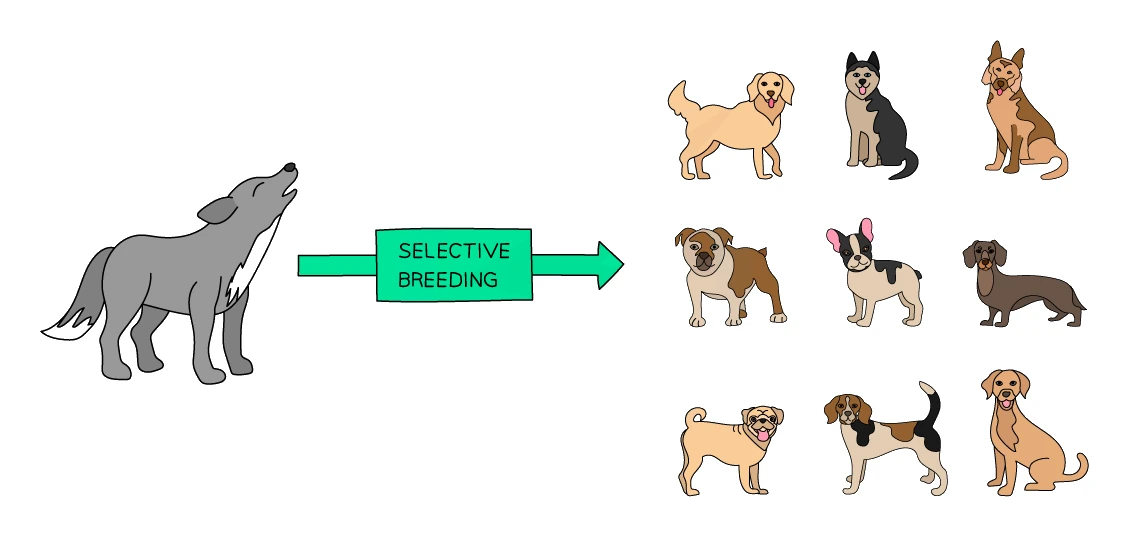
Every breed of domestic dog, from a Chihuahua to a Great Dane, is descended from grey wolves about 15 000 years ago. Yet they have been bred into wildly different shapes, sizes, coat types and behaviours:
- Sheep dogs (Border Collies) bred for herding intelligence and obedience
- Greyhounds and whippets bred for speed (long legs, deep chest, low body fat)
- Retrievers bred for soft mouth (carrying birds without damaging them) and obedience
- Bulldogs bred for short snouts and stocky build (originally for bull-baiting)
- Toy (Chihuahua, Pomeranian) bred small for companion animals
All breeds can still interbreed and produce fertile offspring, so they are still one species: Canis familiaris.
Fish farming and selective breeding
Farmed fish (salmon, trout, tilapia, carp) are selectively bred too, for:
- Fast growth rate
- Disease resistance
- Tolerance to crowding
- Better feed conversion
The use of selective breeding alongside controlled water quality, feeding and disease control allows fish farms to produce far more fish per cubic metre than wild populations could ever sustain. Fish farming is covered in more detail in topic 16 (Human Impact on the Environment).
4. Selective breeding vs natural selection
Selective breeding and natural selection both work by the same underlying mechanism (differences in reproduction between individuals with different traits), but they differ in important ways:
| Feature | Natural selection | Selective breeding (artificial selection) |
|---|---|---|
| What decides which individuals reproduce? | The environment (predators, competition, disease, weather) | Humans decide which individuals to breed |
| What traits get favoured? | Traits that help the organism survive and reproduce in its environment | Traits that humans find useful (more food, better appearance, etc.) |
| Are favoured traits always good for the organism? | Yes, in the current environment | No. Many selectively-bred traits would harm the organism if it had to survive in the wild. A modern broiler chicken cannot fly; modern dairy cows cannot produce enough milk to feed their own calves; bulldogs struggle to breathe due to their flat faces |
| Speed | Slow (thousands or millions of years for big changes) | Fast (decades or centuries for big changes, because every generation is intensely selected) |
| Source of new alleles | Random mutations | Random mutations (plus crossing different existing breeds) |
| Does it produce new species? | Yes, over enough time | Not usually. The breeder usually wants offspring to still be the same species and able to interbreed with the rest of the population |
The key idea: in natural selection, the environment chooses. In artificial selection, humans choose. Otherwise the genetic mechanism is the same.
5. Disadvantages and problems of selective breeding
Selective breeding has fed the world, but it also creates several problems.
Reduced gene pool (loss of genetic variation)
The biggest issue is that selectively bred populations have a much smaller gene pool than wild ones. Only a handful of "best" individuals are used as parents, so most of the species' genetic variation gets thrown away.
The consequences:
- All individuals carry similar alleles. If a new disease arrives that can attack one individual, it can probably attack all of them. The whole population can be wiped out by a single outbreak. (This is the famous concern about the Cavendish banana, where billions of plants are clones of one variety.)
- Adaptation to a changing environment is harder. Without genetic variation, there are no alternative alleles for natural selection to work with if conditions change.
- Loss of traits that might be useful later. Many wild plants have disease-resistance alleles that crop varieties lack. Once those wild relatives are extinct, we cannot get the resistance back.
Inbreeding depression
When closely related individuals (siblings, cousins) are repeatedly bred together to maintain a particular trait, they share most of their alleles. They are likely to share harmful recessive alleles too. When two carriers of the same recessive disease meet, their offspring are likely to be homozygous recessive and show the disease.
This is called and is a serious problem in many pedigree dog breeds:
- Pugs and bulldogs have breathing problems because their flat faces compress their airways (a feature they have been bred for)
- King Charles Spaniels often have a brain condition (syringomyelia) where the skull is too small for the brain
- German Shepherds are prone to hip dysplasia
- Many breeds have shortened lifespans compared to mixed-breed dogs
Loss of natural behaviour and survival skills
Animals selectively bred for thousands of years may have lost the ability to survive in the wild:
- Domesticated turkeys cannot reproduce by natural mating; they have to be artificially inseminated because the males are too heavy
- Modern broiler chickens cannot fly and have weak hearts (their bodies grow faster than their organs can support)
- Many vegetable varieties cannot reproduce without human help (e.g. seedless bananas have to be propagated vegetatively from offshoots (suckers))
Ethical concerns
- Many breeds bred for extreme physical features suffer chronic pain or breathing problems (some flat-faced breeds of dogs and cats)
- Intensive selection for fast growth in farm animals raises welfare concerns
- Loss of traditional and rare breeds reduces genetic diversity and cultural heritage
Mitigating the problems
- Breeders outcross occasionally to introduce fresh alleles
- Rare breed conservation programmes maintain populations of traditional breeds that hold useful genetic variation
- Seed banks (like the Svalbard Global Seed Vault) preserve traditional crop varieties for the future
- Some kennel clubs are tightening breeding standards to discourage extreme physical features
6. Tissue culture and micropropagation
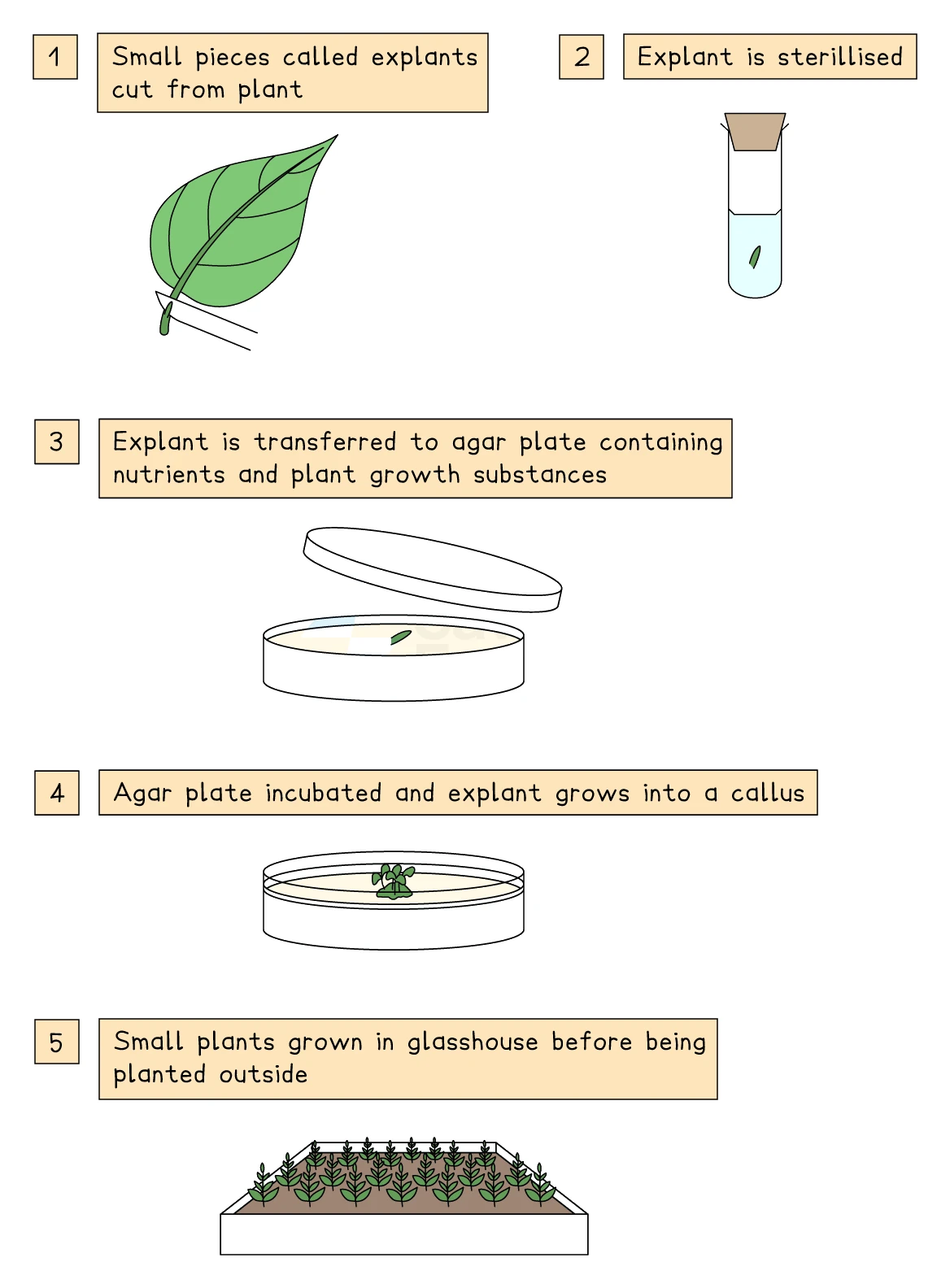
(also called micropropagation) is a modern technique for rapidly cloning plants by growing many small pieces of plant tissue in sterile laboratory conditions. It is an alternative to traditional methods like taking cuttings (covered in topic 12).
How tissue culture works
- Select a parent plant with the desired characteristics (high yield, disease resistance, attractive flowers).
- Take small (small pieces of tissue) from a fast-growing region of the plant, usually a shoot tip or meristem.
- Sterilise the explants by washing in dilute bleach to kill any microbes on the surface.
- Place the explants on a sterile nutrient medium (agar containing sugars, mineral ions, and plant hormones such as auxin and cytokinin) in a sealed Petri dish or culture vessel.
- The cells divide and form a callus (a mass of unspecialised cells) under the influence of the hormones.
- Change the hormone balance in the medium to encourage the callus to develop into tiny plantlets (shoots and roots).
- As soon as small plantlets have formed, transfer them to soil and grow them on like ordinary plants.
The entire process can take just a few weeks. A single parent plant can produce thousands of identical offspring in one year, all genetically identical to the parent and to each other.
Common exam question
Describing the process of micropropagation
Question: Describe the process of micropropagation, or fill the gaps in a passage about it (3–6 marks).
Asked in 2 of the 23 papers, one mark per step or gap. Take small pieces of tissue (explants) from the parent plant, such as shoot tips or meristems. Sterilise them with ethanol, disinfectant or bleach so that microorganisms cannot grow. Place them on agar that supplies minerals and glucose (an energy source) plus plant growth substances such as auxin; "hormones" and "rooting powder" are accepted. The plants produced are clones, genetically identical to the parent.
"Sterile agar" earns both the sterilising mark and the agar mark in one phrase. "Nutrients" on its own is ignored, so name the mineral or the sugar; "carbohydrate" was also ignored where a named energy source was wanted, while "glucose" is credited every time.
Advantages of tissue culture
- Very fast: thousands of clones from one parent in months, not years
- Genetically identical offspring, so all share the parent's desirable traits
- Disease-free: the sterile starting conditions and small explants mean the new plants are free of viruses and other pathogens that the parent might have been carrying
- Year-round production, not dependent on natural growing seasons
- Small space: many plantlets can be grown in a single laboratory
- Useful for endangered plant species where there are too few individuals left to propagate by traditional methods
Common exam question
Why micropropagation is used to copy a plant
Question: Explain why micropropagation, rather than pollination or seeds, is used to make copies of a plant, or give reasons for using it (1–3 marks).
Asked in 4 of the 23 papers, once as gaps in a passage. Every version credits that the new plants are genetically identical to the parent (clones), so each copy keeps the wanted trait or inserted gene. Further marks: it is fast and gives large numbers; it is not tied to a growing season, so copies can be made all year round, and it is quicker than sexual reproduction with its flowers and seeds; when only a single plant exists there is nothing to breed it with, and the genetic modification need not be repeated; and there is less risk of the plants cross-pollinating wild relatives and spreading the gene.
Keep the speed point about producing plants: "the plants grow faster" is ignored.
Disadvantages
- Expensive: needs sterile equipment, trained staff, and specific growing media
- All plants are genetically identical, with the same reduced gene pool problem as in selective breeding. A disease that affects one will affect all
- Some plant species do not respond well to tissue culture
- The plantlets are delicate during transfer to soil; many die at this stage
Uses in practice
Tissue culture is widely used for:
- Mass production of commercially valuable plants (orchids, banana, oil palm, sugar cane, potato)
- Disease elimination in seed potato production (small pieces of meristem from infected plants are free of virus and grow into virus-free plants)
- Plant breeding programmes, where new varieties can be quickly multiplied for testing
- Conservation of rare and endangered species
- Genetic engineering (covered in topic 18), where modified cells need to be grown into whole plants
7. Selective breeding compared with other techniques
Selective breeding is one of several ways humans have developed to produce useful plants and animals. The full picture includes:
| Technique | What it does | Speed | Genetic variation in offspring |
|---|---|---|---|
| Selective breeding (this topic) | Bring together desirable alleles already present in the species, generation by generation | Slow (many generations) | Some (offspring inherit a mix from two parents) |
| Tissue culture / cuttings (this topic + topic 12) | Make many genetically identical clones of a chosen plant | Very fast | None (clones) |
| Genetic engineering (topic 18) | Insert specific genes from another species directly into an organism's DNA | Fast at the lab stage | None (precise control) |
| Cloning of animals (topic 18) | Make genetically identical copies of a chosen animal | Fast at the lab stage but technically demanding | None (clones) |
Each technique has its place:
- Selective breeding is the traditional approach, slow but reliable, useful when many small improvements need to combine
- Tissue culture is best when a parent plant already has all the qualities you need
- Genetic engineering is best when you need a specific feature (e.g. a particular protein) that does not exist in the species
- Cloning is best when you have one outstanding individual whose exact genetic makeup you want to preserve
These topics will all come together in topic 18, which covers genetic engineering and cloning in detail.