1. Sexual and asexual reproduction
Without reproduction, every species would die out. Living organisms have evolved two very different strategies for producing offspring: sexual reproduction and asexual reproduction. Both are used widely, often by the same organism at different times.
Sexual reproduction
Sexual reproduction is the production of offspring by the fusion of two (sex cells) from two different parents
Key features:
- Two parents are required.
- Each parent makes specialised sex cells called gametes. Gametes have half the normal number of chromosomes (in humans, 23 instead of 46), so they are described as haploid. They are made by a special kind of cell division called .
- When the male gamete fuses with the female gamete at fertilisation, the resulting cell (a ) gets a full set of chromosomes back. The zygote then divides by mitosis and develops into an embryo.
- The offspring inherit a mix of DNA from both parents, so they are genetically different from either parent and from each other.
The big advantage of sexual reproduction is that it produces genetic variation in the offspring. Variation is the raw material on which natural selection acts, helping the species adapt to changing conditions and survive new diseases. The price paid is that sexual reproduction is slow and needs two parents, which is expensive in energy and effort.
Asexual reproduction
Asexual reproduction is the production of offspring from one parent only, with no fusion of gametes
Key features:
- Only one parent is needed.
- No gametes are made. The parent's cells divide by mitosis, producing daughter cells that are genetic copies of each other and of the parent.
- All offspring are genetically identical to each other and to the parent. They are called .
- Reproduction can be very fast and does not depend on finding a mate.
The big advantage of asexual reproduction is speed and efficiency. A single individual can produce many offspring quickly. The price is that all the offspring are genetically identical, so if a disease or environmental change can kill one of them, it can probably kill all of them.
Side-by-side comparison
| Feature | Asexual reproduction | Sexual reproduction |
|---|---|---|
| Number of parents | One | Two |
| Number of gametes | None (no gametes made) | Two (male + female fuse) |
| Cell division for offspring | Mitosis | Meiosis (for gametes), then mitosis (after fertilisation) |
| Genetic similarity of offspring to parent | Identical (clones) | Different (mix of two parents) |
| Genetic variation in offspring | None | High |
| Speed | Fast | Slow |
| Number of offspring possible | Many, quickly | Fewer per attempt |
| Vulnerability to disease / environmental change | High (all offspring identical) | Low (variety means some survive) |
Some organisms use both strategies depending on conditions. Plants, for example, often reproduce sexually in good conditions (producing seeds that can be dispersed widely), but also asexually through runners or bulbs (filling out the local area quickly). Yeast and aphids reproduce mainly asexually when conditions are good but switch to sexual reproduction when conditions become harsh.
Exam tip
Differences between sexual and asexual reproduction
Differences questions score on gametes and genes, not parents: one scheme ignores the number of parents. Asexual reproduction makes no gametes and has no fusion, so the offspring are clones made by mitosis alone; sexual reproduction makes gametes by meiosis and fuses them, giving genetic variation. "Sexual reproduction involves the fusion of gametes" earns two of those marks; speed (asexual is faster) is a fourth. After fertilisation the zygote divides by mitosis, and a scheme rejects meiosis.
2. Asexual reproduction in plants
Natural asexual reproduction: runners
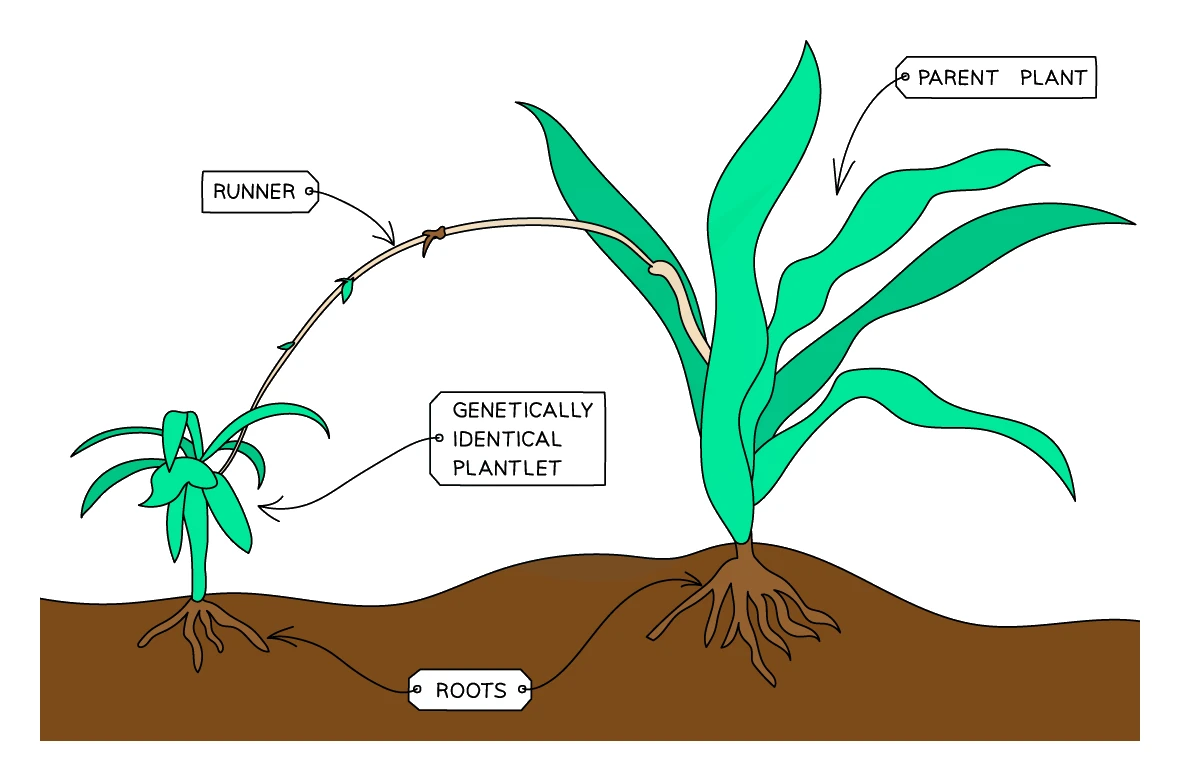
Some plants grow horizontal stems called runners that creep along the soil surface from the parent plant. At the tip of each runner, a small plantlet forms. When the plantlet touches soil, it grows its own roots and eventually breaks free from the parent to become an independent plant.
Strawberry plants are the classic example. A single mother strawberry plant can colonise a wide patch of ground in a few years by running.
Other natural asexual mechanisms in plants include:
- Bulbs (e.g. onions, tulips) split into daughter bulbs
- Tubers (e.g. potatoes) sprout new plants from "eyes"
- Rhizomes (e.g. ginger, irises) are underground horizontal stems that send up new shoots
Artificial asexual reproduction: cuttings
Gardeners take advantage of plants' ability to reproduce asexually by taking cuttings:
- A piece of a healthy parent plant (usually a shoot carrying at least one bud) is snipped off with a sharp blade.
- The cut end is sometimes dipped in rooting powder, which contains the plant hormone auxin to encourage roots to grow.
- The cutting is either placed in water until roots appear or planted directly in moist soil.
- After a few weeks, the cutting has grown its own root system and is an independent plant, genetically identical to the parent.
Cuttings are useful because:
- They are fast and cheap
- The new plant has exactly the same characteristics as the chosen parent (useful for ornamental plants with desirable flowers, or for crop plants with high yields)
- A single parent can produce many cuttings in one season
A drawback is that all the cuttings are clones, so they all have the same vulnerabilities. A disease that affects one will affect all of them.
Common exam question
Asexual reproduction in plants and why growers use it
Question: Give a natural and an artificial method of asexual reproduction in plants, describe how a strawberry plant reproduces asexually, or explain why a grower reproduces plants asexually rather than from seed (1–4 marks).
Set in 5 of the 23 papers. The natural method is runners (bulbs, corms, tubers and rhizomes also accepted), the artificial one cuttings (grafting, layering, tissue culture and micropropagation also count); "cloning" is rejected. A strawberry's runner is a stem that grows along the ground, roots and breaks off as a new plant; "cuttings" is ignored there.
A grower's reasons earn two marks: the new plants are genetically identical to the parent (clones), so a desired flavour, colour or yield is kept; and it is faster, works at any time of year and needs only one plant. One scheme ignores "more plants". A discuss question pairs sexual reproduction (cross-pollinate a different variety for a new flavour) with asexual (runners or cuttings for many identical copies).
3. Sexual reproduction in flowering plants
Flower structure
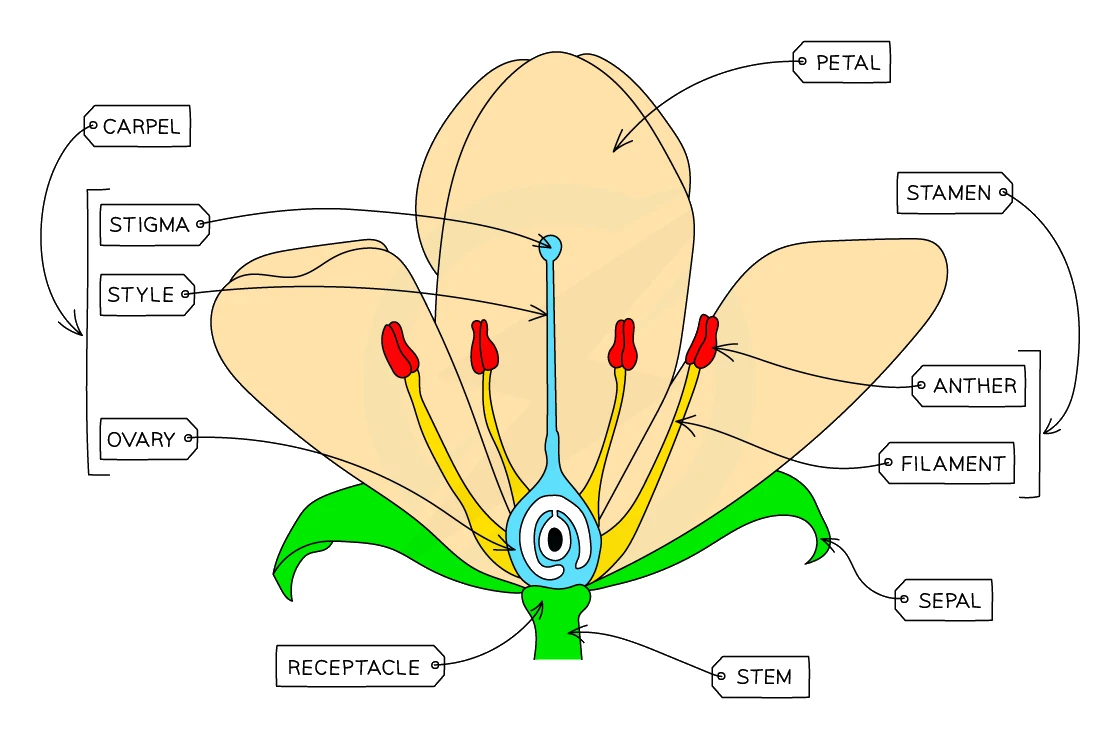
A flower is the reproductive organ of a flowering plant. It contains the male and female parts in one structure.
The main parts of a flower:
| Part | What it does |
|---|---|
| Sepal | A green leaf-like structure that protects the flower bud before it opens |
| Petals | Colourful (in insect-pollinated flowers) or small and dull (in wind-pollinated). Attract insects in the first case |
| Stamen (male part) | Made of an anther at the top, supported by a thin stalk called the filament |
| Anther | Produces and releases pollen grains, which contain the male gametes |
| Filament | The stalk that holds the anther in position |
| Carpel (female part) | Made of the stigma, style and ovary |
| Stigma | The top of the carpel, where pollen lands during pollination. May be sticky or feathery |
| Style | A tube connecting the stigma to the ovary |
| Ovary | Contains the ovules, which hold the female gametes |
| Ovule | The structure containing the female gamete; develops into a seed after fertilisation |
Common exam question
Identifying the parts of a flower on a diagram
Question: On a labelled flower diagram, pick the structure that is the style, releases pollen, is where pollen grains germinate, becomes the seed or the fruit, or is a male part, or name two labelled structures (1 mark each).
Asked in 6 of the 23 papers. Pollen grains germinate on the stigma; the pollen tube grows down the style; the anther produces and releases pollen, and anther plus filament are the male parts; the ovule becomes the seed and the ovary becomes the fruit. Pollination is the transfer of pollen from an anther to a stigma, so on a self-pollinating flower the correct arrow runs anther to stigma. You may also have to name a labelled stigma or anther yourself, so learn the diagram, not just the words.
Pollination
Pollination is the transfer of pollen from the anther of one flower to the stigma of another flower (or the same flower) of the same species
Pollination is not the same as fertilisation. Pollination is just the journey of the pollen grain to the stigma. Fertilisation is what happens later, when the male gamete inside the pollen fuses with the female gamete in the ovule.
There are two main methods of pollination: by insects and by wind. Flowers that use each method look quite different.
Insect-pollinated flowers
Insect-pollinated flowers are designed to attract insects (or birds, or bats) and to make sure pollen sticks to the visitor's body for the journey to the next flower.
Adaptations:
- Large, brightly coloured petals to attract insects from a distance
- Sweet scent and sugary nectar at the base of the flower (in a nectary) to lure insects in close
- Anthers held inside the flower so insects must brush past them to reach the nectar, picking up pollen on their bodies as they go
- Sticky stigmas inside the flower so that pollen on a visiting insect transfers across
- Pollen grains are larger, fewer, and stickier (with rough or spiky surfaces) so they cling to insects easily
Examples: roses, sunflowers, snapdragons, orchids.
Wind-pollinated flowers
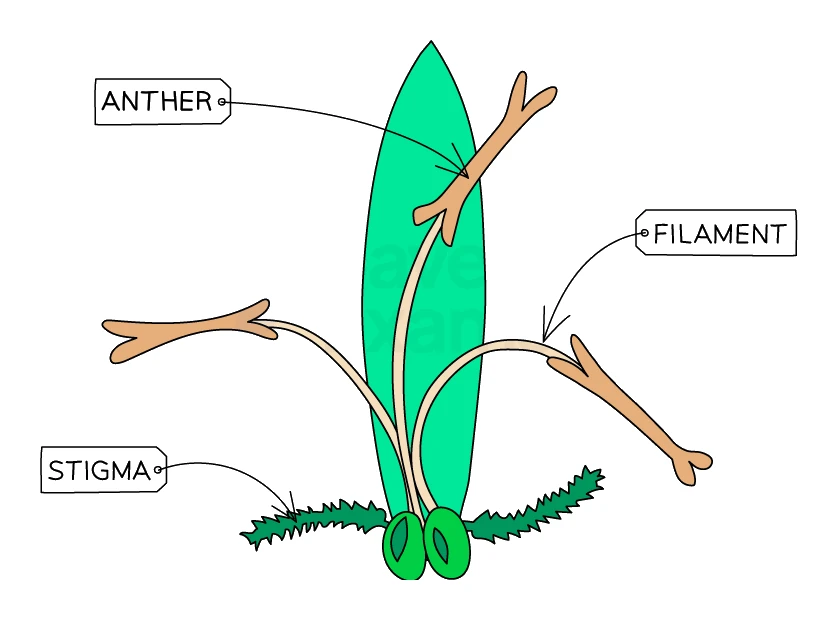
Wind-pollinated flowers are designed to release pollen into the air and catch pollen blowing past, with no help from animals.
Adaptations:
- Small, dull-coloured petals (often green or brown) since there is no need to attract animals
- No nectar and no scent (making them would be wasted energy)
- Anthers hang outside the flower on long filaments so they can sway in the breeze and release pollen into the air
- Long, feathery stigmas hang outside the flower to maximise the chance of catching airborne pollen
- Pollen grains are smaller, much more numerous, and lighter (smooth and dry) so they are easily blown long distances
Examples: grasses, cereals (wheat, rice, maize), most trees (oak, birch, hazel).
Side-by-side comparison
| Feature | Insect-pollinated | Wind-pollinated |
|---|---|---|
| Petals | Large, brightly coloured | Small, dull (often green) |
| Scent and nectar | Strong scent, sweet nectar | None |
| Anthers | Inside the flower, stiff | Hang outside on long filaments |
| Stigmas | Sticky, inside the flower | Feathery, hang outside |
| Pollen grains | Large, few, sticky, often rough or spiky | Small, many, smooth, light |
Common exam question
Wind-pollinated versus insect-pollinated flowers
Question: Describe how labelled structures differ in a wind-pollinated flower, give differences between insect- and wind-pollinated flowers, or explain how a flower is adapted for its pollination (1–4 marks).
Asked in 7 of the 23 papers. One mark per structure: a wind-pollinated stigma is feathery and hangs outside; the anthers hang outside on long, hinged filaments; the petals are small, green or absent, with no scent or nectary; the pollen is small, light, smooth and plentiful. The insect-pollinated converse (large coloured petals, sticky stigma and anthers inside, large sticky or spiky pollen, a nectary) scores the same marks. Say petals, not flowers, and nectary, not "nectar": one scheme ignores both "large flowers" and "nectar".
Explaining two adaptations is marked in pairs, feature plus purpose: anthers outside so the wind carries pollen away, a feathery stigma to catch it, dull petals because no insects need attracting. When only structures in the diagram count, colour, scent and nectar are ignored.
Fertilisation in plants
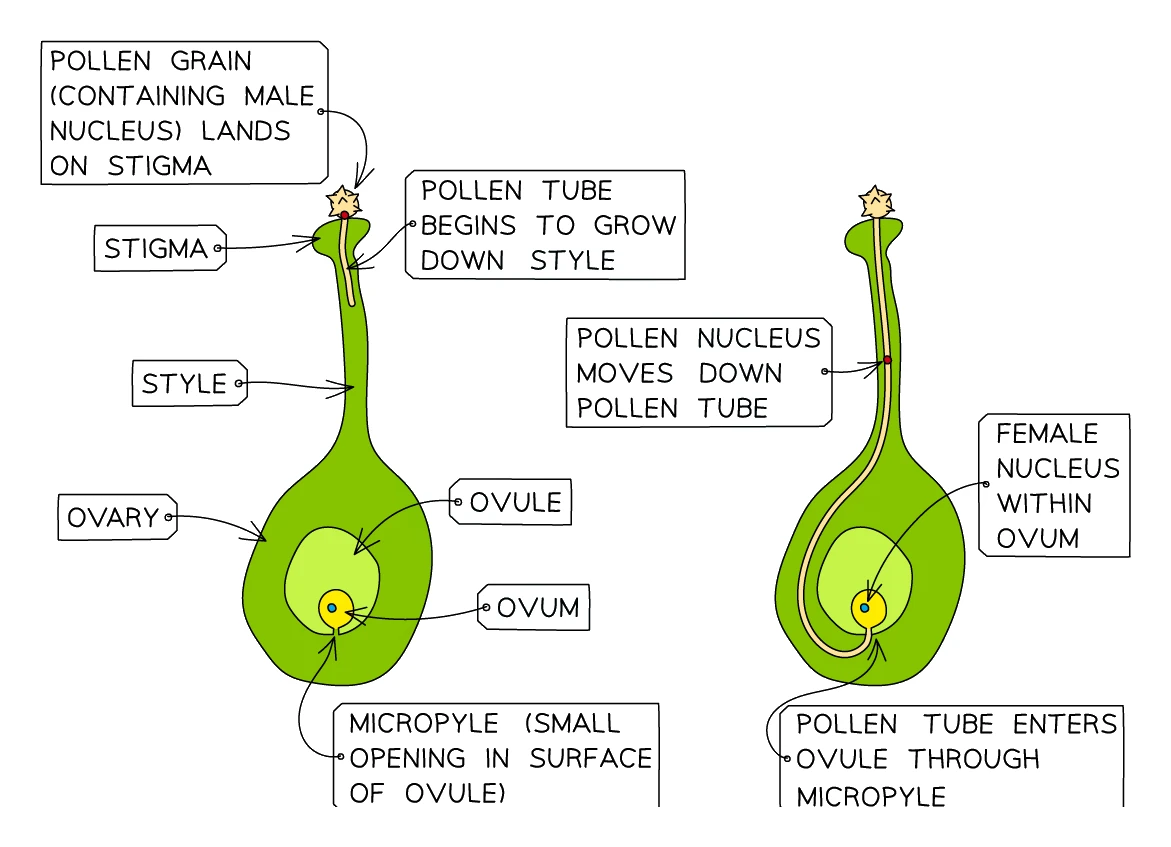
Once a pollen grain lands on a compatible stigma, the male gamete still has to travel down to the ovule. The journey takes a few hours to a few days:
- The pollen grain lands on the stigma (pollination).
- A pollen tube grows out of the pollen grain, down through the style towards the ovary.
- The pollen tube delivers the male nucleus to an ovule inside the ovary.
- The male nucleus fuses with the female nucleus inside the ovule. This is .
- The fertilised ovule develops into a seed.
- The surrounding ovary develops into a fruit that contains the seed (or seeds).
Seed dispersal
A new seedling that grows right next to its parent has to compete with the parent for light, water and nutrients. Plants therefore have many ways of dispersing their seeds so the next generation gets enough resources of its own:
- Wind dispersal: seeds have wings or parachutes that catch the air (e.g. sycamore "helicopters", dandelion "clocks").
- Animal dispersal: fleshy fruits are eaten and the seeds pass through the animal's gut undamaged, being deposited elsewhere in faeces (e.g. blackberries, tomatoes). Other seeds have hooks or burrs that stick to animal fur (e.g. cleavers).
- Self-dispersal (explosive): pods dry out and split suddenly, flinging the seeds out (e.g. pea pods, gorse).
- Water dispersal: lightweight floating seeds (e.g. coconut, water lily) drift on currents to new shores.
Common exam question
Explaining seed dispersal by animals and why it matters
Question: Explain how a sweet fruit helps a plant spread its seeds, or why it is an advantage for seeds to germinate away from the parent plant (2–3 marks).
Set in 2 of the 23 papers. For the fruit, give the chain: it is eaten by an animal, which carries the seeds to a new area, and the seeds pass through undigested and are egested in its faeces. Say egested or deposited, not excreted, which is ignored; bright colour attracts animals and the sugar makes the fruit worth eating. For the advantage, each mark is a named resource there is less competition for: light, water and minerals. "Less competition" with nothing named earns one mark only, and space and carbon dioxide are ignored.
Germination
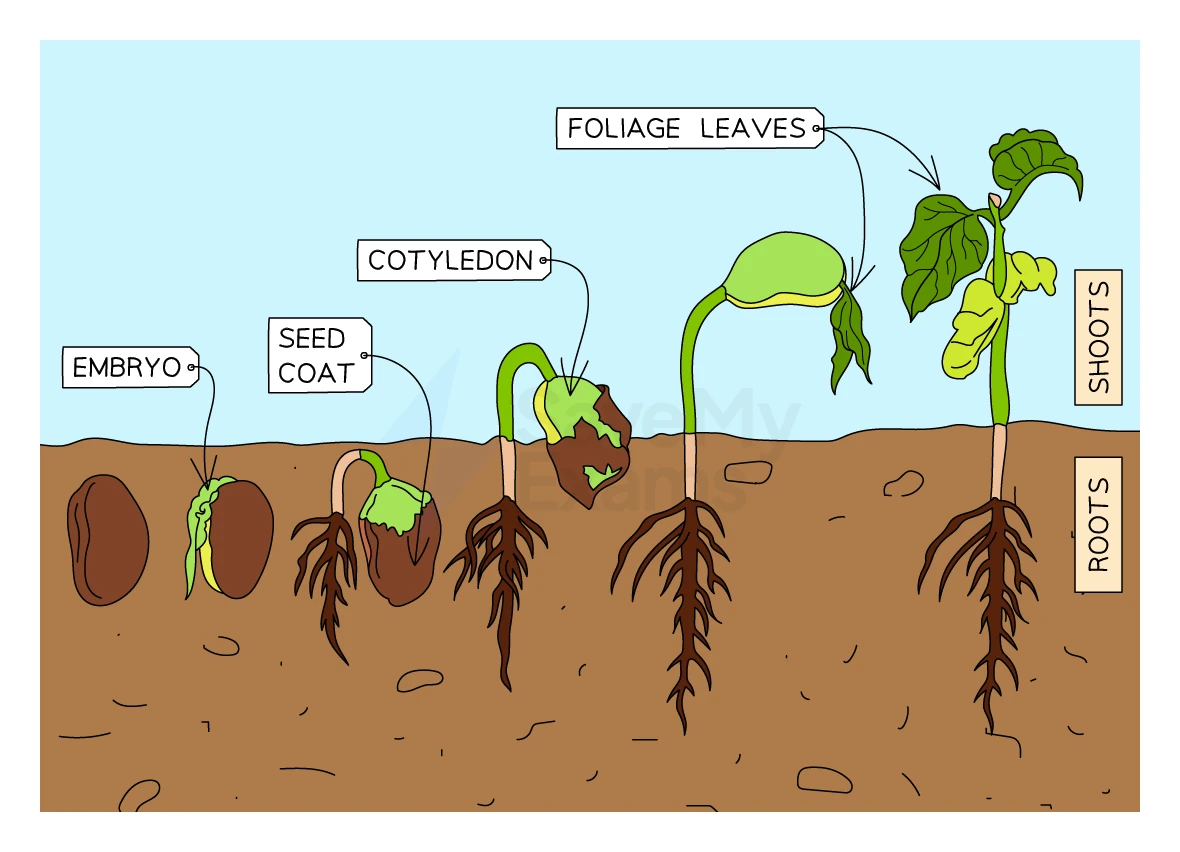
Germination is the process by which a seed begins to grow into a new plant
A seed contains:
- An embryo root (the radicle)
- An embryo shoot (the plumule)
- Seed leaves (cotyledons), which contain a food store of starch and sometimes lipids
- A tough protective seed coat (testa)
Three things are needed for germination:
- Water: swells the seed, softens the seed coat, and activates the enzymes that digest the food store
- Oxygen: needed for aerobic respiration, which releases the energy the embryo needs to grow
- Warmth: enzymes work faster at higher temperatures (up to their optimum)
A seed without any of these three things stays dormant and does not germinate. Light is not needed at the early stages, because the seedling uses its starch food store, not photosynthesis, until its first true leaves emerge.
Common exam question
Explaining the conditions needed for germination
Question: Explain the conditions a seed needs in order to germinate, or explain why germinating seeds need water and oxygen (2–3 marks).
Asked in 2 of the 23 papers. Each mark needs the factor and its reason: water to activate the enzymes (amylase digests the stored starch to glucose), oxygen for respiration (releasing the energy for growth) and warmth for enzyme action. A factor named without its reason earns nothing. Light is the trap: a seed does not photosynthesise, so "light for photosynthesis" is not credited and references to photosynthesis are ignored; one scheme allows light only for breaking dormancy or stimulating growth.
Core practical: investigating the conditions needed for germination
Aim: to investigate which conditions (water, oxygen, warmth) are needed for seeds to germinate.
Method:
- Set up four test tubes labelled A to D, each containing cotton wool and 10 cress seeds.
- Tube A: dry cotton wool, kept at room temperature. (Tests whether water is needed.)
- Tube B: moist cotton wool, kept at room temperature. (This is the control with all three conditions.)
- Tube C: cotton wool moistened with boiled water (which has had the dissolved oxygen driven out) and covered with a layer of oil that blocks any new oxygen from entering. Room temperature. (Tests whether oxygen is needed.)
- Tube D: moist cotton wool, kept in a fridge at about 4 °C. (Tests whether warmth is needed.)
- After 3 to 5 days, count how many seeds have germinated in each tube.
Expected results:
| Tube | Conditions removed | Outcome |
|---|---|---|
| A | Water absent | No germination |
| B | (control: all present) | Most seeds germinate |
| C | Oxygen absent | No germination |
| D | Warmth absent | No germination |
Conclusion: all three of water, oxygen and warmth are needed for germination. Removing any one of them stops the process.
4. The human reproductive systems
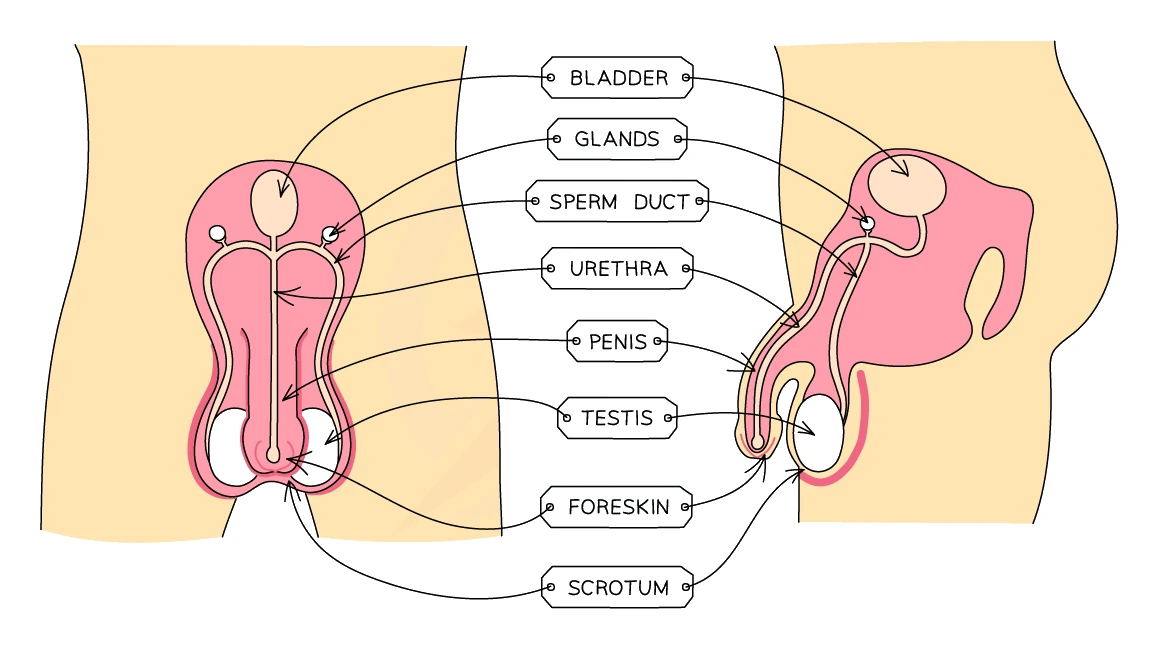
Male reproductive system
| Structure | Function |
|---|---|
| Testes (singular: testis) | Produce sperm (the male gametes) and testosterone (the male hormone). Kept outside the body in the scrotum because sperm need a temperature slightly below body temperature to develop properly |
| Scrotum | A pouch of skin holding the testes outside the body |
| Sperm duct | The tube that carries sperm from the testis to the urethra; sperm are mixed here with fluids from glands to make semen |
| Prostate gland and other glands | Add fluids that nourish the sperm and help them move |
| Urethra | The single tube running along the inside of the penis; carries either urine (from the bladder) or semen (during ejaculation), but never both at once. A small ring of muscle stops the two mixing |
| Penis | Delivers semen into the female reproductive system during sexual intercourse |
Female reproductive system
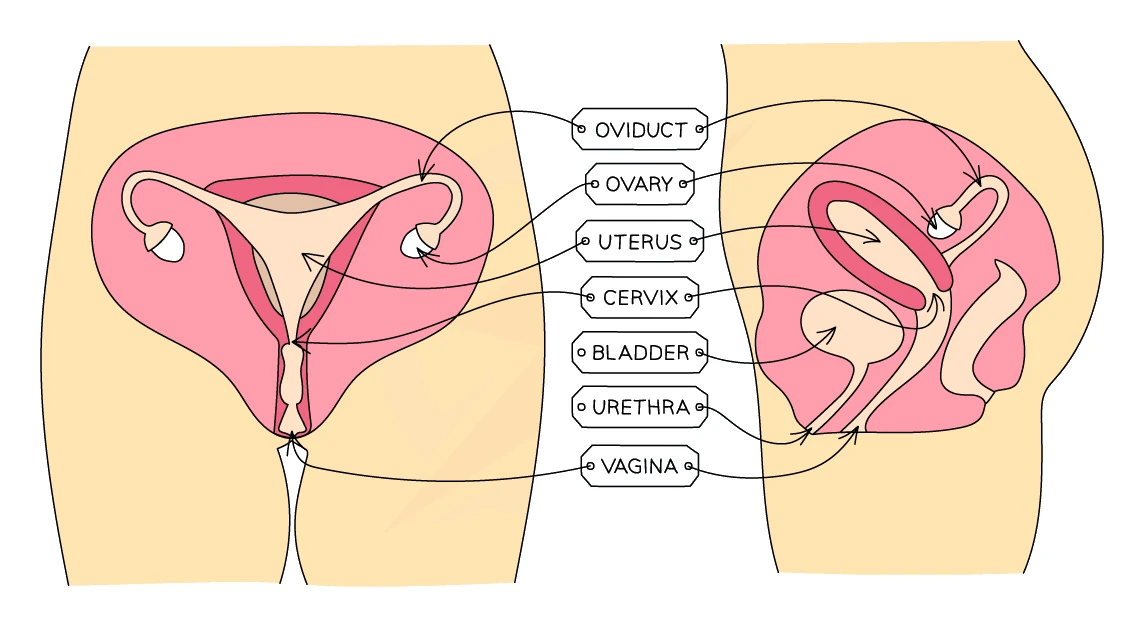
| Structure | Function |
|---|---|
| Ovaries | Contain eggs (ova) from birth. From puberty onwards, one ovary releases a mature egg roughly every 28 days. Also produce the female hormones oestrogen and progesterone |
| Oviduct (also called the fallopian tube) | A muscular tube that carries the released egg from the ovary towards the uterus. Fertilisation usually happens here. The inner surface is lined with cilia that gently waft the egg along |
| Uterus (womb) | A muscular sac with a thick blood-rich lining (the endometrium) in which an embryo can implant and develop into a fetus |
| Cervix | A ring of muscle at the lower end of the uterus. Holds the developing fetus in place during pregnancy and opens during birth |
| Vagina | A muscular tube from the cervix to the outside of the body. Receives the penis during sexual intercourse; also the birth canal |
Common exam question
Identifying structures of the reproductive systems
Question: On a diagram of the female (or male) reproductive system, name labelled structures, pick where fertilisation occurs, which structure makes gametes or where the placenta develops, and describe the role of the uterus (1–3 marks).
Asked in 3 of the 23 papers. Fertilisation happens in the oviduct (fallopian tube), not in the ovary, uterus or vagina; gametes are made in the ovary and the testis; the placenta develops in the uterus. The uterus earns its marks as the site of implantation of the embryo, the place where the placenta grows, and the organ that provides the embryo with nutrition and removes its waste. Be able to name the oviduct, ovary, uterus and cervix on a front view.
The gametes: sperm and egg
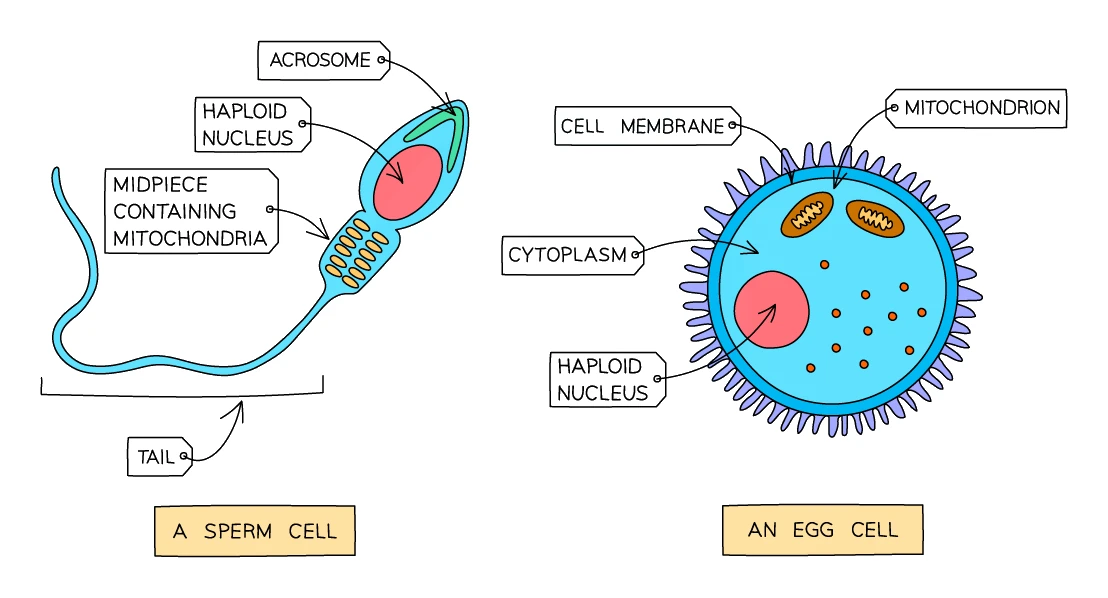
| Feature | Sperm (spermatozoon) | Egg (ovum) |
|---|---|---|
| Size | Tiny, around 0.05 mm long | Large, around 0.1 mm across (one of the largest cells in the body) |
| Made in | Testes | Ovaries |
| Number produced | Millions per day | Around one per month from puberty to menopause |
| Shape | Streamlined head, middle section, long tail (flagellum) | Roughly spherical |
| Special features | Tail for swimming; many mitochondria in the middle for energy; acrosome at the tip with enzymes to break through the egg's outer layer | Cytoplasm packed with nutrients to feed the early embryo; outer jelly-like coat that hardens after one sperm enters |
| Genetic content | Haploid (23 chromosomes); 50:50 mix of X-carrying and Y-carrying sperm | Haploid (23 chromosomes); always carries an X chromosome |
The male gamete is small, mobile and produced in vast numbers. The female gamete is large, immobile and produced one at a time. Both contain 23 chromosomes, half the normal number; when they fuse at fertilisation, the resulting zygote has the full 46.
Fertilisation in humans
During sexual intercourse, semen (containing roughly 200–500 million sperm) is deposited near the cervix. From there:
- Sperm swim up through the cervix into the uterus and then into the oviducts.
- If an egg is present in one oviduct (usually for about a day after ovulation), sperm cluster around it.
- One sperm uses the enzymes in its acrosome to break through the egg's outer jelly coat.
- The nuclei of the sperm and egg fuse together, forming a with 46 chromosomes (23 from each parent).
- Within seconds, the egg's outer membrane hardens, preventing any other sperm from entering.
- The zygote begins dividing by mitosis as it travels down the oviduct.
- By the time it reaches the uterus, it is a tiny ball of cells called a blastocyst, which implants into the soft endometrium and begins to develop into an embryo.
Only one sperm successfully fertilises the egg; the rest are prevented from entering once the egg's membrane hardens.
Common exam question
Why a cut or blocked tube prevents pregnancy
Question: Explain why a vasectomy is a permanent way of preventing pregnancy, or what effect thick mucus in the cervix has on reproduction (2 marks).
Set in 2 of the 23 papers. Each scheme credits any two of three points, and the safe pair is the sperm not reaching the egg and fertilisation not happening. After a vasectomy there are no sperm in the semen that is ejaculated, so the egg is not fertilised; with a blocked cervix, sperm cannot reach the oviduct, so fertilisation and pregnancy are less likely. "Sperm are not produced" is ignored (the testes still make them), as are "no semen is released" and "less reproduction".
5. The menstrual cycle
From puberty (around age 11–14) until menopause (around age 50), the female body runs a roughly 28-day cycle that prepares for possible pregnancy each month. If pregnancy does not happen, the body sheds the prepared lining and starts again.
What happens during the cycle
The cycle is usually counted from day 1, which is the first day of menstruation (the period).
- Days 1–5: Menstruation. The thick uterine lining that was prepared during the previous cycle breaks down and is shed through the vagina. About 30–80 ml of blood and tissue are lost.
- Days 5–14: Lining rebuilds, egg matures. The uterus rebuilds a thick blood-rich lining ready for a possible fertilised egg. Meanwhile, one egg matures in one ovary.
- Day 14: Ovulation. The mature egg is released from the ovary into the oviduct. This is the only fertile day in the cycle.
- Days 14–28: Lining maintained, waiting. The lining stays thick, waiting for a fertilised egg to implant.
- Day 28: If no has happened, the lining breaks down and the next cycle begins. If fertilisation has happened, the lining stays intact and pregnancy continues.
The four hormones that run the cycle
Four hormones coordinate the menstrual cycle, working in a carefully timed sequence. Two come from the pituitary gland in the brain, and two come from the ovaries.
| Hormone | Made in | Main role |
|---|---|---|
| FSH (follicle-stimulating hormone) | Pituitary gland | Causes an egg to mature inside a follicle in the ovary; stimulates the ovary to release oestrogen |
| Oestrogen | Ovaries | Rebuilds the uterine lining after menstruation; inhibits further FSH release; triggers the LH surge that causes ovulation |
| LH (luteinising hormone) | Pituitary gland | Triggers ovulation (the release of the mature egg); causes the empty follicle to become the corpus luteum and start making progesterone |
| Progesterone | Ovaries (corpus luteum) | Maintains the thick uterine lining for the second half of the cycle. If pregnancy does not occur, progesterone drops, triggering menstruation |
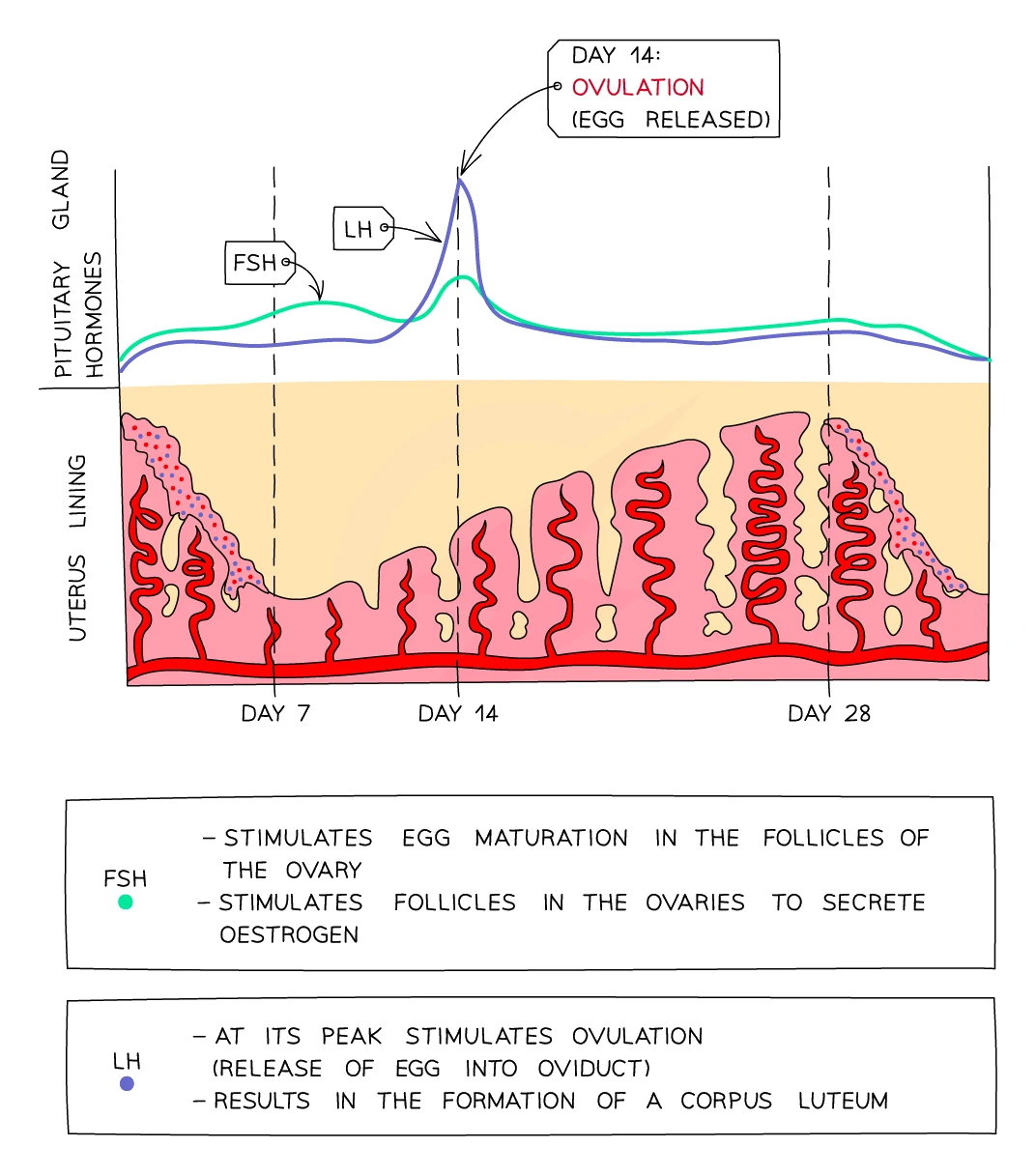
The interaction between the four hormones
- At the start of the cycle, the pituitary releases .
- FSH causes a follicle in the ovary to develop, and the follicle starts releasing .
- Rising oestrogen levels:
- Rebuild the uterine lining
- Inhibit FSH (so no further follicles develop)
- Stimulate release as oestrogen peaks
- The LH surge around day 13–14 triggers ovulation.
- The empty follicle becomes the corpus luteum, which secretes .
- Progesterone maintains the thick uterine lining and inhibits both FSH and LH.
- If the egg is not fertilised, the corpus luteum breaks down, progesterone levels fall, and the uterine lining breaks down → menstruation begins → the cycle starts again.
- If the egg is fertilised, the corpus luteum is kept active by hormones from the developing embryo, progesterone stays high, the lining is maintained, and pregnancy continues.
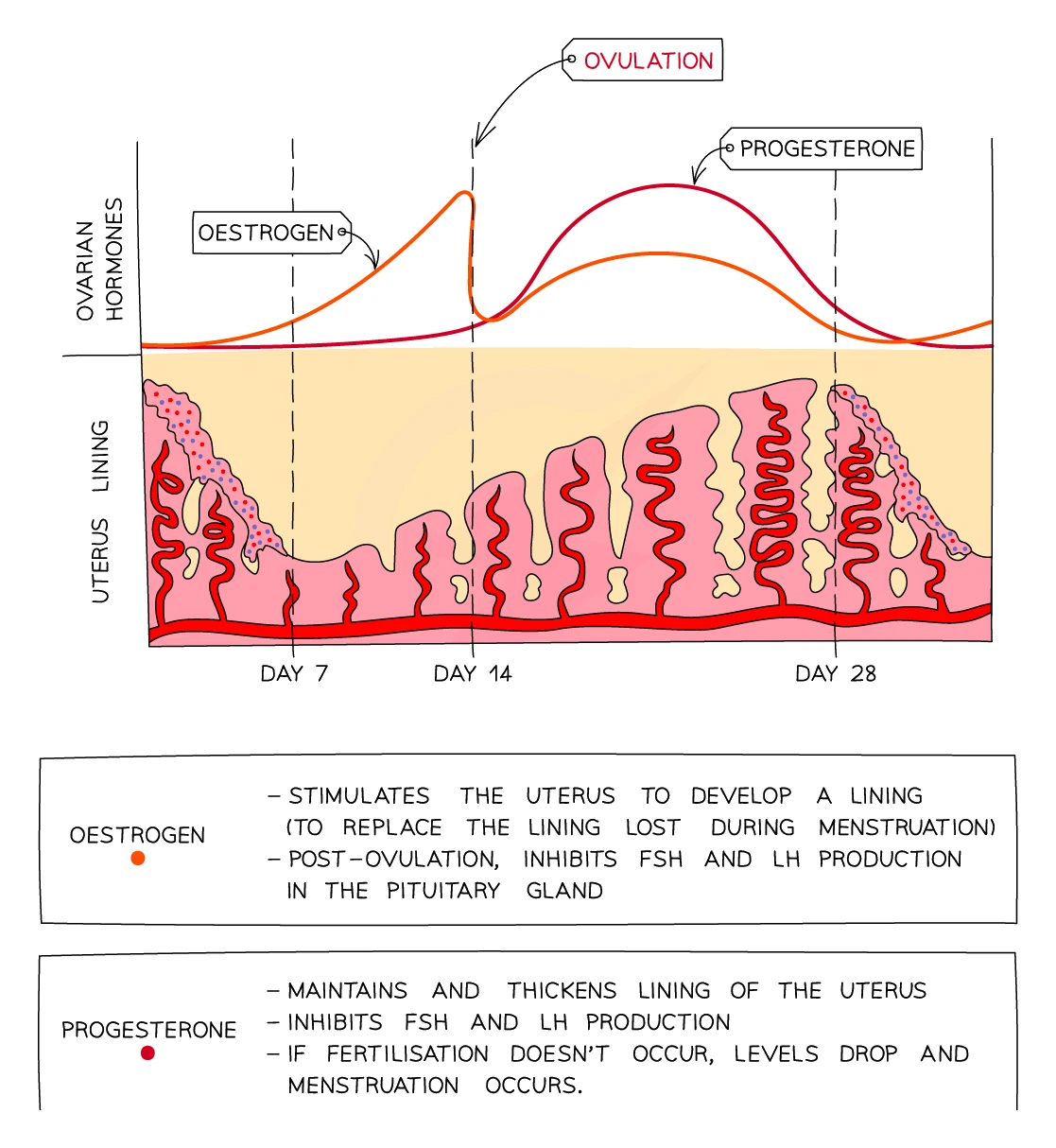
Common exam question
Roles of FSH, LH, oestrogen and progesterone
Question: Describe the roles of FSH, LH, oestrogen and progesterone in the menstrual cycle, pick which graph line is which hormone, or explain the changes the graph shows (1–4 marks).
Asked in 5 of the 23 papers. FSH matures an egg in its follicle and stimulates oestrogen release; LH causes ovulation and makes the corpus luteum release progesterone. Oestrogen repairs and thickens the uterus lining after menstruation, inhibits FSH and stimulates LH, peaking just before ovulation; progesterone maintains the lining, prevents menstruation, inhibits FSH and LH, and its fall makes the lining break down. On a graph, oestrogen peaks before day 14 and progesterone rises after it. Each role is one mark: the 4-mark FSH and LH question wants two for each.
6. Pregnancy and birth
After fertilisation: implantation
About a week after fertilisation, the zygote (now a ball of cells called a blastocyst) implants into the soft endometrium of the uterus. The blastocyst is now called an embryo, and the embryo begins to grow.
The placenta
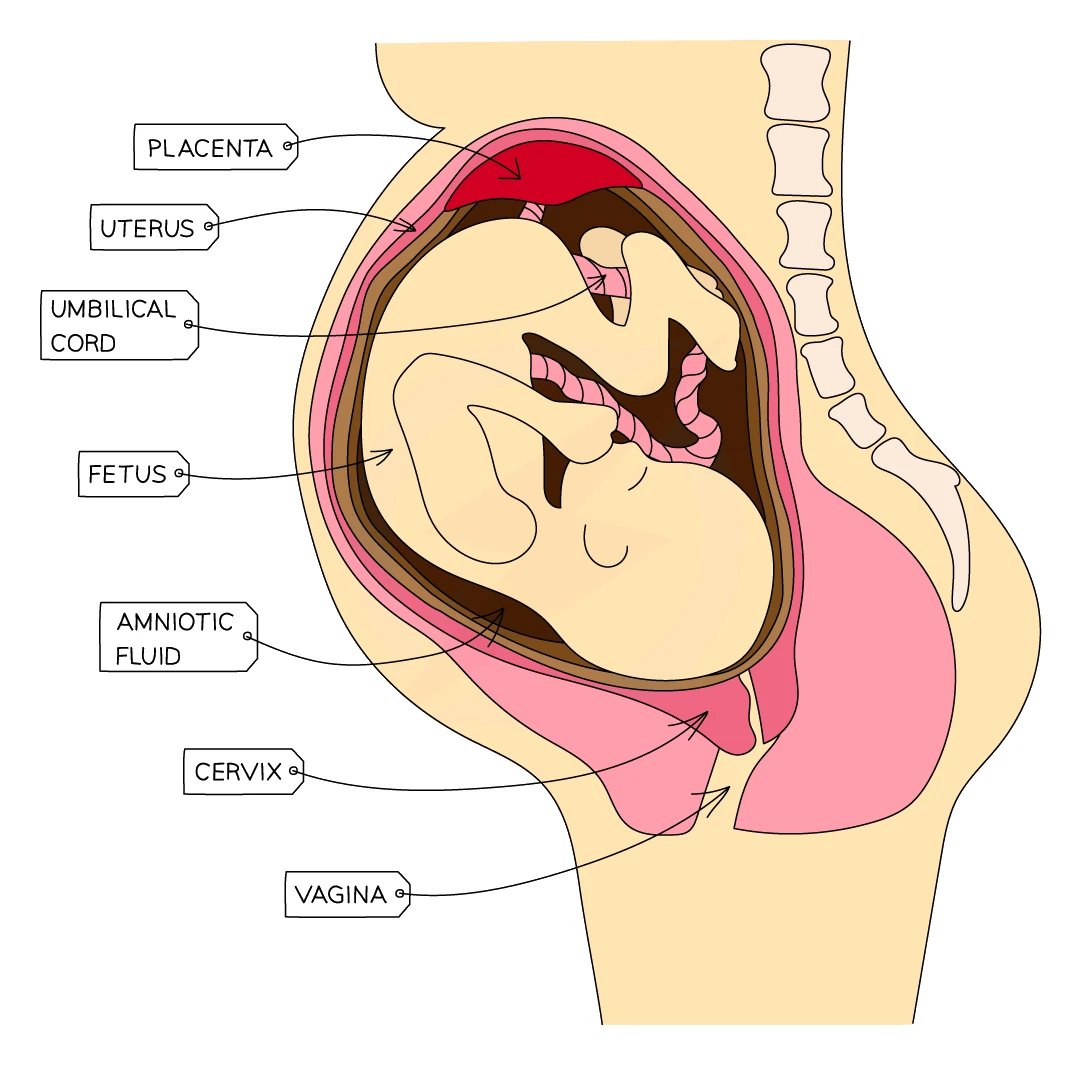
By around eight weeks of pregnancy, a special organ called the has formed at the site where the embryo implanted. The placenta is the interface between the mother and the developing fetus. It is built from the tissue of the embryo and the wall of the uterus.
The placenta connects to the developing fetus by the umbilical cord, which contains:
- Two umbilical arteries carrying deoxygenated blood from the fetus to the placenta
- One umbilical vein carrying oxygenated blood from the placenta to the fetus
Important: the mother's blood and the fetus's blood never mix directly. They are separated by a very thin barrier in the placenta. Substances cross this barrier by diffusion.
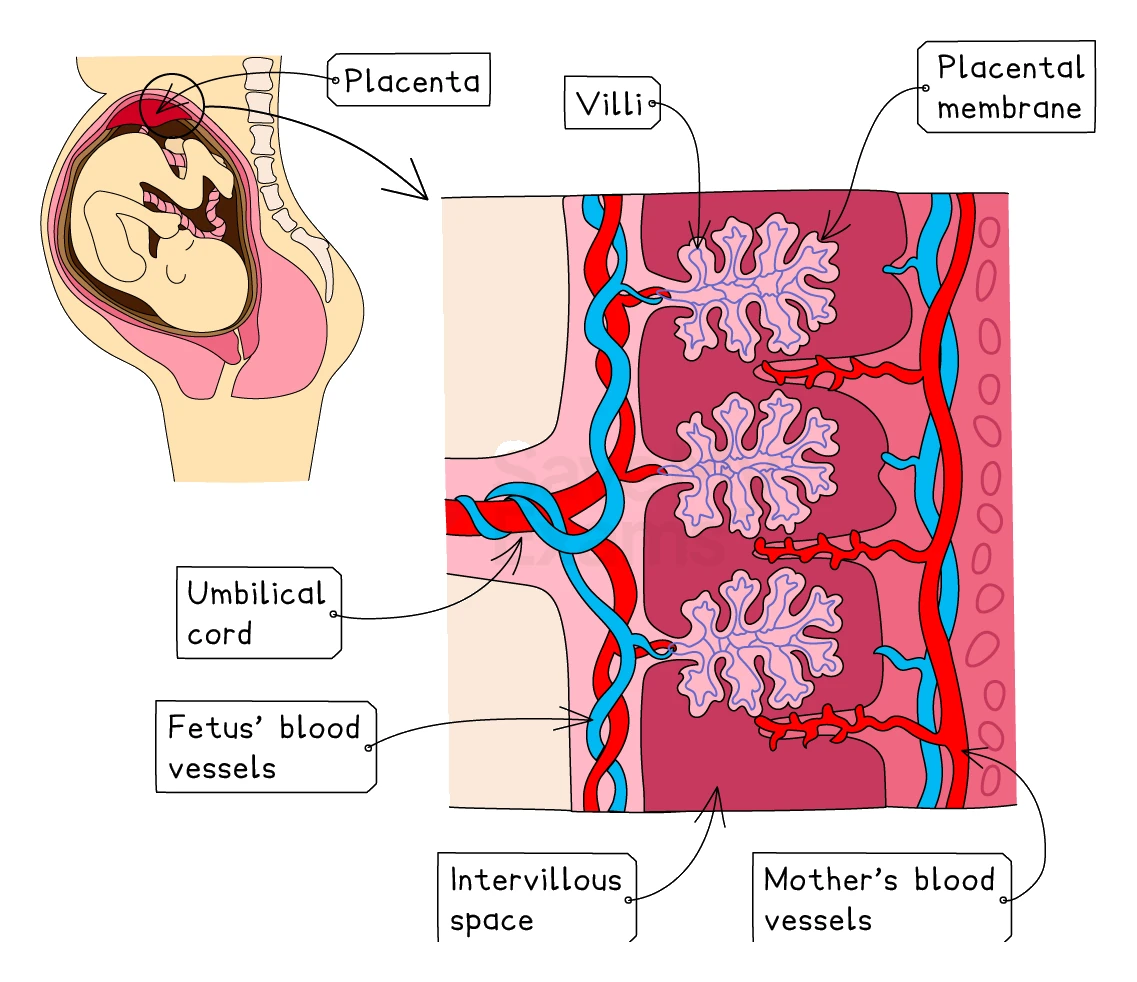
What crosses the placenta
The placenta is highly adapted as an exchange surface, with a large surface area and a very thin wall between the two blood supplies.
From mother to fetus (down concentration gradients):
- Oxygen (the fetus needs it for respiration)
- Glucose and other dissolved food molecules
- Amino acids for protein synthesis
- Vitamins and mineral ions
- Antibodies (giving the newborn passive immunity to common pathogens for the first few months)
From fetus to mother (down concentration gradients):
- Carbon dioxide from fetal respiration
- Urea from fetal protein breakdown
Common exam question
Describing the role of the placenta
Question: Describe the role of the placenta in reproduction, or explain how the placenta and amniotic fluid allow the fetus to grow safely (3 marks).
Asked in 3 of the 23 papers, one mark per point: the placenta allows diffusion (and active transport) between the two blood supplies; it supplies the fetus with oxygen, glucose, amino acids, vitamins and minerals; it passes on antibodies; it removes carbon dioxide and urea from the fetus; it secretes progesterone; and it keeps the mother's and fetus's blood from mixing. Give the direction every time (to the fetus, from the fetus) and name the substances: one scheme ignores "food" alone and "waste" alone, and another penalises saying blood passes from mother to fetus. Amniotic fluid earns its mark for cushioning the fetus against physical damage.
What can also cross, including harmful substances
The placenta is not a perfect barrier. Some harmful substances can cross from mother to fetus, with serious consequences:
- Nicotine and other chemicals from smoking restrict the fetus's blood supply, leading to low birth weight
- Alcohol can damage fetal brain development, causing fetal alcohol syndrome
- Some drugs and medicines can cause birth defects (the most famous example is the drug thalidomide in the 1950s and 60s)
- Viruses such as rubella, HIV, and Zika can cross and infect the fetus
This is why pregnant women are advised to avoid smoking, alcohol, certain medicines, and certain infections during pregnancy.
The amniotic fluid
The developing fetus is surrounded by amniotic fluid, a clear liquid contained in the amniotic sac (also called the amniotic membrane). The amniotic fluid:
- Cushions the fetus against mechanical bumps and pressure when the mother moves
- Keeps the temperature stable around the fetus
- Allows the fetus to move freely as it grows, which is important for muscle and skeletal development
- Breaks at the start of labour (the "waters breaking"), helping to lubricate the birth canal
7. Secondary sexual characteristics and puberty
Puberty is the period during adolescence when the body changes from a child into an adult capable of reproducing. The changes are triggered by sex hormones released by the reproductive organs:
- Testosterone from the testes in males
- (and progesterone) from the ovaries in females
The changes are called secondary sexual characteristics to distinguish them from the primary sexual characteristics (the reproductive organs themselves, which were present from birth).
Male secondary sexual characteristics
Triggered by rising testosterone:
- Growth of the penis and testes to adult size
- Sperm production begins
- Growth of pubic, underarm and facial hair
- The voice deepens as the larynx (voice box) enlarges
- Increased muscle mass and broader shoulders
- A growth spurt that adds height
- Skin becomes oilier (often causing acne)
Female secondary sexual characteristics
Triggered by rising oestrogen:
- Breast development
- Hips widen to make room for childbirth
- Growth of pubic and underarm hair
- The menstrual cycle begins (the first period is called menarche)
- A growth spurt that adds height
- Body shape becomes more curved as fat is laid down on the hips, thighs and breasts
- Skin becomes oilier (often causing acne)
Common to both sexes
Some changes happen in everyone during puberty:
- Body hair grows
- Sweat glands become more active (with body odour)
- Mood swings and emotional changes due to changing hormone levels
- Growing interest in sex and relationships