1. What evolution is
Evolution is the gradual change in the inherited characteristics of a population of organisms over many generations
Notice three things about that definition:
- It happens to populations, not to individual organisms. A single rabbit cannot evolve during its lifetime. The population it belongs to evolves over generations.
- It is gradual and takes many generations. For most species evolution is slow, taking hundreds or thousands of years to produce visible changes. For organisms with very short generation times (bacteria, viruses, insects) it can happen in months or years.
- The changes are inherited. Differences caused by environment (a sunburned skin, a leg muscle built up at the gym) do not pass to offspring and are not evolution. Only changes coded in the DNA can be inherited and accumulate over generations.
The mechanism by which evolution happens was worked out by Charles Darwin and Alfred Russel Wallace in the 1850s. They called it .
2. Natural selection: the four-step argument
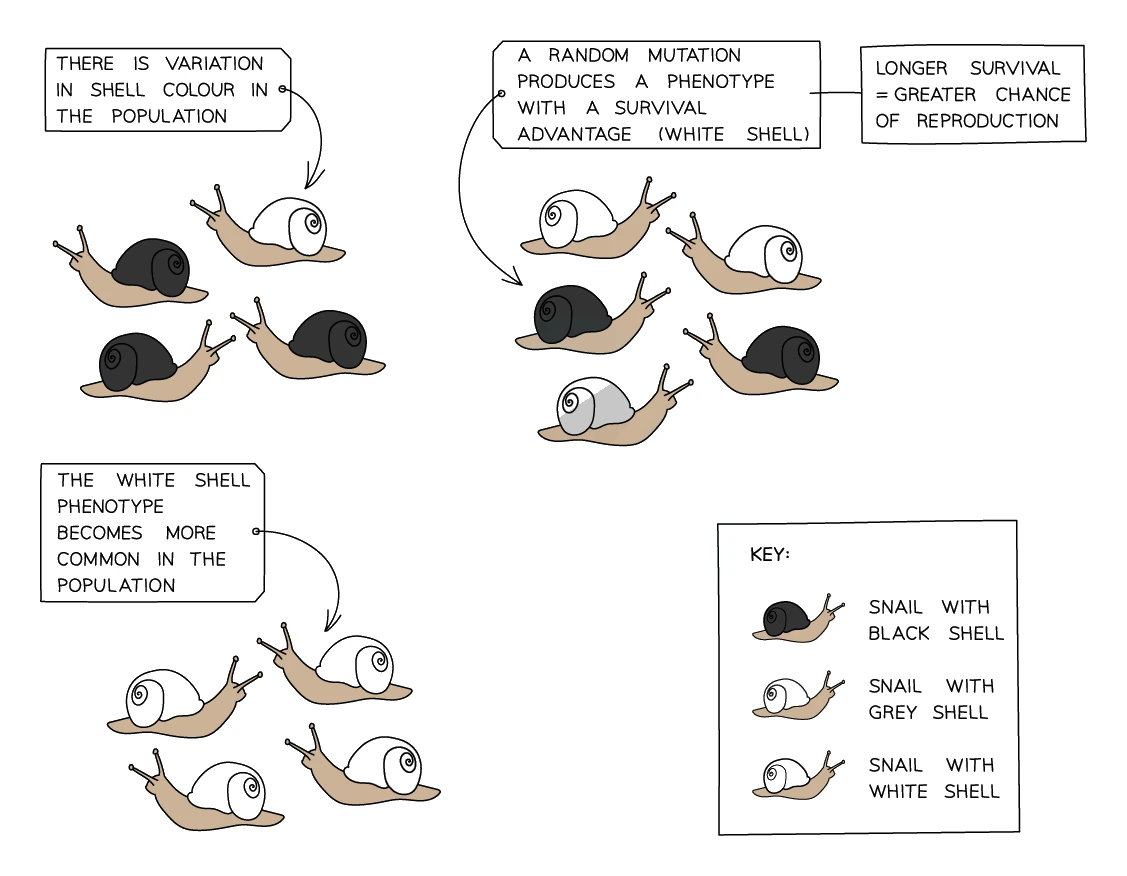
Darwin's theory of evolution by natural selection follows a clear logical sequence. There are four key steps, and exam questions on this topic almost always ask you to list them in order.
Step 1: Variation
Every population contains variation: differences between individuals. Some of this variation is genetic, caused by different alleles of the same genes. New genetic variation arises through:
- in DNA (random changes)
- Meiosis, which shuffles existing alleles into new combinations in gametes
- Random fertilisation, where any sperm can fuse with any egg
This means no two individuals in a population are genetically identical (except identical twins or clones).
Step 2: Differential survival
Members of a population have to compete for limited resources: food, water, space, mates. Not every individual survives long enough to reproduce. Some individuals happen to have genetic variations that give them an advantage in their environment:
- A rabbit with thicker fur survives a harsh winter
- A bacterium with a slightly different cell wall is harder for the immune system to attack
- A moth with darker wings is better camouflaged on a sooty tree
- A plant with deeper roots survives drought
Individuals with these advantageous alleles are more likely to survive to reproductive age than those without them. This is sometimes called "survival of the fittest", though "fittest" here means best suited to the environment, not strongest or fastest.
Step 3: Differential reproduction
Survivors are more likely to reproduce and pass on their genes. Each surviving individual passes on all of its alleles to its offspring, including the advantageous ones that helped it survive.
Individuals that did not survive long enough to reproduce never pass on their alleles, no matter how good their genes might have been at other things. Evolution is shaped by which individuals leave offspring, not by which live the longest.
Step 4: Change in allele frequency
Over many generations, the advantageous alleles become more common in the population. Less helpful alleles become rarer because the individuals carrying them leave fewer offspring.
After enough generations, the average characteristics of the population have shifted: the population has evolved.
Common exam question
Explaining how a population evolved by natural selection
Question: Explain how a population (bacteria, weeds, llamas, guinea pigs, milk drinkers) evolved a useful characteristic, or describe how a behaviour evolved by natural selection (4 marks).
Asked in 7 of the 23 papers, always for four marks from five (once six) points. A mutation produced the new allele; that gave variation; individuals with the advantage were more likely to survive (not eaten, competed better; one scheme accepts naming the selection pressure); they reproduced; and they passed the allele on to their offspring, so it became more common. Four schemes give the last two marks for the sentence "they passed the allele on to their offspring", so write it in full.
Allele or gene is the safe word there: "passed on the characteristic" or "the behaviour" earns nothing, and "passed on the mutation" was refused by one scheme but accepted by two later ones. The converse for survival (the others were eaten or died) is accepted in most schemes.
3. Sources of genetic variation
For natural selection to act, there has to be to act on. Without genetic differences between individuals, every member of a population would respond identically to every change in the environment, and the population could not evolve.
There are three main sources of genetic variation:
Mutation
A mutation is a random change in the DNA sequence (covered in detail in topic 13). Mutations are the ultimate source of all new alleles. Every new variant that has ever existed in any organism started as a mutation.
Mutations:
- Happen continuously in every cell
- Are random: they do not happen because they are useful
- Are mostly neutral (no effect on the phenotype) or harmful
- Are rarely beneficial, but even rare beneficial mutations can spread through a population by natural selection over many generations
Meiosis: independent assortment and crossing over
When gametes are made by meiosis, the existing alleles in the parent get shuffled into new combinations:
- Independent assortment: which chromosome of each pair ends up in which gamete is random, so each gamete carries a unique mix of the parent's chromosomes.
- Crossing over: matching chromosomes can swap sections of DNA before they separate, creating new allele combinations on the same chromosome.
The result is that a single person can produce a near-infinite number of genetically different sperm or eggs. Meiosis does not create new alleles, but it reshuffles existing alleles in new ways.
Random fertilisation
Any one of millions of sperm can fertilise an egg. The combination of parents' alleles in each new offspring is therefore largely random. This adds another layer of shuffling on top of the variation produced by meiosis.
Why this matters for evolution
Mutation is the only source of genuinely new alleles. Meiosis and random fertilisation reshuffle existing alleles. Both kinds of variation are needed:
- New alleles (from mutation) provide the raw material for evolution.
- Shuffling of existing alleles (from meiosis + random fertilisation) lets populations adapt quickly to changing conditions without needing to wait for new mutations.
4. Case study: peppered moths
The peppered moth (Biston betularia) is a textbook example of natural selection caught in the act. The species naturally comes in two colour forms:
- A pale, speckled form (the original form)
- A dark (melanic) form (rare, caused by a mutation)
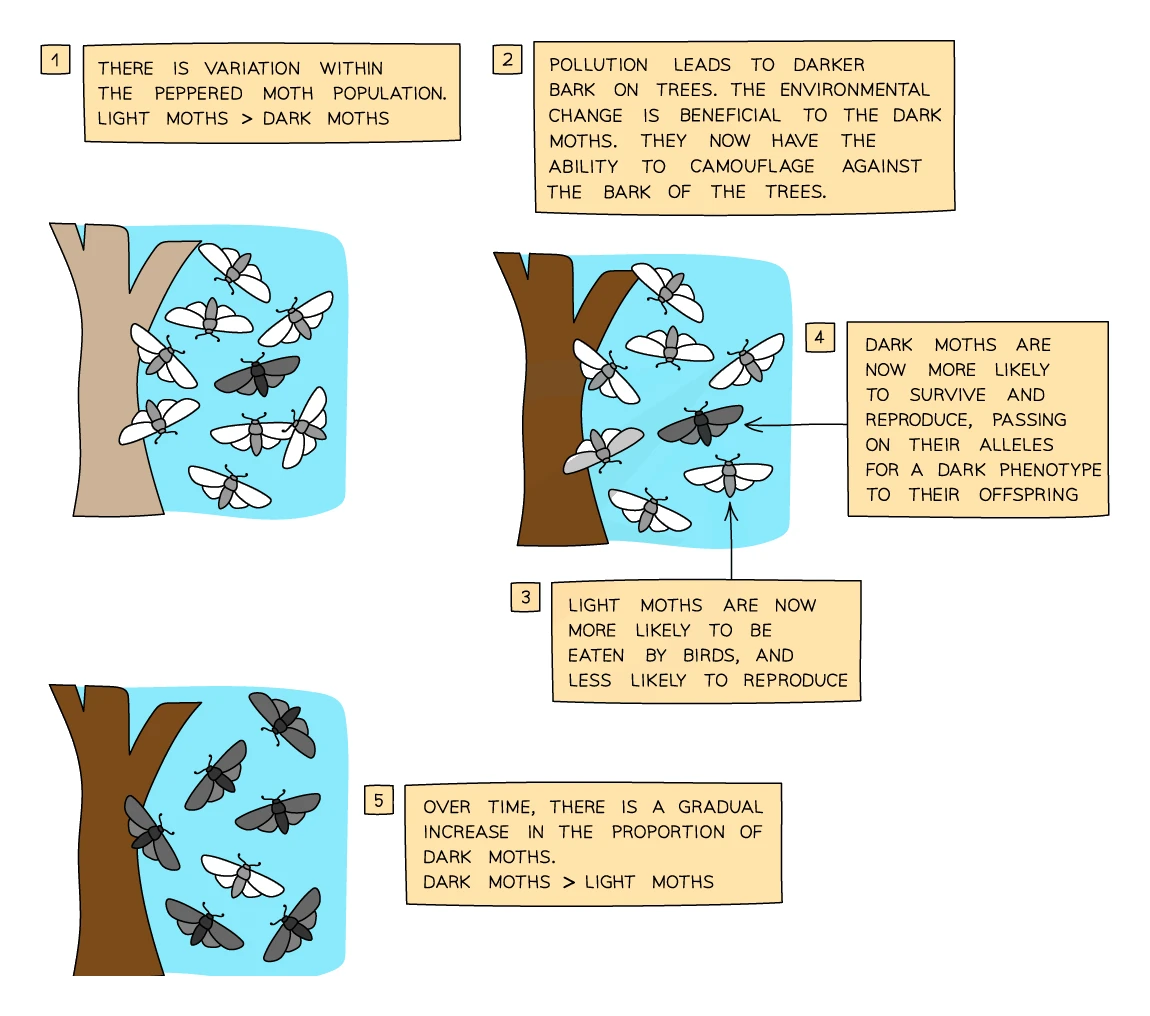
In the 19th century, before the Industrial Revolution, the trees these moths rested on were covered in pale lichens. The pale moths were well camouflaged; the rare dark moths stood out and were quickly eaten by birds. The pale allele was much more common in the population.
The Industrial Revolution covered tree trunks in soot from coal burning. Now the trees were dark and the lichens died:
- Pale moths became visible to predators and were eaten.
- Dark moths were now camouflaged and survived better.
Within a few decades, the dark form had become the more common one in industrial areas. The population had evolved by natural selection, with no new alleles needed; just a shift in the relative frequency of two existing alleles.
After the Clean Air Act in the 1950s, soot deposits fell and lichens returned. Pale moths regained their advantage and the dark form has been declining again. The peppered moth example shows natural selection working in both directions as the environment changes.
Exam tip
Commenting on peppered moth data
One paper printed yearly counts of light and dark moths trapped in a city as coal burning was being banned and asked for a comment on the changes: five marks from ten points, half data and half biology. Data: each form's trend, the fall in the total catch, and which form was commoner at the start and at the end. Biology: disease, predation or food shortage causing that fall, less coal burned so less pollution, dark moths no longer camouflaged on clean bark and so seen and eaten by birds, and the better-adapted pale moths passing their alleles on.
5. Antibiotic resistance
is one of the most important real-world examples of natural selection, and arguably the most serious medical problem facing modern healthcare.
What antibiotics are
Antibiotics are drugs that kill bacteria (or stop them growing). They work by targeting features of bacterial cells that human cells do not have:
- The cell wall (penicillin and related drugs prevent bacteria building their wall properly)
- The bacterial ribosome (different from the human ribosome; some antibiotics target it specifically)
- Enzymes only bacteria have
Antibiotics have saved millions of lives since the discovery of penicillin in 1928. Before antibiotics, even a minor infection could be fatal.
How resistance develops
In any population of bacteria, there is genetic from random mutations. Occasionally a mutation produces a protein that makes the bacterium resistant to a particular antibiotic (for example, by changing the shape of the antibiotic's target so the antibiotic can no longer bind).
When the bacterial population is exposed to that antibiotic:
- Variation: a few bacteria in the population have the resistance allele from random mutation.
- Differential survival: bacteria without the resistance allele are killed. Bacteria with the resistance allele survive.
- Differential reproduction: the surviving bacteria multiply rapidly (a single bacterium can become millions in a day), all carrying the resistance allele.
- Allele frequency change: within just a few days, almost the whole population has resistance to the antibiotic. The antibiotic no longer works.
Because bacteria reproduce so quickly, this whole process can happen in days or weeks, not the centuries it might take in a slower-reproducing species.
Exam tip
Bacteria become resistant, never immune
An antibiotic-resistance question is the natural-selection chain with resistance as the variation, set once for four marks: a mutation made a few bacteria resistant; only they survived the antibiotic while the rest were killed; they reproduced and passed on the resistance allele; so resistant bacteria increased in frequency until most infections were caused by resistant strains, a mark of its own. The scheme ignores "immune", as does one on biological control that credits "the pest does not become resistant", so "became immune" earns nothing. The mutation arose by chance before the antibiotic was used; the antibiotic only selected for it.
Resistance is amplified by misuse of antibiotics
Several human behaviours make resistance worse:
- Overprescribing: prescribing antibiotics for viral infections (which they don't treat), or "just in case", exposes huge numbers of bacteria to the drugs.
- Patients not finishing their course: stopping antibiotics as soon as you feel better leaves the slightly less susceptible bacteria alive, ready to multiply and resist next time.
- Use of antibiotics in farming: many farm animals are routinely given low-dose antibiotics to promote growth. This creates a constant low-level selection pressure for resistant bacteria in the animal population, which can then transfer to humans.
Famous resistant bacteria
- MRSA (Methicillin-Resistant Staphylococcus aureus): resistant to many common antibiotics; a major cause of hospital infections.
- Multidrug-Resistant Tuberculosis (MDR-TB): resistant to the standard first-line TB drugs.
- Carbapenem-resistant Enterobacteriaceae (CRE): resistant to one of the strongest classes of antibiotics; very difficult to treat.
What can be done
- Use antibiotics only when needed and finish the prescribed course
- Develop new antibiotics, although this has slowed because it is not very profitable for drug companies
- Reduce antibiotic use in farming
- Improve hygiene in hospitals to prevent the spread of resistant strains
- Vaccination to prevent bacterial infections in the first place
6. Pesticide resistance
The same evolutionary mechanism that produces antibiotic resistance in bacteria also produces in insects (and in weeds, against herbicides). The four steps of natural selection apply in exactly the same way:
- Variation: a few insects in the field have a mutation that makes them less susceptible to a particular pesticide.
- Differential survival: when the field is sprayed with the pesticide, susceptible insects die. Resistant insects survive.
- Differential reproduction: the survivors reproduce. Their offspring inherit the resistance allele.
- Allele frequency change: after a few generations, most of the insect population in that field is resistant. The pesticide stops working.
Real examples
- DDT resistance in mosquitoes appeared within just a few years of DDT being introduced as an anti-malaria spray.
- Pyrethroid resistance in bedbugs has made standard chemical control much less effective.
- Glyphosate-resistant weeds (resistant to the herbicide "Roundup") are now widespread in farmland that has been repeatedly sprayed.
Slowing the spread
Strategies to manage pesticide resistance include:
- Rotate pesticides: use different chemicals with different modes of action, so insects cannot become resistant to all of them at once.
- Integrated pest management (IPM): combine pesticides with other methods (biological control with natural predators, crop rotation, resistant crop varieties) to reduce the selection pressure from any one pesticide.
- Genetically modified crops that produce their own insecticide (Bt crops) reduce the need for spraying, although insects are slowly becoming resistant to these too.
Exam tip
Resistance earns a mark in biological-control questions
Two papers compared a chemical pesticide with a biological control and credited the evolution of resistance as a reason the pesticide loses while the predator keeps working. In one scheme "the pests mutate", "they become resistant to the pesticide" and "natural selection occurs" are three separate marks, with "they survive and reproduce, passing the allele on" accepted for the third; in the other, "the pest does not become resistant" is one of the advantages of biological control. Add that a pesticide washes off or stops working, whereas the control species breeds on and only needs introducing once.
7. Speciation: how new species evolve
So far we have looked at change within a species. But evolution can also produce new species: a process called .
What a species is
A species is a group of organisms that can interbreed to produce fertile offspring. A horse and a donkey can mate to produce a mule, but the mule is sterile, so horses and donkeys are different species. A Labrador and a Poodle can mate to produce fertile labradoodles, so they are the same species (Canis familiaris).
How a new species can form: geographic isolation
The most common way new species evolve is allopatric speciation, which means "in different places":
- A single population of one species is split into two by a physical barrier. The barrier might be a new river, a rising mountain range, a sea level change, or just a piece of land becoming too dry for the species to cross.
- The two halves of the population can no longer interbreed with each other.
- The environments on either side of the barrier are slightly different.
- Different arise in each half of the population (mutations are random).
- favours different traits in each environment.
- Over many generations, the two populations diverge genetically.
- Eventually the differences are so great that even if the barrier is removed, members of the two populations can no longer interbreed to produce fertile offspring. They are now separate species.
A classic example: Darwin's finches
When Charles Darwin visited the Galápagos Islands in 1835, he noticed that each island had its own slightly different species of finch. The finches differed mainly in beak shape:
- Some islands had finches with large strong beaks for cracking hard seeds.
- Other islands had finches with slender pointed beaks for picking up insects.
- Others had medium beaks for cactus flowers.
Darwin worked out that all the finches must have descended from a single ancestral species that arrived on the islands long ago. Once they were spread across different islands, the populations were geographically isolated from each other. The food sources on each island were different, so natural selection favoured different beak shapes on each island. Over many generations, the different populations evolved into distinct species, each adapted to its own island's food.
A modern example: ring species and salamanders
Some species are caught in the act of speciating, where the process is incomplete. The Ensatina salamanders of California form a ring around the Central Valley. Neighbouring populations can interbreed, but populations at the two ends of the ring (where they meet again at the southern end) cannot. They behave as the same species at every step, yet act as separate species at the ends.
Why speciation usually takes a long time
For two populations to diverge into separate species, they need enough generations for genetic differences to build up. For most large animals (with generation times of years to decades), this takes tens or hundreds of thousands of years. For bacteria with generation times of 20 minutes, speciation can happen in human-scale time.
8. Evidence for evolution
Evolution is one of the best-supported theories in all of biology. The evidence comes from many independent sources, all of which point in the same direction.
Fossils
A fossil is the preserved remains, or impression, of an organism that lived in the past. Fossils form when:
- An organism dies and is buried quickly enough to avoid being eaten or decomposing fully.
- The soft parts rot away, leaving hard parts (bones, shells, teeth, wood).
- Over thousands of years, minerals seep into the hard parts and replace them, leaving a stone copy in the rock.
- Geological processes eventually expose the rock at the surface, where palaeontologists can dig up the fossils.
Rocks are arranged in layers (strata), with the older rocks at the bottom and younger ones on top. Fossils from each layer can be dated by the rock they are found in.
What fossils tell us
- The age of life on Earth. The oldest fossils (of bacteria-like cells) are about 3.5 billion years old. Life on Earth is therefore extremely ancient.
- The order in which different groups appeared. Fossils show that life began with single-celled organisms, then evolved through simple multicellular organisms, fish, amphibians, reptiles, dinosaurs, mammals, and birds. The order matches what evolution predicts: complex organisms developed gradually from simpler ones, not all at once.
- Transitional forms. Fossils show animals with features that are part-way between two groups. For example, Archaeopteryx (a famous fossil from 150 million years ago) has feathers and a wishbone (like a bird) but also teeth and a long bony tail (like a reptile). It is a transitional form between reptiles and birds.
- Extinction. Many fossil species no longer exist today. Mass extinctions (such as the one that wiped out the dinosaurs 66 million years ago) are visible as sudden changes in the kinds of fossils found in successive rock layers.
Why the fossil record is incomplete
Fossilisation is rare. Most dead organisms decompose completely or are eaten before they can fossilise. Soft-bodied organisms (like worms or jellyfish) almost never leave fossils. Whole groups of organisms have therefore left no record at all. The fossil record we have is therefore a small, patchy sample of the history of life, but the patterns it shows are still strong enough to support evolution.
Other evidence for evolution
Although the syllabus focuses on fossils, evolution is supported by several other independent lines of evidence:
- Anatomy: many distantly-related species share the same underlying body plan. Human arms, bat wings, whale flippers, and horse legs all have the same arrangement of bones (a single upper bone, two lower bones, wrist bones, and five digits). These homologous structures make sense if all four species evolved from a common ancestor.
- DNA sequencing: the more closely related two species are, the more similar their DNA sequences. Comparing genomes lets biologists draw evolutionary trees that match the trees previously drawn from anatomy.
- Direct observation: evolution has been seen happening within human lifetimes in fast-reproducing organisms, including antibiotic resistance in bacteria, pesticide resistance in insects, and beak changes in Galápagos finches in response to droughts.
9. Common misunderstandings about evolution
"Survival of the fittest" doesn't mean strongest
The phrase "survival of the fittest" is often misunderstood. "Fittest" here means best fitted to the environment, not strongest, fastest, or most aggressive. A small camouflaged moth can be "fitter" than a large showy one if it survives to reproduce while the showy moth gets eaten.
Individuals don't evolve
A single rabbit cannot evolve in its lifetime. Its genes are fixed at conception. Populations evolve over many generations as the mix of alleles in the population changes.
Mutations are random, but selection is not
Mutations happen randomly with no regard for what would be useful. The vast majority are neutral or harmful. Natural selection, however, is not random: it consistently favours individuals with traits that help them survive and reproduce. So evolution combines random mutation with non-random selection.
Evolution does not have a goal
Evolution is not "trying" to produce humans, or any particular outcome. It simply favours whatever variants happen to survive and reproduce best in the current environment. If conditions change, evolution can move in the opposite direction (as with peppered moths becoming pale again after the Clean Air Act).
Acquired characteristics are not inherited
A bodybuilder's muscle growth is not passed to their children. A skill learned during life (speaking a language, playing piano) is not encoded in DNA. Only genetic changes are inherited. This was an old idea (called Lamarckism) that was disproved when DNA was discovered.
Humans did not evolve from monkeys
Humans and modern monkeys share a common ancestor, but humans did not evolve from any species alive today. Modern chimpanzees, gorillas and humans are all descended from a single ape-like ancestor that lived about 8 to 10 million years ago, and have evolved separately ever since.