1. The scale of the problem
Humans have changed the planet more in the last 250 years than in all the previous time we have been on it. Industrialisation, modern agriculture, and a global population that has grown from 1 billion in 1800 to over 8 billion today have all combined to put serious pressure on the natural environment.
The major categories of human impact are:
- Air pollution: greenhouse gases, acid rain, smog
- Water pollution: eutrophication, sewage, plastic, oil spills
- Land use change: deforestation, urbanisation, intensive agriculture
- Overexploitation of resources: fishing, hunting, deforestation again
- (the consequence of long-term air pollution)
- Loss of (the consequence of all of the above)
This topic looks at the main mechanisms by which human activities are damaging ecosystems, and at what is being done to manage or reduce the harm.
2. Air pollution
Industrial activity, road traffic, power stations and agriculture release several pollutants into the air. The two most important are and .
Carbon monoxide (CO)
Where it comes from: incomplete combustion of fossil fuels. Petrol engines, faulty gas boilers, badly-ventilated coal fires, and forest fires all produce carbon monoxide.
How it harms people: carbon monoxide binds to haemoglobin in red blood cells in the same place that oxygen would normally bind. It binds much more strongly than oxygen does, so while it is attached the haemoglobin can no longer carry oxygen. Even small concentrations of CO in the blood reduce its oxygen-carrying capacity, causing:
- Headache, dizziness and confusion at low doses
- Suffocation and death at higher doses
Carbon monoxide is odourless and invisible, which is why home CO detectors are required by law in many countries.
Sulfur dioxide (SO₂)
Where it comes from: burning of coal and oil that contain sulfur impurities. Coal-fired power stations, diesel engines and some volcanic eruptions all release SO₂.
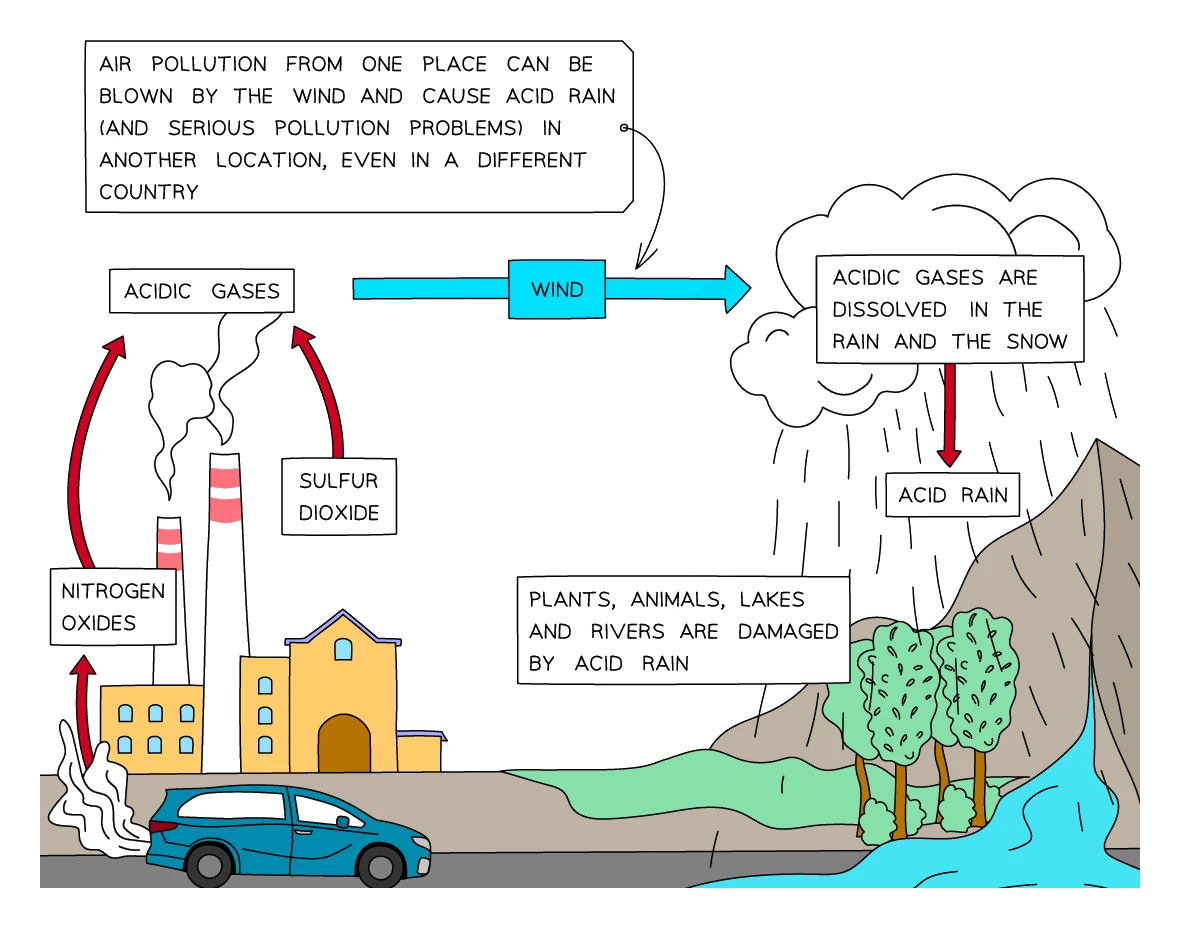
How it causes acid rain: sulfur dioxide gas reacts with water vapour in the atmosphere to form sulfuric acid (and a similar process happens with nitrogen oxides forming nitric acid). These acids dissolve in rain, snow or fog, lowering the rain's pH to as low as pH 3 (compared to normal rainwater at about pH 5.6).
How it harms people: irritates the airways and lungs. Can trigger or worsen asthma. Long-term exposure raises the risk of bronchitis and other respiratory diseases.
Common exam question
Describing the effects of an air pollutant
Question: Describe the effects of carbon monoxide on the human body, or the biological consequences of releasing sulfur dioxide into the atmosphere (2 marks).
Asked in 2 of the 23 papers, once for each gas, both on Paper 2. For carbon monoxide the two marks are a linked pair: it binds to haemoglobin, forming carboxyhaemoglobin, so less oxygen is transported. One sentence saying that it binds to haemoglobin instead of oxygen earns both marks, and less (or more anaerobic) respiration is an alternative second point. The same binding point earns a mark in a smoking question too.
For sulfur dioxide, name acid rain first (sulfuric acid is accepted), then its victims: trees and other plants damaged or killed, and fish and other animals dying in lakes and rivers, so biodiversity falls. Where a question asks why burning less fossil fuel helps, less carbon dioxide released, a smaller greenhouse effect and less sulfur dioxide (so less acid rain) are credited.
3. Acid rain
Acid rain is rain with a lower pH than normal (typically below pH 5). It is caused mainly by and released by burning fossil fuels.
How acid rain forms
- Power stations and vehicles release sulfur dioxide (SO₂) and nitrogen oxides (NOₓ) into the atmosphere.
- In the atmosphere, these gases react with water vapour in clouds.
- Sulfur dioxide reacts to form sulfuric acid (H₂SO₄). Nitrogen oxides react to form nitric acid (HNO₃).
- These dissolved acids fall back to earth in rain, snow, fog or dew. The result is acid precipitation (acid rain).
Effects on living things
On trees and other plants:
- Damages the waxy cuticle on leaves, making them more vulnerable to disease and to drying out
- Leaches important mineral ions (especially magnesium, calcium and potassium) out of the soil
- Releases toxic ions (especially aluminium) that were previously locked into the soil
- Result: trees grow more slowly, lose leaves, and eventually die. Vast areas of forest in Europe, North America and China have been damaged
On aquatic ecosystems (lakes and streams):
- Lowers the pH of the water
- Fish eggs cannot hatch below pH 5
- Adult fish struggle to breathe; many species cannot survive below pH 4.5
- Invertebrates (mayflies, snails) die off too
- Eventually the lake becomes a "dead zone" with almost no aquatic life
- Famous example: many lakes in Scandinavia and eastern Canada were left almost fishless in the 1970s and 80s
On buildings and statues:
- Sulfuric and nitric acid react with limestone, marble and concrete, dissolving them slowly
- Historic buildings (e.g. medieval cathedrals, statues) gradually lose their detail
What has been done
Modern regulation has helped. Most coal-fired power stations now have flue-gas desulfurisation units that remove SO₂ from exhaust before it reaches the atmosphere. Vehicle exhausts have catalytic converters that reduce NOₓ emissions. Switching to renewable energy (wind, solar, nuclear) removes the source entirely. Acid rain is much less of a problem in Europe than it was in 1980, but it remains a serious issue in fast-industrialising countries.
4. The greenhouse effect and climate change
The biggest environmental challenge of the 21st century is caused by rising levels of greenhouse gases in the atmosphere.
The natural greenhouse effect
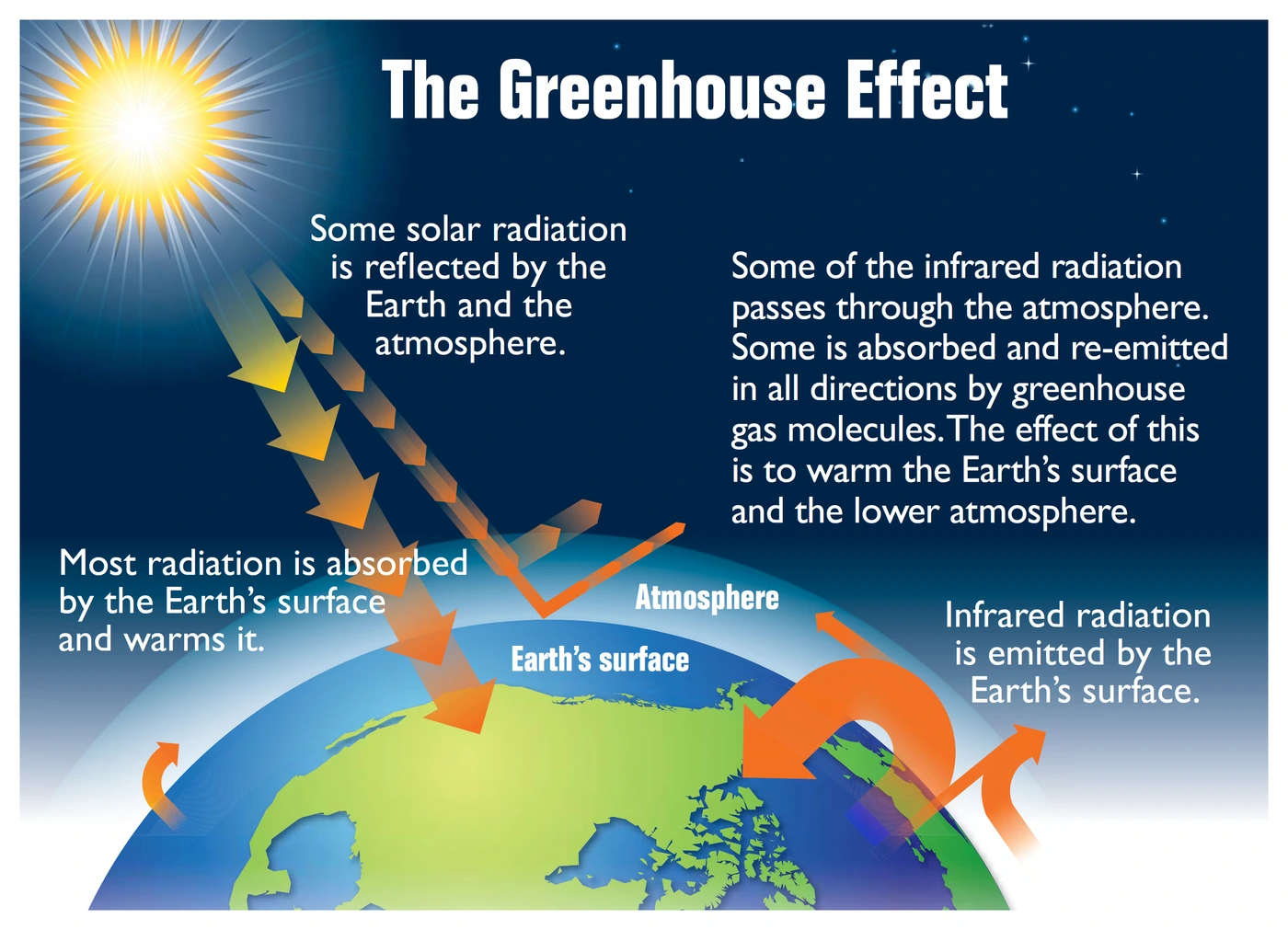
The Earth would be far too cold to support life without the natural . Here is how it works:
- The Sun emits high-energy radiation (mostly visible light) towards the Earth.
- Most of this passes through the atmosphere and reaches the surface.
- The Earth's surface absorbs the energy and warms up.
- The warm surface re-emits the energy as lower-energy infrared radiation (heat).
- Some of the infrared radiation escapes back to space.
- Some is absorbed by greenhouse gases in the atmosphere (carbon dioxide, water vapour, methane and others). The trapped energy keeps the lower atmosphere warm.
The natural greenhouse effect keeps the Earth's average surface temperature at about 15 °C instead of the -18 °C it would otherwise be. Without it, the oceans would be ice and there would be no life.
Common exam question
Explaining the greenhouse effect
Question: Explain what is meant by the greenhouse effect, or how a named gas such as carbon dioxide or nitrous oxide causes global warming or climate change (2 marks).
Asked in 3 of the 23 papers, always for 2 marks. The two credited ideas are the mechanism and its result: greenhouse gases absorb (trap) the infrared radiation re-emitted from the Earth's surface, stopping it escaping to space, so the Earth's temperature rises: global warming. "Traps heat" is accepted for the first idea, but one scheme ignores "traps light", and another credits neither a bare "heats up the Earth" for the trapping idea nor a bare "increases the temperature" for the result, so name the trapped radiation and say global warming. When the question names the gas, stating that it is a greenhouse gas is itself a credited point, so the safe answer has all three sentences.
The enhanced greenhouse effect
The problem is not the natural greenhouse effect itself, but the enhanced version of it that humans have created by adding extra greenhouse gases to the atmosphere. The most important human-emitted greenhouse gases are:
| Gas | Where it comes from | Notes |
|---|---|---|
| Carbon dioxide (CO₂) | Burning fossil fuels (coal, oil, gas); deforestation; cement production | The single biggest contributor by volume |
| Methane (CH₄) | Cattle (and other ruminants) burping; rice paddies; landfills; leaks from natural gas pipelines | Around 25× more powerful than CO₂ per molecule but present in much smaller quantities |
| Nitrous oxide (N₂O) | Agricultural fertilisers; some industrial processes | Around 300× more powerful than CO₂ but very minor in total |
| Water vapour | The atmosphere holds more water vapour as it warms (a feedback loop) | The dominant natural greenhouse gas, but humans do not directly emit it |
| CFCs (chlorofluorocarbons) | Old refrigerators, aerosol sprays | Banned by the Montreal Protocol (1987); now declining |
Common exam question
Naming the greenhouse gases
Question: Name another greenhouse gas, or pick from a list which gases are, or are not, greenhouse gases (1 mark).
Asked in 4 of the 23 papers. The five the specification names are water vapour, carbon dioxide, nitrous oxide, methane and CFCs; any of them that the question has not already named earns the mark, and one scheme also allows other fluorinated gases. Water vapour is the one students doubt: it counts, and a multiple-choice option that leaves it out is wrong. Oxygen and nitrogen are not greenhouse gases, and carbon monoxide is rejected outright, so never offer it as your example.
The result of adding all these extra greenhouse gases is that more infrared radiation is trapped in the atmosphere, and the Earth's average temperature is rising. Atmospheric CO₂ has risen from about 280 ppm in 1750 to over 420 ppm today, and global average temperature is about 1.2 °C above pre-industrial levels.
Consequences of climate change
A warming planet has many cascading effects:
- Melting polar ice and glaciers, raising sea levels and threatening coastal cities and low-lying countries
- Warming oceans, which expand and add further to sea-level rise
- Coral bleaching: corals expel the algae they depend on when water is too warm, turning white and often dying
- More frequent and severe extreme weather: heatwaves, droughts, wildfires, storms, flooding
- Shifts in habitats and species ranges: some species move towards the poles or to higher altitudes; those that can't, decline or die out
- Disruption to food chains and loss of as ecosystems struggle to adapt at the speed change is happening
- Spread of disease: warmer climates allow tropical diseases (malaria, dengue) to spread to new areas
- Crop failures in regions hit by drought; some agricultural land becomes unproductive
Common exam question
Consequences of global warming
Question: Give two consequences of global warming for the environment, or explain the negative effects of rising atmospheric carbon dioxide (2–3 marks).
Set in 2 of the 23 papers, both on Paper 2. In the 2-mark version each consequence is one mark, from a fixed menu: melting ice caps and glaciers, rising sea levels and flooding, habitat loss, drought or desertification, extinctions and disrupted food chains (or species migrating), coral bleaching, spread of disease and pests, and extreme weather or changed weather patterns. In the 3-mark explain version the first mark is the mechanism itself (carbon dioxide is a greenhouse gas that traps heat), so give that before the consequences, and pick consequences of different kinds: there melting ice, rising sea level, flooding and habitat loss share a single mark. Two correct consequences written on one answer line are both credited.
What is being done
Reducing emissions is the only long-term solution. International agreements (Kyoto Protocol, Paris Agreement) have set targets for emission reduction. National measures include:
- Renewable energy (wind, solar, hydro, nuclear) replacing fossil-fuel power stations
- Electric vehicles replacing petrol and diesel cars
- Insulation of buildings to reduce heating energy
- Reforestation to absorb CO₂ from the atmosphere
- Carbon capture (still experimental) to remove CO₂ from power station exhaust
5. Eutrophication
Eutrophication is the over-enrichment of a body of water with nutrients, leading to the collapse of its ecosystem. It is the leading cause of dead zones in lakes, rivers and coastal seas worldwide.
The five-step sequence
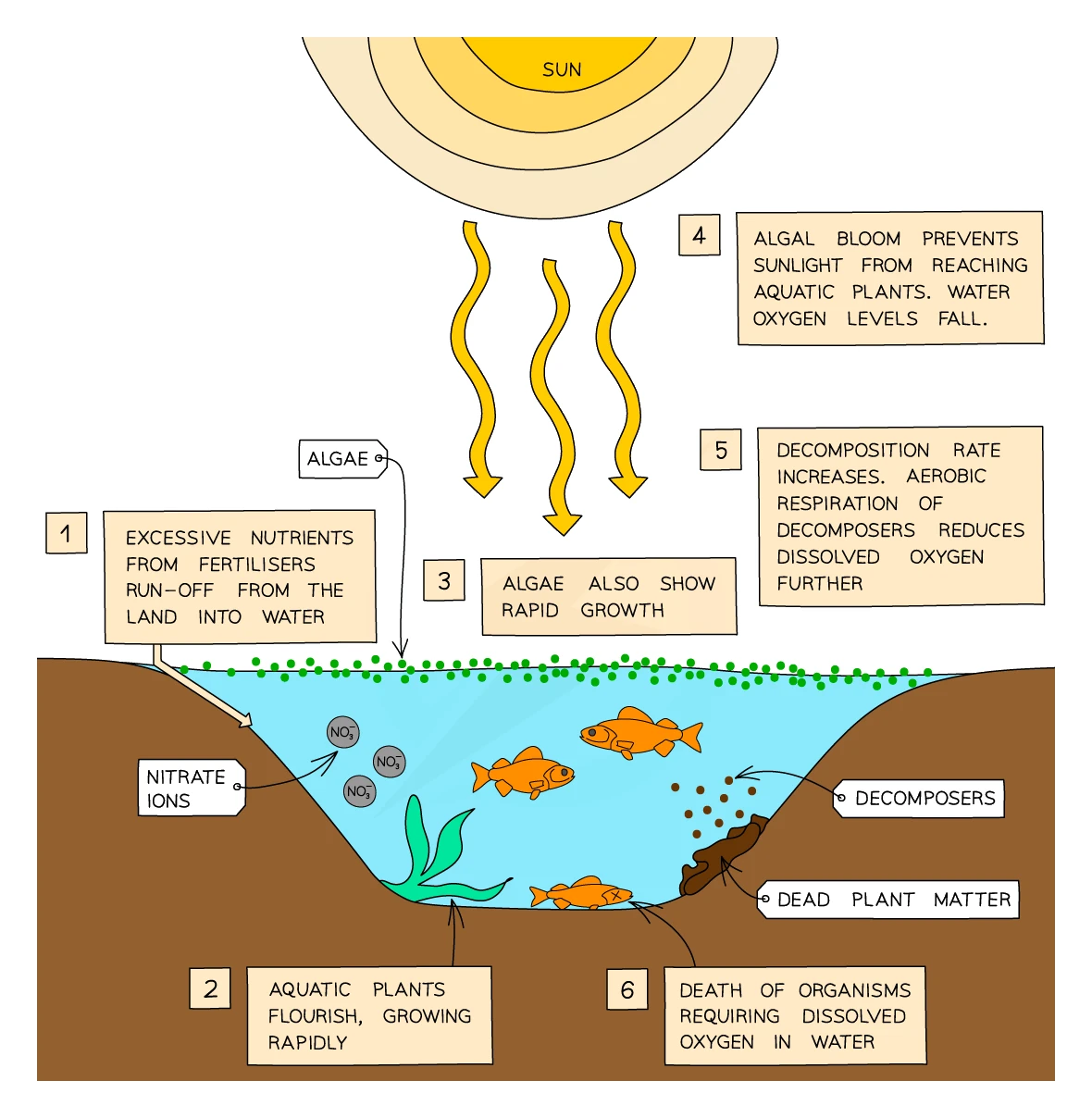
- Excess nutrients (nitrate and phosphate) enter a body of water. Most commonly from agricultural fertilisers washed off fields by rain, or from sewage containing detergents.
- The extra nitrates and phosphates cause explosive growth of algae at the water surface (an algal bloom).
- The thick algal layer blocks sunlight from reaching the deeper-water plants. Those plants cannot photosynthesise and die.
- The dead plants and (later) the algae are broken down by decomposer bacteria. The decomposers multiply rapidly and use up the dissolved oxygen in the water as they respire.
- Fish, invertebrates and other aquatic animals suffocate because there is no longer enough oxygen in the water. The water body becomes a "dead zone".
Common exam question
Eutrophication after fertiliser leaches into a river
Question: Describe or explain how fertiliser, or a rise in nitrate, washing into a river or lake affects the aquatic ecosystem (3–5 marks).
Asked in 4 of the 23 papers, all on Paper 2, and marked as a chain, one mark per link, so give every link in order: nitrate (and phosphate) leaches or runs off into the water; algae grow rapidly into an algal bloom (name eutrophication, a mark of its own in one scheme); the bloom blocks light, so underwater plants cannot photosynthesise and die; bacteria decompose the dead material; their respiration uses up the dissolved oxygen; fish and other animals die.
Two schemes give separate marks for the bacteria, their respiration and the fall in oxygen, so a bare "the oxygen runs out" leaves marks behind. Say nitrate, not "nutrients", which two schemes ignore. The same chain scores for a fish farm; for sewage only its second half does, as bacteria feed on the sewage itself.
Why fertilisers are the main culprit
Modern agriculture uses huge amounts of nitrogen-based fertiliser to maximise crop yields. Plants only absorb a fraction of the applied nitrate; the rest stays in the soil and is leached out by rainfall into rivers and groundwater. Even small fields can release enough nitrate to disturb a downstream lake.
Phosphates from older washing detergents used to make the problem worse; phosphate-free detergents have largely solved this part of the problem in the UK, but agricultural runoff remains the dominant source.
Where eutrophication happens
- Lakes and slow rivers in farming areas
- Coastal seas at the mouths of large rivers draining intensive agricultural land. The Gulf of Mexico has a dead zone the size of New Jersey every summer, fed by nitrate runoff from the Mississippi River
- The Baltic Sea, surrounded by farming countries, has experienced widespread eutrophication
Solutions
- Reduce fertiliser use by applying only as much as the crop will absorb, at the right time of year
- Buffer strips: leave strips of grass and trees along rivers and ditches to absorb runoff before it reaches the water
- Improve sewage treatment to remove nitrate and phosphate before discharging treated water
- Use phosphate-free detergents (now standard in the UK)
- Restore wetlands that naturally filter excess nutrients
6. Sewage pollution and bioindicators
Sewage is the waste water from homes, businesses and industry, containing human waste, food scraps, detergents, and sometimes industrial chemicals. When raw or poorly-treated sewage enters a water body, it causes a similar oxygen-depletion problem to fertiliser-driven eutrophication.
How sewage damages aquatic ecosystems
- Sewage contains lots of organic matter that bacteria can digest.
- Aerobic bacteria multiply rapidly, breaking down the organic matter.
- As they respire, they use up the dissolved oxygen in the water.
- Oxygen-sensitive species (mayflies, stoneflies, trout) die or move away.
- Only species that can tolerate low oxygen survive (sludge worms, blood worms, rat-tailed maggots, certain bacteria).
- Biodiversity collapses.
Sewage also contains pathogenic bacteria and viruses that can cause disease in humans who drink the water, swim in it, or eat shellfish from it.
Bioindicators: using species to measure pollution
You can tell how polluted a water body is by looking at which species are living in it. Different species have different tolerances for oxygen and pollution:
| Species found | What it tells you about the water |
|---|---|
| Mayfly nymphs, stonefly nymphs, freshwater shrimps | High dissolved oxygen, very low pollution (clean water) |
| Caddisfly larvae, watercress, riffle beetles | Moderate oxygen, low pollution |
| Bloodworms, water lice, leeches | Low oxygen, moderate pollution |
| Sludgeworms (Tubifex), rat-tailed maggots | Very low oxygen, severe pollution |
| No life at all | Severe pollution; oxygen completely depleted |
Sampling a stream with a kick net and identifying what is there is a standard way to assess water quality. Bioindicator species are useful because they reflect conditions over weeks or months, not just a single moment (which a chemical test would).
Exam tip
Sewage questions: pair every change with the oxygen link
In a data question that tracks oxygen, bacteria and two indicator species downstream of a sewage outlet, the credited points mix describing the curves with explaining them, so do both. Bacteria increase because they arrive in the sewage and feed on it; their respiration uses up the dissolved oxygen; mayfly nymphs fall because they need that oxygen; tubifex worms rise because they feed on the sewage and tolerate low oxygen. Downstream the bacteria decline, oxygen recovers and the two species swap back. As indicators, give both halves: mayflies mean oxygen-rich, unpolluted water; tubifex worms mean polluted, oxygen-poor water.
Lichens as air-quality bioindicators
The same idea works for air. Different lichens (small symbiotic organisms growing on rocks and tree bark) have different tolerances for sulfur dioxide:
| Lichen type | What it indicates |
|---|---|
| Bushy and shrubby lichens | Clean air |
| Leafy lichens | Slightly polluted air |
| Crusty lichens only | More polluted air |
| No lichens at all (just algae) | Very polluted air, lots of SO₂ |
A walk through a city centre and a walk through unpolluted countryside will quickly show this pattern.
7. Deforestation
Deforestation is the large-scale clearing of forests, usually to make room for agriculture (especially cattle ranching, palm oil and soy plantations), logging for timber, road and city building, or mining.
The world has lost about a third of its forests since the start of the agricultural revolution. Tropical rainforests are being lost at a rate of around 10 million hectares per year. Each lost hectare typically contained hundreds of species of plants, insects, and animals.
Worked example
Mean rate of forest loss
A country's forest covered 5 420 km² in 2004 and 5 228 km² in 2024. (a) Calculate the mean rate of decrease in forest area, in km² per year. (b) Calculate the loss in km² per month, giving your answer in standard form.
Solution:
- Decrease in area = 5 420 − 5 228 = 192 km²
- Time = 2024 − 2004 = 20 years
- (a) Mean rate of decrease = 192 ÷ 20 = 9.6 km² per year
- (b) 20 years = 20 × 12 = 240 months, so 192 ÷ 240 = 0.8 km² per month = 8.0 × 10⁻¹ km² per month
Write the subtraction and the division down: in both papers that set this calculation the first mark was for that step (or for the right divisor, such as the number of months), and a correct answer on its own earned both marks.
Five major consequences of deforestation
1. Loss of
Forests, especially tropical rainforests, are home to a huge fraction of Earth's species. Cutting down a rainforest destroys habitats and pushes many species to extinction. Some are lost before they have even been discovered or studied.
2. Soil erosion
Tree roots hold soil together. Without trees, heavy rain washes the topsoil away, leaving infertile subsoil. The lost soil ends up in rivers, where it can clog spawning beds and reduce water quality. Many tropical regions now have impoverished farmland that was tropical forest 50 years ago.
3. Leaching of soil minerals
Trees absorb minerals (especially nitrate) from the soil through their roots, holding them in plant tissue. When the trees are gone, those minerals are washed out of the soil by rainfall (leaching) into waterways. The soil becomes nutrient-poor and unable to support agriculture for long.
4. Disruption of the water cycle
Forests release enormous amounts of water vapour through transpiration. The Amazon rainforest, for example, transpires enough water vapour to generate much of its own rainfall. When the forest is cleared:
- Less transpiration → less water vapour in the air → fewer clouds → less rainfall
- The area becomes drier
- Streams and rivers can dry up
- Other vegetation cannot grow back as easily
5. Disruption of the carbon cycle and accelerated
This effect is the biggest at global scale:
- Forests are huge carbon sinks: trees hold enormous amounts of carbon in their wood (and in the soil beneath them). When forests are cut down and burned, that stored carbon is released as CO₂ to the atmosphere.
- Removing the trees also reduces future photosynthesis, so less CO₂ is being absorbed from the atmosphere in years to come.
- Both effects push atmospheric CO₂ higher, accelerating climate change.
- Deforestation is responsible for around 10–15% of human-caused CO₂ emissions.
Common exam question
Explaining the effects of deforestation
Question: Describe the effects of deforestation on an ecosystem, or explain one effect: why it raises atmospheric carbon dioxide, or how it changes a nearby river (2–4 marks).
Asked in 4 of the 23 papers, all on Paper 2. The credited effects: loss of biodiversity and habitat, more carbon dioxide in the atmosphere (less is absorbed; felled trees release it as they burn or decay), less photosynthesis, soil erosion, leaching of minerals so the soil is less fertile, flooding, and a disturbed water cycle with less transpiration and less rainfall. In the 4-mark question the carbon dioxide rise and the fall in photosynthesis are separate marks; in a carbon-sink question either earns the single deforestation mark.
For a river below the cleared land, continue the chain: eroded soil and leached nitrate wash in, algae grow, light is blocked, plants die, bacteria decompose them and respire, oxygen falls, animals die and biodiversity drops. Say "leaching" or "run-off": "nutrients" is ignored.
What is being done
- Reforestation and afforestation: planting new forests and replanting cleared areas
- Protecting old-growth forests through laws and national parks
- Sustainable forestry: managed harvesting where trees are replaced as they are taken
- Reducing demand: choosing products certified as not linked to deforestation (e.g. FSC-certified timber, RSPO palm oil)
- Paying tropical countries to protect their forests, through schemes like REDD+
8. Biological control of pests
A pest is any organism (insect, weed, fungus) that damages crops, livestock or people. The traditional way to manage pests is to spray chemical pesticides on them, but this has several drawbacks:
- Pesticides kill non-target species (bees, ladybirds, songbirds) as well as the pests
- Pests evolve resistance (see topic 14), making the pesticide useless over time
- Pesticides can biomagnify up food chains (see topic 15)
- Chemical pesticides contaminate soil, water and the food we eat
What biological control is
Biological control is the use of a living organism to control a pest, instead of a chemical. The control organism is typically a natural predator or parasite of the pest:
- A predator that eats the pest
- A parasite or parasitoid that lives on or inside the pest, weakening or killing it
- A disease-causing microbe that infects the pest
Advantages of biological control
- No chemical pollution of soil, water or food
- Targets only the pest species if the control organism is well-chosen
- Self-sustaining once established; the predator population maintains itself
- No resistance develops in the same way as with chemicals
- Cheaper in the long run than repeated chemical sprays
Disadvantages and risks
- The control organism can become an invasive species if it has no natural predators in its new habitat
- It can attack non-target species, sometimes more so than the pest it was meant to control
- The cane toad in Australia is a famous example: introduced to control beetles, the toads ignored the beetles, multiplied uncontrollably, and now devastate native wildlife by being poisonous to anything that tries to eat them
- It can take a long time to work, so cannot deal with sudden pest outbreaks
- It does not eliminate the pest entirely; it just keeps the population low
Common exam question
Advantages of biological control over pesticides
Question: Explain the advantages of biological control rather than chemical pesticides, or describe how a farmer could reduce a pest without a pesticide (1–4 marks).
Asked in 4 of the 23 papers, all on Paper 1, once as multiple choice. The credited advantages: it is specific to the pest, leaving other organisms and the food chain unaffected; it lasts longer with no reapplication, because the predator breeds and maintains itself (a long-term solution); no residue on the crop; no bioaccumulation up the food chain; and the pest does not become resistant. "Cheaper" alone is ignored, as is "immune" where resistant is wanted. Describing the method earns marks for naming biological control, introducing a predator and saying it eats the pest.
Asked why a farmer might avoid it: it acts more slowly, does not kill every pest, varies with the season, the predators cost money, and the introduced organism may itself become a pest or harm other species.
Integrated pest management (IPM)
Modern farming usually combines several approaches in integrated pest management:
- Biological control as the foundation
- Targeted pesticide use only when pest numbers are very high
- Crop rotation to break pest life cycles
- Pest-resistant crop varieties (sometimes from selective breeding or genetic modification)
- Physical barriers (netting, traps)
Integrated pest management uses far less chemical pesticide than traditional farming, with similar or higher yields.
9. Fish farming and sustainable food production
Why fish farming is needed
Wild fish populations have been severely overfished. Many fisheries that fed coastal communities for centuries have collapsed in the last 50 years; the Atlantic cod off Newfoundland is the most famous example. The UN estimates that around a third of all wild fish stocks are overfished and another half are at the limit of sustainability.
At the same time, demand for fish keeps rising as the world's population grows and as fish (especially oily fish) are seen as healthier than red meat. Fish farming (aquaculture) is supplying more and more of the world's seafood, now over half of it.
How fish farming works
Fish farms keep fish in enclosed cages or ponds, allowing them to be raised in controlled conditions:
- Marine cages: salmon, sea bass, sea bream raised in coastal sea cages
- Freshwater ponds: trout, carp, tilapia raised in inland ponds
- Recirculating tank systems: enclosed tanks where water is filtered and reused
Fish farmers control:
- Stocking density: how many fish per cage
- Feed: usually a pellet mix containing fishmeal, soy, vegetable oils and vitamins
- Water quality and oxygen levels
- Disease: vaccinations and (sometimes) antibiotics
- Temperature and lighting to maximise growth rate
Common exam question
Methods a fish farmer uses
Question: Explain the methods a fish farmer uses to maximise production, or describe how a farmer reduces disease in the fish (2–5 marks).
Set in 2 of the 23 papers, both on Paper 2, with one mark per method, and the specification's list is the menu: separate species, and separate sizes or ages, to prevent predation; feed protein-rich food in small, frequent amounts so waste does not build up; control disease with antibiotics, fungicides, pesticides or vaccination, by isolating or removing sick and dead fish, and by keeping the stocking density low; filter out faeces, waste and dead fish; aerate the water to keep oxygen levels up; and selective breeding or GM for faster growth. Unqualified answers earn nothing: "control their diet" needs the protein or the small portions, "clean the water" needs the oxygen or the waste removal, and "medicine" is ignored where antibiotics or vaccination are wanted.
Advantages of fish farming
- Reduces pressure on wild fish stocks
- Provides a reliable source of protein for a growing population
- Fish convert feed into body mass more efficiently than cattle or pigs, so they need less feed per kg of meat
- Creates jobs in coastal and rural areas
Disadvantages and concerns
- Pollution: uneaten food, fish faeces and urine pollute the surrounding water with nutrients, sometimes causing local
- Disease and parasites (especially sea lice in salmon farms) can spread to wild fish populations nearby
- Escape of farmed fish that breed with wild populations, potentially reducing the wild population's genetic fitness
- The feed contains wild fish: small fish are caught from the sea and ground up into fishmeal, so fish farming does not entirely remove pressure on wild stocks
- Antibiotic use can drive resistance (see topic 14)
- Habitat destruction: mangrove forests have been cleared in many tropical countries to make space for shrimp farms
Making fish farming more sustainable
Modern aquaculture is trying to reduce these problems:
- Use of closed-containment systems that filter out waste
- Plant-based fish feed to reduce reliance on wild fish
- Vaccinations instead of antibiotics
- Integrated multi-trophic aquaculture: farming fish, shellfish and seaweed together so the shellfish and seaweed take up the fish waste
Common exam question
How fish farms pollute the water and how to reduce it
Question: Explain how fish farms cause pollution, or how a change (a multi-trophic system, faster-growing GM fish, moving the farm offshore) reduces its effect on the ecosystem (2–5 marks).
Set in 3 of the 23 papers, all on Paper 2. The pollution answer is the eutrophication chain with a fish-farm source: uneaten food and faeces add organic waste and raise nitrate and phosphate levels; algae grow; bacteria decompose the waste and respire, so dissolved oxygen falls; pesticides, antibiotics and hormones add harm. A change that reduces pollution is marked as the chain in reverse: less waste, fewer decomposers and less bacterial respiration, so more oxygen stays in the water and less disease spreads; seaweed that takes up the nitrate prevents the algal bloom, and crabs or lobsters that eat the waste are extra products to sell. For an offshore site, any two of four points score: deep water, which dilutes the waste, and faster currents, which disperse it.
Sustainable wild fishing
For wild fish stocks, sustainable practices include:
- Catch quotas that limit how much can be caught each year
- Mesh size regulations so small juvenile fish escape and grow to breeding age
- Marine protected areas where no fishing is allowed
- Seasonal closures to protect breeding times
- Better fishing gear that reduces bycatch (accidental catch of non-target species)
When properly managed, wild fish stocks can recover. The North Sea cod population has slowly recovered from overfishing thanks to strict EU quotas.
10. Conserving biodiversity
The biodiversity loss caused by all the above pressures is alarming. Scientists estimate that current extinction rates are 100 to 1000 times the natural background rate. Many efforts are underway to slow or reverse the loss.
Methods of conservation
Habitat protection:
- National parks and nature reserves set aside large areas where wildlife is protected
- Marine protected areas for ocean wildlife
- Wildlife corridors linking fragmented habitats so animals can move between them
- Site of Special Scientific Interest (SSSI) designations in the UK to protect small but ecologically valuable sites
Species-specific programmes:
- Captive breeding in zoos for endangered species. The Arabian oryx was extinct in the wild by 1972, bred in zoos, and reintroduced. There are now over 1000 in the wild.
- Seed banks preserve plant genetic diversity. The Svalbard Global Seed Vault in Norway stores millions of seed samples as a backup against agricultural catastrophe.
- Frozen zoos preserve animal cells (sperm, eggs, tissue) for possible future use, including potential cloning of extinct or endangered species.
Legal protection:
- CITES (Convention on International Trade in Endangered Species) bans trade in many endangered species
- National laws protect specific species (e.g. all UK bats and their roosts are protected)
- Anti-poaching enforcement in countries with iconic but threatened species (elephants, rhinos, tigers)
Sustainable use:
- Sustainable forestry allows forest products to be harvested without destroying the forest
- Sustainable fishing quotas allow long-term harvesting
- Ecotourism lets people pay to visit wildlife without harming it, providing economic incentives for local communities to protect their wildlife
Habitat restoration:
- Reforestation of cleared land
- Wetland restoration to recover lost biodiversity hotspots
- Reintroducing species to areas where they had been lost (e.g. wolves reintroduced to Yellowstone National Park, beavers reintroduced to Britain)
Reducing demand for wildlife products:
- Education campaigns to reduce the market for rhino horn, tiger bone and other illegal wildlife products
- Banning trade in ivory and other endangered-species materials
Why conservation matters
Beyond the moral question of whether humans have the right to drive other species to extinction, there are practical reasons to protect biodiversity:
- Ecosystem services: insects pollinate crops, soil organisms recycle nutrients, wetlands filter water. Lost species mean lost services.
- Medicines: many drugs come from wild species; future discoveries are impossible if the species is extinct first.
- Food security: crop wild relatives carry genes that may be vital for future agriculture.
- Climate regulation: forests, peat bogs and oceans help regulate the global climate.
- Cultural and recreational value: people value wildlife for its own sake.
Conservation success stories
It is easy to be pessimistic, but conservation does work when given resources and time:
- Bald eagle (USA): nearly extinct in 1970 after DDT; now over 70,000 pairs
- Humpback whale: hunted to near-extinction by 1960; protected since 1966; now over 80,000 worldwide
- Mountain gorilla: down to 250 individuals in the 1980s; now over 1000 thanks to anti-poaching and ecotourism
- California condor: down to 27 birds in 1987; captive-bred and reintroduced; now over 500
- European bison: extinct in the wild by 1927; reintroduced from zoos; now several thousand in Poland and Belarus
These examples show that with concerted effort, declines can be reversed. But the underlying pressures (habitat loss, climate change, pollution) continue to grow, and many more species are at risk than there are conservation programmes to save them.