1. What genetic engineering is
Genetic engineering (also called genetic modification, GM) is the process of deliberately changing an organism's DNA by inserting a gene from a different organism, usually to give it a useful new characteristic
In selective breeding (topic 17), the alleles being shuffled around already exist within the species. Genetic engineering goes much further: it lets scientists take a gene from any species and insert it into the DNA of any other species. This is possible because the genetic code is universal: every living thing uses the same four DNA bases (A, T, G, C) and the same code (three-base codons) to specify amino acids. A human gene placed inside a bacterium still codes for the same human protein.
Some terminology
| Term | Meaning |
|---|---|
| Genetically modified organism (GMO) | Any organism whose DNA has been deliberately altered |
| Transgenic organism | A GMO that contains DNA from a different species (a subset of GMOs) |
| Recombinant DNA | DNA that has been built from pieces of more than one source organism |
| Vector | A "carrier" molecule used to insert the new gene into the host cell. Usually a bacterial plasmid or a virus |
| Restriction enzyme | A bacterial enzyme used to cut DNA at specific base sequences |
| DNA ligase | An enzyme used to join two pieces of DNA together |
A useful memory aid: picture restriction enzymes as the scissors that cut DNA, and ligase as the glue that joins it back together.
Exam tip
Transgenic means a gene moved between species
When a question asks what the term transgenic means (1 mark), the mark is for the species boundary: a gene, allele or piece of DNA has been moved from one species into a different species, so the organism carries a gene from another species. The scheme ignores "genetic modification" on its own and ignores "organism" on its own, because neither says that genes were transferred between species. A bacterium carrying the human insulin gene, a Bt crop and a transgenic tomato all fit the same one-line definition.
2. The process of genetic engineering
The general procedure for inserting a new gene into a host organism has the same five steps every time.
Step 1: Isolate the desired gene
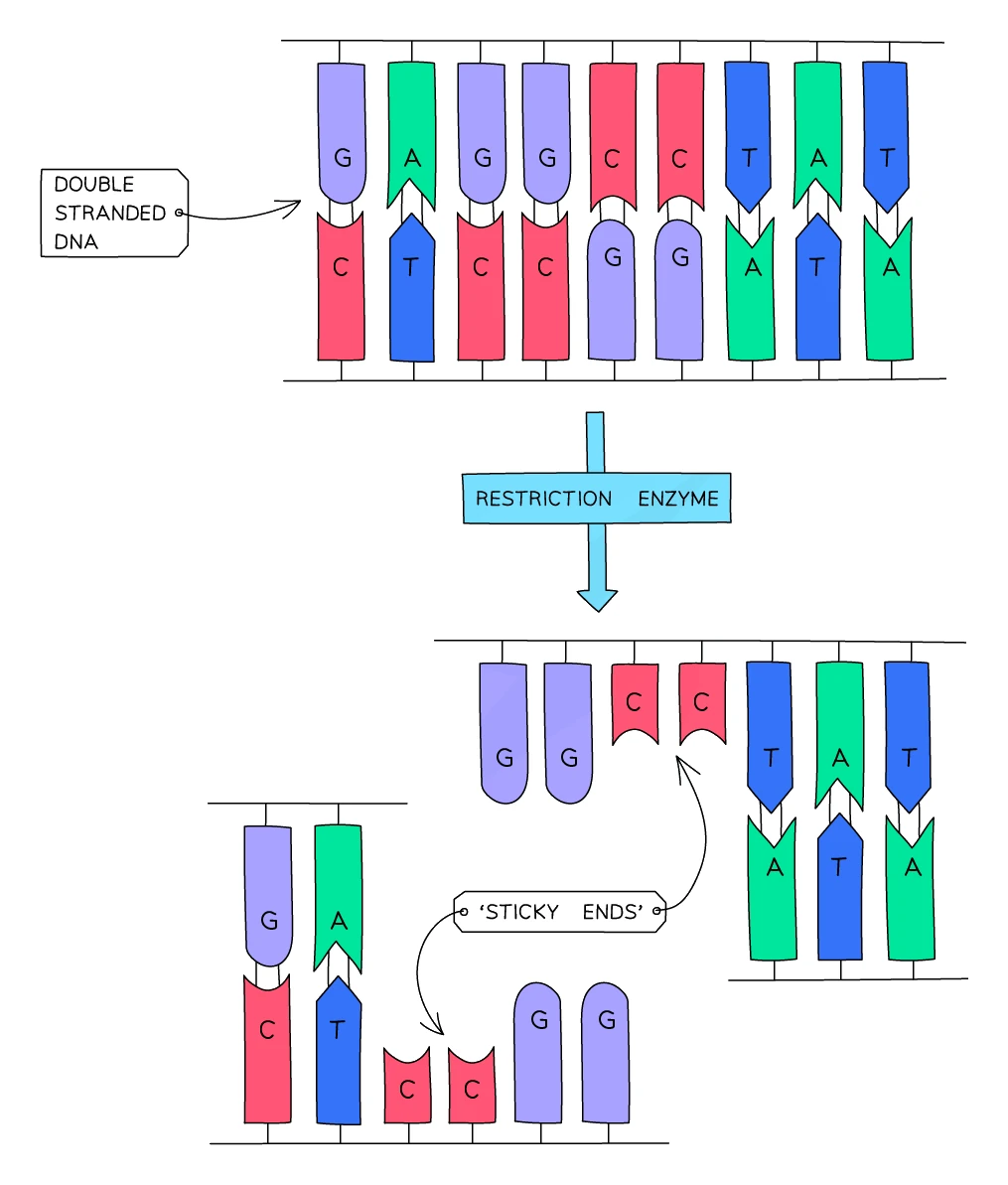
The gene that codes for the desired protein is first found within the source organism's DNA. A specific then cuts the gene out. Restriction enzymes are remarkable: each one only cuts the DNA at a specific base sequence (called a recognition site), so you can choose the right enzyme to cut out exactly the gene you want.
When a restriction enzyme cuts double-stranded DNA, it leaves short overhangs of unpaired bases on each cut end. These overhangs are called because they will pair up with any other piece of DNA that has matching complementary bases.
Step 2: Prepare the vector
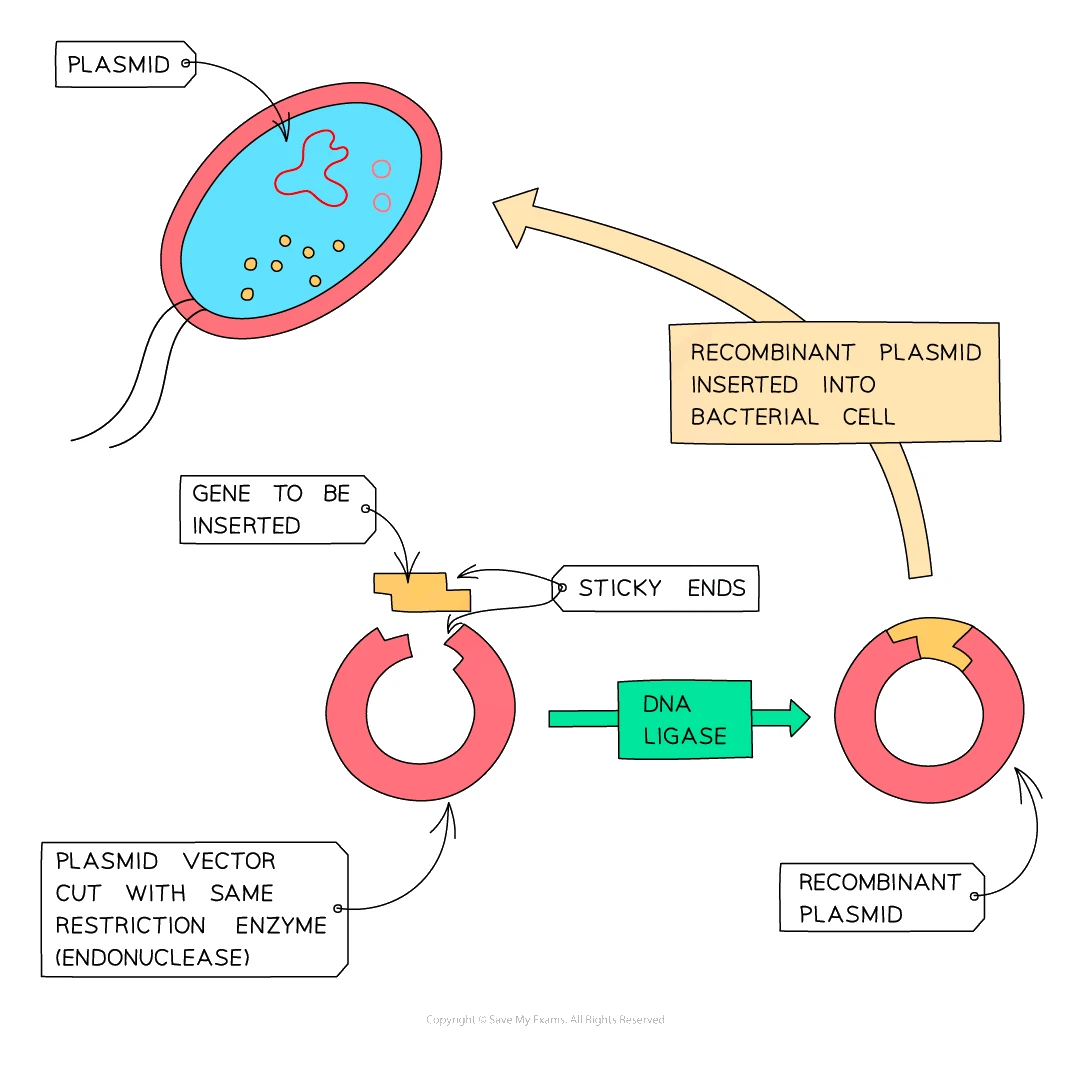
The vector is usually a bacterial (a small circular piece of DNA found inside bacteria, separate from the main chromosome). The same restriction enzyme is used to cut the plasmid open. Because it is the same enzyme, the plasmid ends up with complementary sticky ends to the desired gene.
Using the same enzyme to cut both the gene and the plasmid is crucial. It is what guarantees the sticky ends will match and pair up.
Step 3: Join the gene to the vector
The cut gene and the opened plasmid are mixed together. Their sticky ends find each other and pair up using the base-pairing rules (A with T, G with C). The enzyme DNA then seals the joints, forming a single complete molecule of (DNA made from two different sources joined together).
Step 4: Insert the vector into the host cell
The recombinant plasmid is added to a culture of host cells (usually bacteria). Some of the cells take the plasmid in (a process called transformation). The host cell now contains the new gene and can use it to make the new protein.
Step 5: Grow the host cells in a fermenter
The transformed bacteria are placed in a large industrial fermenter along with their nutrients and the right temperature, pH and oxygen conditions. They multiply rapidly. Every time a bacterium divides, the plasmid is copied too, so every new bacterium contains the gene and makes the protein. Within a few days the fermenter contains millions of bacteria all producing the desired protein, which can then be extracted and purified.
Common exam question
Describing how a recombinant plasmid is made
Question: Describe how named enzymes are used to make a recombinant plasmid or vector, or explain how genetically modified bacteria are produced (2–4 marks).
Asked in 5 of the 23 papers, once as a multiple-choice question on which enzyme removes a gene from DNA. Name both enzymes and give each its job: a restriction enzyme cuts the gene out of the DNA and cuts the plasmid open; DNA ligase joins the gene into the plasmid. Each enzyme is a mark in the 2-mark versions. "Endonuclease" is accepted for the restriction enzyme; "lipase" for ligase is rejected.
A 3-mark version also credits naming the plasmid as the vector. The 4-mark version offers five points: the restriction enzyme cuts out the gene; the same enzyme cuts the bacterial plasmid; this gives matching sticky ends; ligase joins the gene into the plasmid; the recombinant plasmid is taken up by the bacterium. No scheme credits growing the bacteria in a fermenter.
3. GM bacteria producing human insulin
The classic example of genetic engineering, and the first to be commercialised in 1982, is the production of human insulin for treating people with type 1 diabetes. Before genetic engineering, diabetics had to use insulin extracted from cow or pig pancreases, which was expensive, in short supply, and slightly different from human insulin (some patients developed allergic reactions).
Step by step
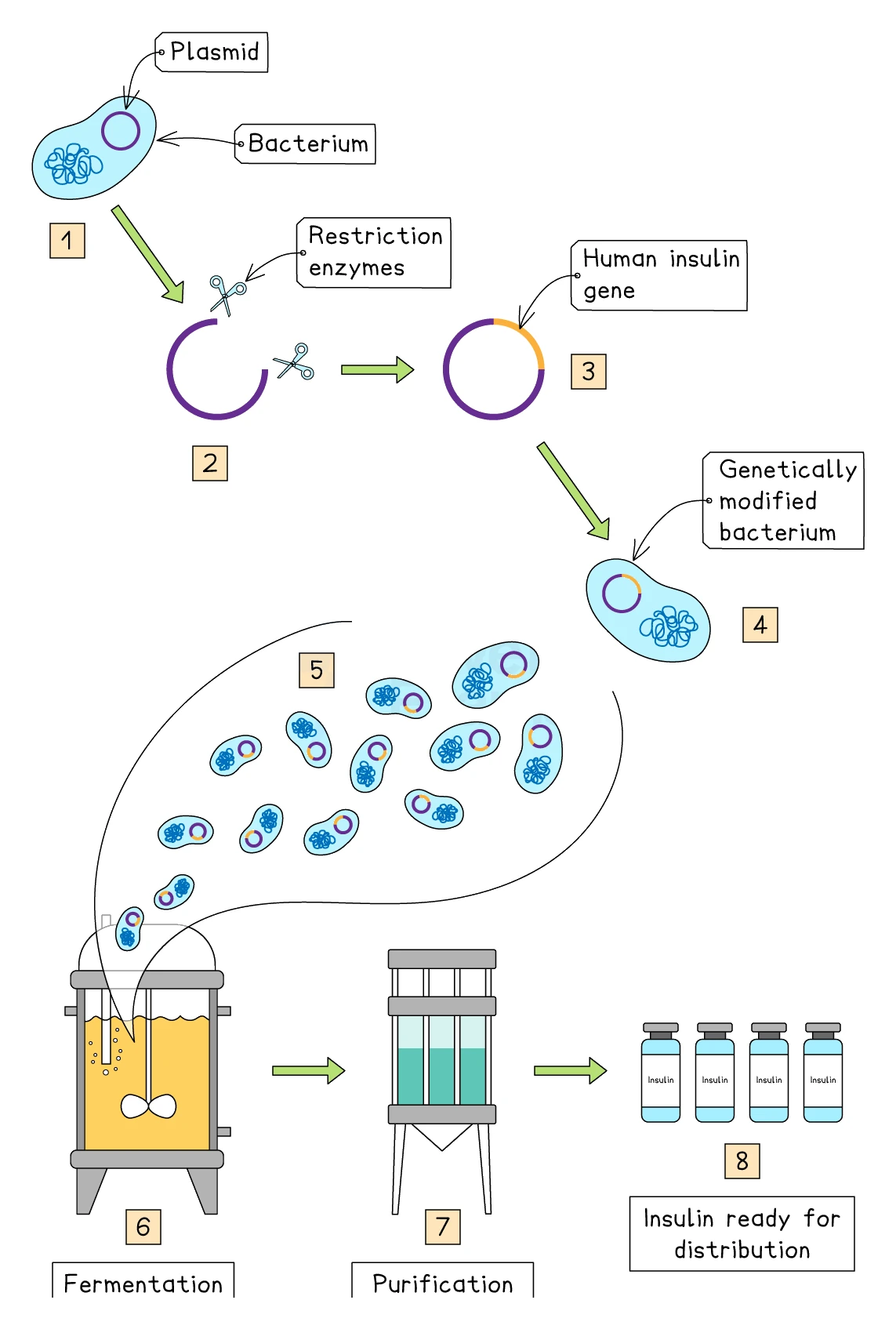
Applying the general five-step process specifically to insulin:
- Locate the human insulin gene on human chromosome 11.
- Use a specific to cut the gene out of human DNA. The gene now has sticky ends.
- Use the same restriction enzyme to cut open a bacterial . The plasmid now has matching sticky ends.
- Mix the gene with the cut plasmid. The sticky ends pair up by complementary base pairing.
- DNA seals the joints, forming a recombinant plasmid containing the human insulin gene.
- The recombinant plasmid is inserted into bacterial cells (usually Escherichia coli).
- The bacteria are grown in industrial fermenters under controlled conditions (temperature, pH, oxygen, nutrients). They multiply rapidly.
- Each bacterium reads the human insulin gene and produces human insulin protein from it. (The bacterium's own ribosomes do not care that the gene is human; they read the code the same way they would for any bacterial gene.)
- The insulin is extracted and purified from the fermenter and packaged as medical-grade insulin.
Why bacteria are ideal for this
Bacteria are the workhorse of genetic engineering for several reasons:
- They have plasmids, which are easy to remove, modify and put back. This is the natural vector for engineering bacteria.
- They reproduce extremely fast (one cell can become billions in a day), so you can rapidly produce large quantities of the modified organism.
- They use the same genetic code as humans (and every other organism), so they can read and translate human genes correctly.
- They don't raise the same ethical concerns as engineering animals or plants. There is no animal welfare issue with bacteria.
- They are cheap and easy to grow.
Insulin today
Today, almost all of the world's medical insulin is made by GM bacteria using exactly this process. The insulin produced is chemically identical to human insulin, with no risk of allergic reaction. It can be made in unlimited quantities at low cost. This was one of the great medical successes of the late 20th century.
Other proteins made by GM bacteria include human growth hormone, blood-clotting factors for haemophilia patients, and several vaccines.
4. GM crops
Genetic engineering of plants has produced crops with useful new traits.
Common GM traits in crops
| Trait | Source of gene | Why it matters |
|---|---|---|
| Insect resistance | The Bt gene from the bacterium Bacillus thuringiensis makes a protein toxic to caterpillars but harmless to humans | The plant produces its own insecticide; less chemical pesticide needed; less crop loss |
| Herbicide resistance | Genes that allow the plant to break down a specific weedkiller | Farmers can spray the herbicide on the whole field, killing weeds but not the crop |
| Drought tolerance | Genes that help the plant cope with low water | Crops can be grown in drier regions or use less irrigation |
| Vitamin A production | "Golden rice" carries genes from another plant + a bacterium that produce beta-carotene (a vitamin A precursor) | Could prevent vitamin A deficiency, which causes blindness and death in poor regions |
| Disease resistance | Genes for resistance to specific viral or fungal pathogens | Less crop lost to disease; less need for fungicides |
| Longer shelf life | Genes that slow down ripening | Reduces food waste |
Advantages of GM crops
| Advantage | Explanation |
|---|---|
| Higher yields | Less crop lost to pests, weeds and disease |
| Less pesticide use | Bt crops produce their own insecticide; less chemical needed |
| Reduced labour and cost for farmers | Herbicide-resistant crops are easier to weed |
| Better nutrition | Crops like golden rice can deliver missing vitamins to populations who need them |
| Drought tolerance | Allows farming in dry regions that traditional varieties cannot tolerate |
| Less land needed | Higher yields per hectare reduce pressure on rainforests for new farmland |
Disadvantages and concerns
| Concern | Explanation |
|---|---|
| Cost | GM seeds are more expensive; large agribusinesses develop them and charge accordingly. Small farmers may be priced out |
| Cross-contamination | Pollen from GM crops can fertilise wild relatives or organic neighbouring crops, spreading the engineered genes |
| Loss of biodiversity | Heavy use of herbicide-resistant crops kills off most weeds in the field, reducing food for insects and the birds that eat them |
| Pest resistance | Insects can evolve resistance to the Bt toxin if they are exposed to it constantly (natural selection in action: see topic 14) |
| Dependence on agribusiness | Farmers in poorer countries may become locked into buying seed each year from a single company |
| Long-term human health unknown | GM food has been eaten for decades with no proven harm, but long-term effects are not certain |
| Ethical concerns | Some people feel that humans should not "play God" with the natural genome |
The scientific consensus is that current GM crops are safe to eat. The bigger debates are about social, economic and environmental impacts rather than direct health risks.
5. Transgenic animals
Animals can also be genetically engineered. The process is more complex than for bacteria because animals are multicellular and the gene must be inserted at the right early stage of development to end up in every cell of the adult.
Transgenic animals producing proteins for medicine
One major use of transgenic animals is producing useful proteins in their milk:
- The gene for a useful human protein (e.g. a blood-clotting factor) is inserted into the DNA of a fertilised animal egg, typically a goat, sheep or cow.
- The egg is implanted into a surrogate mother and develops normally into an animal that carries the gene.
- The animal grows up and starts producing milk. The human protein is secreted into the milk along with normal milk proteins.
- The milk is collected and the human protein is purified out.
This approach can make proteins that are too large or complex for bacteria to produce. It has been used to make:
- Alpha-1-antitrypsin (used to treat a rare lung disorder)
- Human blood-clotting factors for haemophilia patients
- Antithrombin (used during surgery to prevent dangerous clots)
The animals live normal lives; they are just very expensive milk producers.
Other uses of transgenic animals
- GM mice are widely used in medical research. Specific human disease genes can be put into mice so that researchers can study the disease and test possible treatments.
- fish have been engineered to grow faster (e.g. AquAdvantage salmon, approved in the USA and Canada).
- GM mosquitoes carrying a "self-limiting" gene have been released in some areas to try to suppress mosquito populations that spread diseases like dengue and Zika.
6. Cloning of animals
Cloning means producing genetically identical copies of an organism. Cloning of plants by tissue culture / micropropagation was covered in topic 17. Cloning of animals is much harder because animal cells, unlike plant cells, lose their ability to develop into a whole organism very early in life. Only stem cells in the embryo can do this.
There are two main techniques for cloning animals.
Adult cell cloning (somatic cell nuclear transfer)
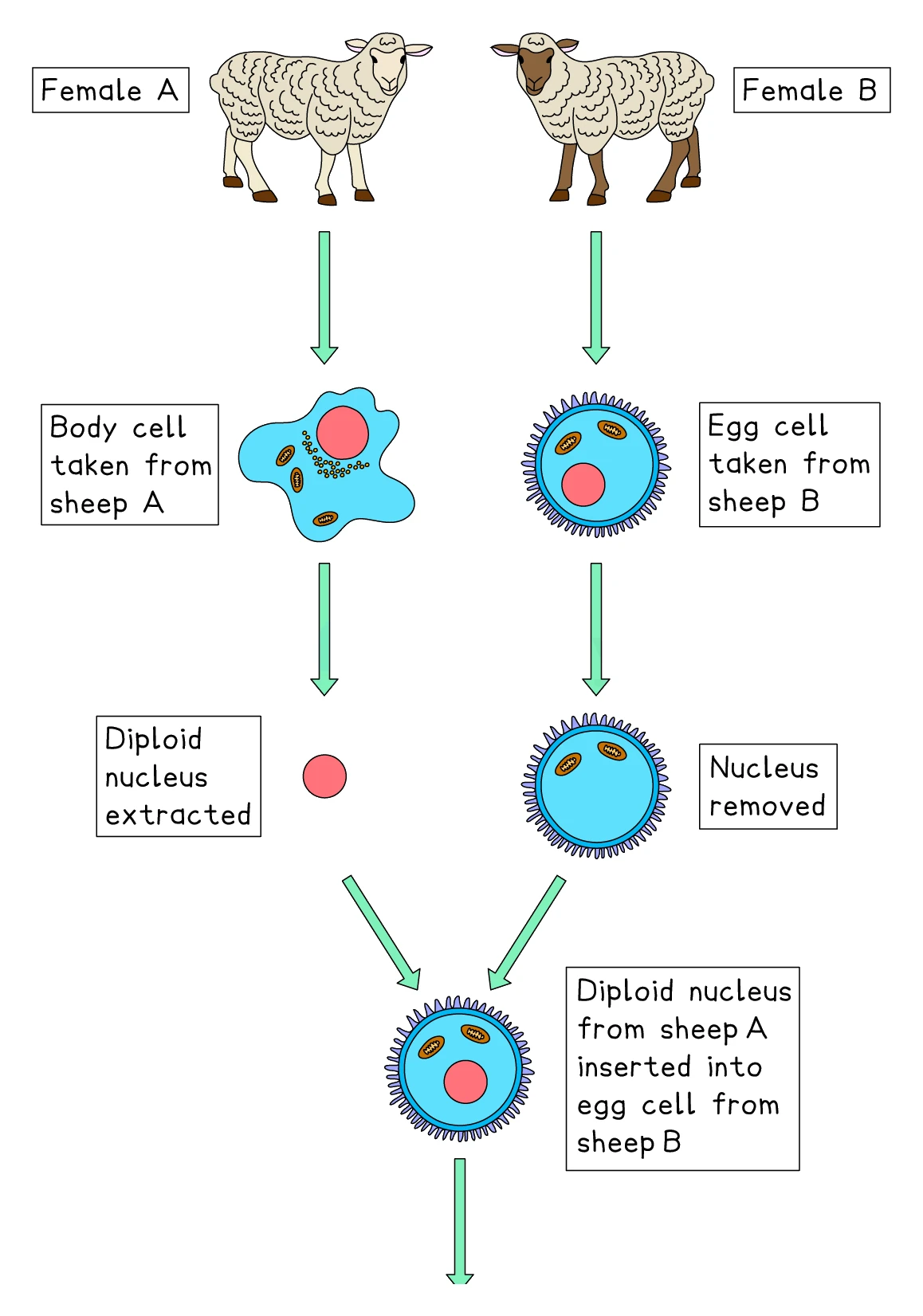
This is the technique that produced Dolly the sheep in 1996, the world's first mammal cloned from an adult cell. The five steps:
- Take an unfertilised egg cell from a female of the species. Using a fine needle, remove its nucleus. The egg is now enucleated (it has no DNA of its own).
- Take a body cell (any normal somatic cell, often a skin or udder cell) from the adult animal you want to clone. This cell contains the full diploid set of chromosomes.
- Insert the diploid nucleus from the body cell into the enucleated egg. The egg now contains DNA identical to the adult animal.
- Give the cell a mild electric shock to fool it into thinking it has been fertilised. The cell starts to divide by mitosis, forming an embryo.
- Once the embryo has reached a small ball of cells, implant it into the uterus of a surrogate mother. The embryo develops normally and is eventually born.
The newborn is a genetic clone of the animal that supplied the body cell, with the same DNA in every cell. The surrogate mother contributes nothing genetically; she just carries the pregnancy.
Common exam question
Describing the stages of cloning a mammal
Question: Describe the stages scientists would use to clone a named mammal, or fill the gaps in a passage about cloning a sheep (4–7 marks).
Asked in 3 of the 23 papers, one mark per stage. Take the nucleus from a diploid body cell of the animal to be cloned and put it into an enucleated egg cell, an egg with its own nucleus removed ("empty egg cell" is accepted). Give the cell an electric shock so that it divides by mitosis, then place the embryo into the uterus of a surrogate mother. Any four of these points score in the 4-mark versions.
One scheme rejects "meiosis" for the division, another "ovule" for the egg. For a male animal take the egg from a female (an egg "from the male" was rejected) and say body cell, not udder. One difference from genetic modification: clones are genetically identical to the donor, whereas GM changes the genes and introduces new variation.
Dolly the sheep
In 1996, scientists at the Roslin Institute in Scotland used this technique on sheep:
- DNA donor: a 6-year-old Finn Dorset ewe (white-faced)
- Egg donor: a Scottish Blackface ewe
- Surrogate mother: another Scottish Blackface ewe
Dolly was born with a white face like the DNA donor, not black like the surrogate, proving she was a true clone of the DNA donor and not a normal offspring of the surrogate. She lived to age 6 and had several lambs of her own. Dolly's success started the whole modern field of mammalian cloning.
Embryo cloning (embryo splitting)
A simpler technique called embryo has been used in livestock breeding for decades:
- Two parent animals with the desired traits are mated normally, producing a fertilised egg (zygote).
- The zygote divides into an early embryo (a ball of identical stem cells).
- The embryo is divided into smaller groups of cells, each of which is genetically identical.
- Each piece is implanted into a separate surrogate mother.
- Each pregnancy results in a clone of the original embryo, so all the offspring are genetically identical to each other (but not identical to either parent, since they come from a normal fertilised egg).
This is how naturally identical twins form: a single fertilised egg accidentally splits into two embryos that develop separately. Embryo cloning just does it on purpose, with more pieces, in more surrogates.
Uses of animal cloning
- Multiplying valuable livestock: one prize bull or top dairy cow can produce thousands of genetically identical offspring through cloning
- Producing transgenic animals at scale: once one transgenic animal has been engineered, cloning makes many more identical copies, all producing the same useful protein
- Conservation of endangered species: cloning could help restore populations of nearly-extinct animals
- Preserving extinct species: there is research into using preserved DNA to clone extinct species (woolly mammoths, dodos), though no successful cases yet
- Medical research: cloned animals provide genetically uniform test subjects, removing variation between individuals as a confounding factor
Limitations and risks
- Very low success rate: only a few percent of cloning attempts produce a healthy live birth. It took 277 attempts to produce Dolly.
- Health problems in clones: cloned animals often have shortened lifespans, premature ageing, weakened immune systems, and various other problems
- Loss of genetic variation: a herd of clones is genetically uniform, so vulnerable to any disease the clones cannot resist
- Ethical concerns (covered below)
7. Comparison with selective breeding
Genetic engineering and selective breeding both aim to produce organisms with useful new traits. They achieve this in very different ways.
| Feature | Selective breeding | Genetic engineering |
|---|---|---|
| What it does | Combines existing alleles already in the species through generations of choosing parents | Inserts specific genes (from any species) directly into the DNA |
| How long it takes | Many generations (often years to decades) | Fast at the lab stage (days to weeks for bacteria) |
| Source of new traits | Alleles already present in the species, brought together by breeding | Genes from any organism, even different kingdoms |
| Precision | Imprecise: many genes are shuffled together at each cross, and offspring inherit a mix | Very precise: only the specific gene wanted is moved |
| Risk of unintended changes | Lower (genes from same species are well-tested) | Higher in principle (foreign DNA in new context can have unexpected effects) |
| Public acceptance | Widely accepted (10 000 years of tradition) | Controversial; many people are wary of "unnatural" GM food |
| Examples of products | Modern wheat, dairy cattle, dog breeds | Insulin-producing bacteria, Bt crops, golden rice |
The two techniques can be combined. Genetic engineering can introduce a useful gene; selective breeding can then improve other characteristics over generations.
8. Ethical and safety concerns
Genetic engineering raises serious ethical and safety questions that scientists, governments and the public have been debating for decades. There are no simple answers.
Safety concerns
- Could the engineered organism harm human health? GM food has been eaten by millions of people for over two decades with no clear evidence of harm, but long-term effects are uncertain.
- Could engineered genes spread to wild populations? Pollen from GM crops can fertilise wild relatives. Genes for herbicide resistance, for example, could spread to weeds, making them harder to kill.
- Could engineered organisms unbalance ecosystems? Bt crops kill the target pests but might also harm non-target species like butterflies that share habitat with crops.
- Could pests evolve resistance? Yes. Insects exposed to Bt crops will be under intense selection for any Bt-resistance allele. Resistance has already been observed in some places.
- Risk of escape: GM fish or insects released could establish wild populations that crowd out natives.
Ethical concerns
- Playing God: some people feel humans should not deliberately alter the genome of any organism, especially across species boundaries. This concern often has religious roots.
- Animal welfare: transgenic animals may suffer from health problems caused by their engineered genes; cloned animals often have shorter lifespans and weaker health.
- Patents and ownership of life: companies can patent the GM organisms they create, treating living things as private property. Critics argue life should not be owned by corporations.
- Inequality: GM seeds and patented livestock benefit large agribusinesses more than small farmers. Some farmers become dependent on annual seed purchases from a single supplier.
- Reduced choice: cross-contamination between GM and non-GM farms can mean farmers and consumers lose the choice to avoid GM products.
- Human gene editing: the same technology can in principle be used on human embryos. In 2018 a Chinese scientist produced the first gene-edited human babies, triggering global condemnation and tighter regulation. The line between curing disease and "designer babies" is murky.
Reasons for cautious optimism
Genetic engineering has also brought real benefits:
- Insulin for millions of diabetics
- Vaccines produced quickly and at low cost
- Vitamin-enriched crops that could prevent millions of cases of malnutrition
- Drought-tolerant crops for areas facing climate change
- Medical research tools that have led to important discoveries
- Conservation potential for endangered species
The regulation question
Different countries take very different approaches:
- The USA treats GM crops mostly like any other crop, with limited labelling.
- The European Union is more cautious: GM crops must be labelled, and many are banned from growing in EU countries.
- The UK is currently relaxing some rules to allow more gene-edited crops.
- Many countries in Africa and Asia have a patchwork of approaches.
Whether genetic engineering is mostly a force for good or for harm depends partly on how carefully it is regulated, who benefits from the new technology, and how transparently companies and governments handle the risks.
9. The full toolkit of biological resource techniques
This is the last topic in the biology syllabus. Bringing together everything from topics 12, 17 and 18, modern biotechnology offers a toolkit of techniques for producing useful plants, animals and proteins:
| Technique | What it produces | Speed | Genetic variation in result |
|---|---|---|---|
| Selective breeding | New breed/variety with desired traits | Slow (many generations) | Some (mix of parents' alleles) |
| Cuttings (topic 12) | Identical plants from a single parent | Fast | None (clones) |
| Tissue culture / micropropagation (topic 17) | Many identical plant clones from one parent | Very fast | None (clones) |
| Genetic engineering | Organism with a specific new trait | Fast (at lab stage) | None (precise control) |
| Cloning animals | Genetically identical animal copies | Slow (per individual), but each is a clone | None (clones) |
| Industrial fermentation | Large quantities of microbial product (e.g. yoghurt, insulin) | Fast | Population grown from one strain |
Each technique has its place. Together, they have completely transformed how humans produce food, medicines and industrial materials, and they continue to develop rapidly. The biggest challenges going forward are not really technical but ethical, regulatory and social: how to deploy these powerful tools wisely, equitably, and with appropriate caution.