1. Increasing crop yield with glasshouses and polythene tunnels
A (greenhouse) is a building with glass walls and roof; a (polytunnel) is a curved frame covered with clear plastic sheeting. Both let growers control the environment around a crop so that photosynthesis, and therefore yield, can be pushed higher than it would be outdoors.
A glasshouse or polytunnel increases yield because it lets the grower manage the factors that limit photosynthesis and growth:
- Higher temperature. The transparent cover traps heat from the Sun (and can be topped up by heaters), so the air inside stays warmer. Warmer conditions speed up the enzyme-controlled reactions of photosynthesis and growth, and they extend the growing season into colder months.
- More light. The clear cover still lets light through, and growers can add artificial lighting to keep photosynthesis going on dull days and after dark.
- Controlled carbon dioxide. The enclosed space can be enriched with extra CO₂ (see section 2).
- Protection. Crops are shielded from frost, wind, heavy rain, and many pests and diseases, so fewer plants are lost.
- Controlled watering. Water and dissolved mineral ions can be supplied steadily so the crop never runs short.
A polytunnel is cheaper to build and cover than a glasshouse, so it is widely used for crops like strawberries and salad leaves, but it gives less precise control than a fully equipped glasshouse.
2. Carbon dioxide and temperature inside a glasshouse
Inside a glasshouse the grower can deliberately raise both the carbon dioxide concentration and the temperature, and each affects yield through its effect on photosynthesis.
Increased carbon dioxide
- Outdoor air is only about 0.04 % CO₂, so carbon dioxide is often the limiting factor for photosynthesis.
- Pumping extra CO₂ into the glasshouse (for example from a burner) raises the rate of photosynthesis, so the plants make more glucose and grow faster, giving a higher yield.
- The benefit only continues while CO₂ is the limiting factor. Once CO₂ is plentiful, light or temperature becomes the new bottleneck and adding still more CO₂ has no further effect.
Increased temperature
- Photosynthesis and the other reactions of growth are controlled by enzymes. As temperature rises towards the optimum, the molecules gain kinetic energy, collide more often, and the reactions speed up, so yield rises.
- Above the optimum the enzymes begin to denature: their active sites change shape, and the rate of photosynthesis falls, so pushing the temperature too high actually reduces yield.
- Warmth also lengthens the growing season, letting growers harvest crops earlier or out of season when they sell for more.
The grower aims for the combination of CO₂, temperature and light that keeps all three close to their optimum, because the yield is set by whichever factor is in shortest supply.
Exam tip
Write the limiting-factor chain through to yield
When asked why a glasshouse raises yield, write the chain: light, carbon dioxide and warmth are supplied, so no factor limits photosynthesis and more of it happens, so yield and profit rise. Add protection from pests, disease and frost, and any fossil fuel, carbon dioxide or food miles the question's set-up saves. Naming oxygen as a factor, or promising better-quality crops, is ignored. The same logic covers why extra fertiliser adds no yield: the crop already has all the mineral ions it can take up, so light, carbon dioxide, temperature or a mineral the fertiliser lacks is now limiting.
3. Fertilisers and crop yield
Plants need mineral ions from the soil to build the molecules that glucose alone cannot supply. Intensive farming removes these ions with every harvest, so they are replaced using fertiliser. Most commercial fertilisers are described as NPK because they supply the three ions crops need in the largest amounts:
| Element | Ion supplied | What the plant uses it for | Effect of shortage |
|---|---|---|---|
| N — nitrogen | Nitrate (NO₃⁻) | Making amino acids and therefore proteins (for growth and enzymes) | Stunted growth; older leaves turn yellow |
| P — phosphorus | Phosphate (PO₄³⁻) | Making DNA and cell membranes; needed for healthy root growth | Poor root growth |
| K — potassium | Potassium (K⁺) | Helps enzymes of photosynthesis and respiration work; controls stomata | Yellow leaf edges; weak growth |
Adding fertiliser replaces the lost ions, so plants can make more protein and chlorophyll, grow larger and faster, and produce a higher yield. Magnesium is often added too, because it is needed to make chlorophyll.
The link to the wider environment matters here: if fertiliser is washed off the land into rivers and lakes, it can cause eutrophication, covered in topic 16. Growers therefore try to apply only what the crop needs.
4. Yeast in bread-making
Yeast is a single-celled fungus. In bread-making it is mixed with flour, water and sugar to form a dough, and it respires the sugars.
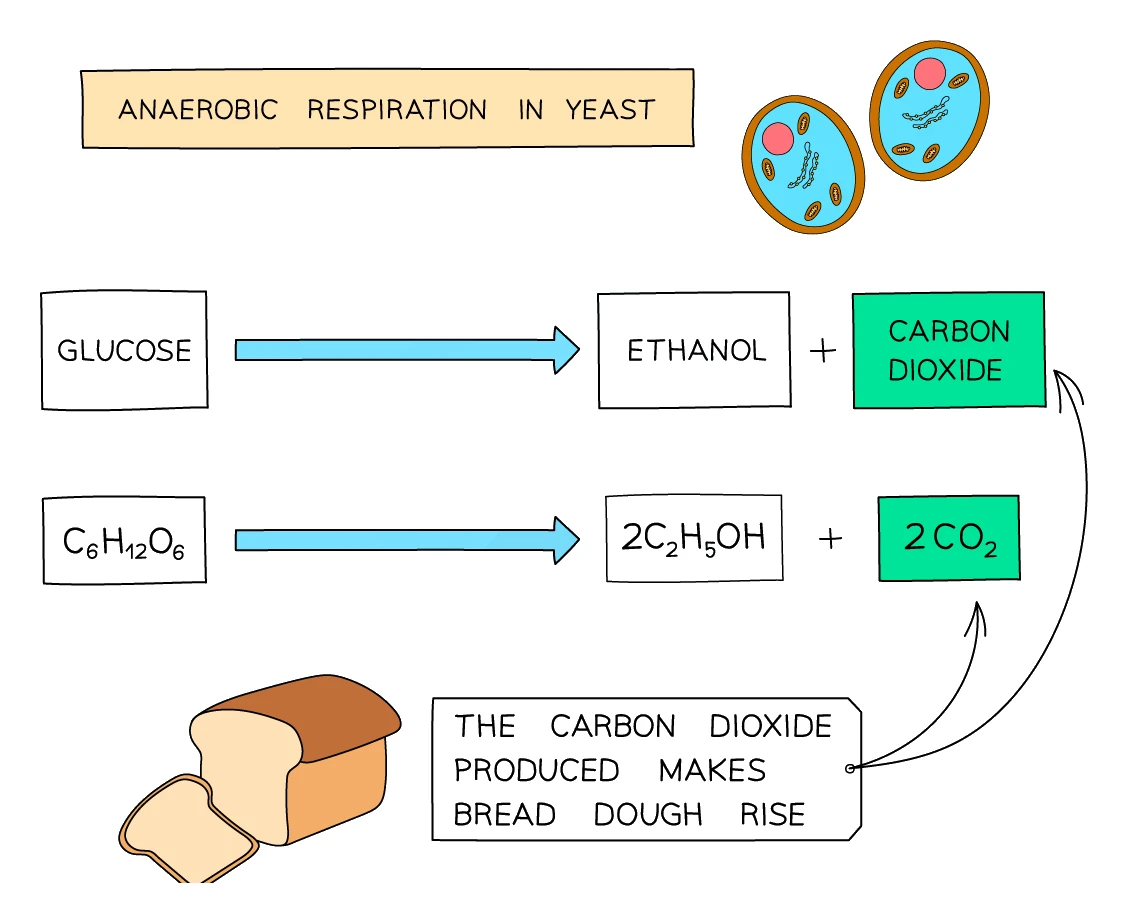
- Yeast carries out anaerobic respiration (fermentation) in the dough, where oxygen soon runs low:
glucose → ethanol + carbon dioxide (+ energy)
- The carbon dioxide produced is trapped as bubbles in the stretchy dough, making it rise so the baked bread is light and full of holes.
- The small amount of ethanol (and any remaining gas) is driven off during baking in the hot oven, so the finished bread contains essentially no alcohol.
- Warmth speeds the yeast's respiration, which is why dough is left to rise in a warm place; too hot, though, and the yeast's enzymes denature and it stops working.
Exam tip
Describing how yeast makes bread rise as a chain
The four-mark description of how yeast is used to make bread offers six credited links, any four of which score: yeast respires aerobically at first, then anaerobically (fermentation is accepted); the starch in the flour is converted to maltose and then glucose, using the enzymes amylase and maltase (two separate links); respiration releases carbon dioxide; and the gas is trapped as bubbles, so the dough rises and its volume increases. "Yeast makes the dough rise" on its own is only the last link, so start from the starch, name the enzymes and name the gas.
Core practical: anaerobic respiration in yeast under different conditions
The rate of anaerobic respiration in yeast can be measured by how fast it releases carbon dioxide.
- Mix with a glucose solution that has been boiled and cooled (boiling drives off dissolved oxygen so respiration is anaerobic).
- Put the mixture in a tube and seal it; let the carbon dioxide it makes pass through a delivery tube into a counting setup. The CO₂ can be counted as bubbles per minute through limewater, or its effect followed using hydrogencarbonate indicator (which turns from orange/red towards yellow as CO₂ builds up).
- A layer of oil on top of the yeast–glucose mixture keeps air out and confirms the respiration is anaerobic.
- To test the effect of temperature, run identical tubes in water baths at a range of temperatures (for example 10, 20, 30, 40 and 50 °C) and count the bubbles produced per minute in each.
- Keep everything else the same (same volume and concentration of yeast and glucose, same time), and use a control with no yeast to show the CO₂ comes from the yeast.
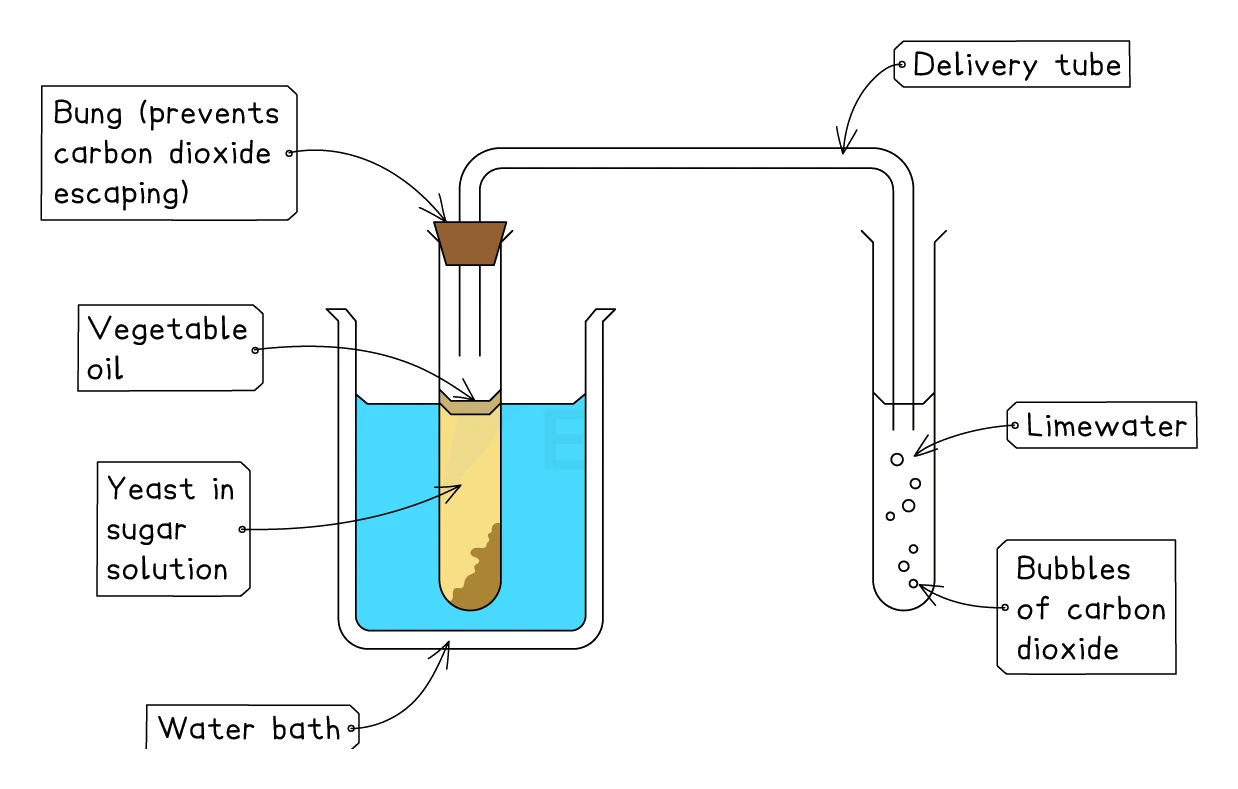
Result: the rate rises with temperature up to an optimum (around 35–40 °C) as the yeast's enzymes work faster, then falls at higher temperatures as those enzymes denature. The same method can compare different sugars or different glucose concentrations.
5. Lactobacillus in yoghurt
Yoghurt is made from milk using the bacterium .
- Milk is first heated (pasteurised) to kill unwanted microorganisms, then cooled to about 40 °C, and a culture of Lactobacillus is added.
- The bacteria respire the milk sugar lactose anaerobically, producing .
- The lactic acid lowers the pH of the milk. The acidity makes the milk proteins clot (coagulate), thickening the milk into yoghurt and giving it its sharp, tangy taste.
- The acidic conditions also help preserve the yoghurt by stopping the growth of many spoilage and harmful microorganisms.
Common exam question
Describing how Lactobacillus turns milk into yoghurt
Question: Describe how Lactobacillus makes yoghurt from milk, complete a passage on yoghurt production, or explain why rising acidity measures yoghurt production (2–7 marks).
Asked in 3 of the 23 papers, with the same credited chain each time. Milk is heated (pasteurisation; sterilisation also scores) so the bacteria in it are killed, then cooled before Lactobacillus (Streptococcus also scores) is added. The bacteria respire the milk sugar lactose anaerobically, producing lactic acid (lactate is accepted), which lowers the pH and makes the milk protein clot (coagulate), thickening the milk. The three-mark describe version credits any three of respiration, lactose, lactic acid and clotting, so the sugar and the acid are separate marks, and "the milk becomes acidic" counts for the acid. Where rising acidity measures yoghurt production, the two marks come from any two of anaerobic respiration, by the bacteria, and producing lactic acid; with less oxygen the bacteria respire more anaerobically, so the acidity rises faster.
6. The industrial fermenter
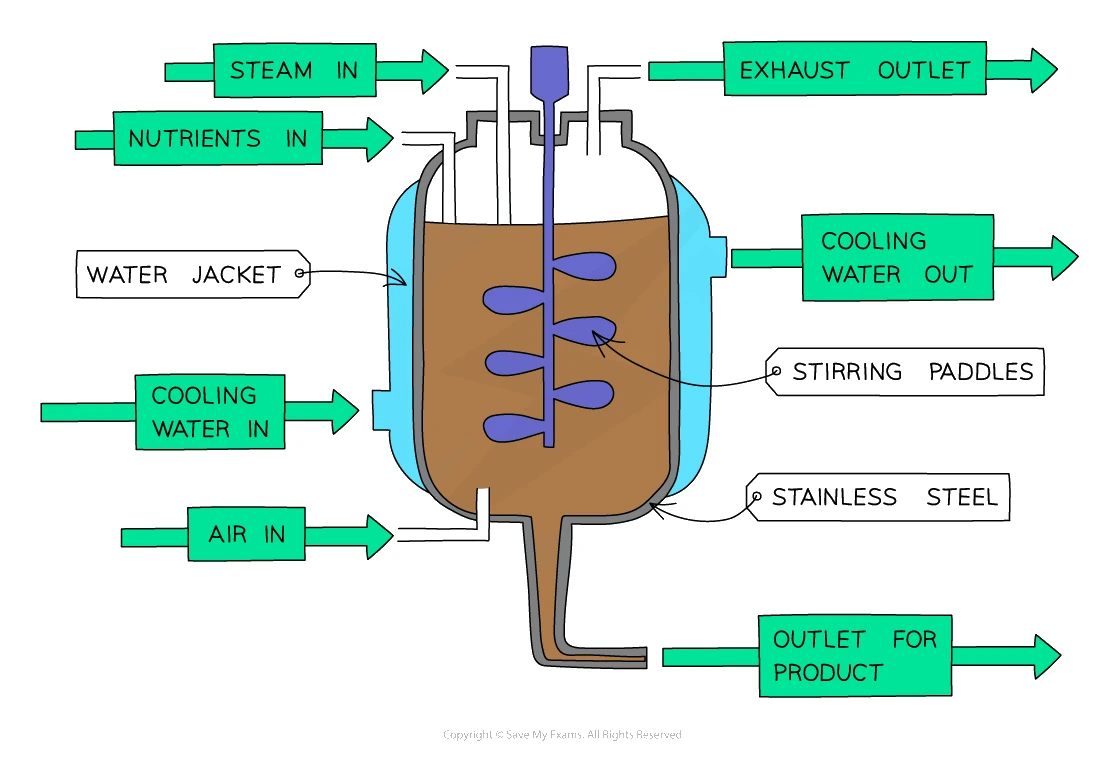
When a useful product (such as the protein insulin from genetically engineered bacteria in topic 18, mycoprotein, or an antibiotic) is made by culturing microorganisms on a large scale, the microorganisms are grown in a large stainless-steel vessel called an . The fermenter must provide and maintain the conditions the microorganisms need to grow quickly and make the product, while keeping unwanted microorganisms out.
| Condition the fermenter provides | Why it is needed | How the fermenter does it |
|---|---|---|
| Aseptic (sterile) conditions | Stop other microorganisms contaminating the culture, competing for nutrients or spoiling the product | The vessel and the nutrient medium are sterilised (e.g. with steam) before use, and only filtered air is let in |
| Nutrient medium | Supply the carbon, nitrogen and mineral ions the microorganisms need to respire and build new cells | A measured supply of nutrients (such as sugars and a nitrogen source) is added |
| Optimum temperature | Enzymes work fastest at the optimum; too hot and they denature, too cold and growth is slow | A water jacket around the vessel removes the heat released by respiration and a temperature probe keeps it steady |
| Optimum pH | Enzymes work best at a particular pH; the wrong pH slows growth | A pH probe monitors the culture and acid or alkali is added automatically to correct it |
| Oxygenation | Aerobic microorganisms need oxygen for respiration to release energy and grow | Sterile air is bubbled in through a sparger at the base |
| Agitation (stirring) | Keeps the microorganisms, nutrients, oxygen and heat evenly distributed so every cell has the conditions it needs | A motor-driven paddle or stirrer mixes the contents continuously |
When all of these are kept at their best values, the microorganisms multiply rapidly and make large amounts of the product, which is then extracted and purified.
Common exam question
Explaining how a fermenter controls its conditions
Question: Explain how named conditions in a fermenter are controlled, or the role of one labelled part: the water jacket, stirrer, air supply or air filter (2–4 marks per part).
Asked in 3 of the 23 papers. The four-mark version pairs a condition (oxygen, optimum temperature, optimum pH, aseptic conditions or even mixing) with its control, and the control scores only if the condition is named; "high temperature" is ignored.
Explaining one part needs its full purpose. The jacket removes the heat respiration releases, holding the optimum so enzymes do not denature; "warms it up" is ignored, as was "cools it down" alone for a part labelled cooling jacket. The stirrer keeps the temperature even, with no hot spots, and the bacteria in contact with nutrients; "stirs" and "keeps the optimum temperature" are ignored. Air supplies oxygen for respiration ("for anaerobic respiration" is rejected); the filter keeps out microorganisms that would contaminate the product ("keeps it clean" is ignored).
7. Fish farming
Producing protein by fish farming (aquaculture) is the other food-production method in this section of the spec. It is dealt with in topic 16 (Human Impact on the Environment), where the methods used to farm fish, control disease and predation, manage feeding and waste, and farm sustainably are covered in full. See that topic for the detail.