Poverty
Economic Development · 2 question types
People fall into poverty for several distinct reasons. A typical question rewards reasons drawn from different categories.
- Unemployment. Someone without a job has no wage income and must rely on benefits, which are usually well below average earnings. Long-term or structural unemployment is a leading cause of poverty.
- Low wages. Being in work does not guarantee escaping poverty. Workers in low-skilled, low-productivity or insecure jobs may earn too little to cover basic needs, especially where there is no minimum wage.
- Illness. Poor health stops people working, reduces the hours they can do and adds medical costs. Illness can push a household into poverty and then keep it there.
- Age. The very young depend on others, and the elderly may live on small or no pensions once they stop earning. Both groups are over-represented among the poor.
- Environmental factors. Drought, floods, poor soil or natural disasters can destroy crops, livelihoods and homes, and the resulting fall in output and incomes pushes households into poverty.
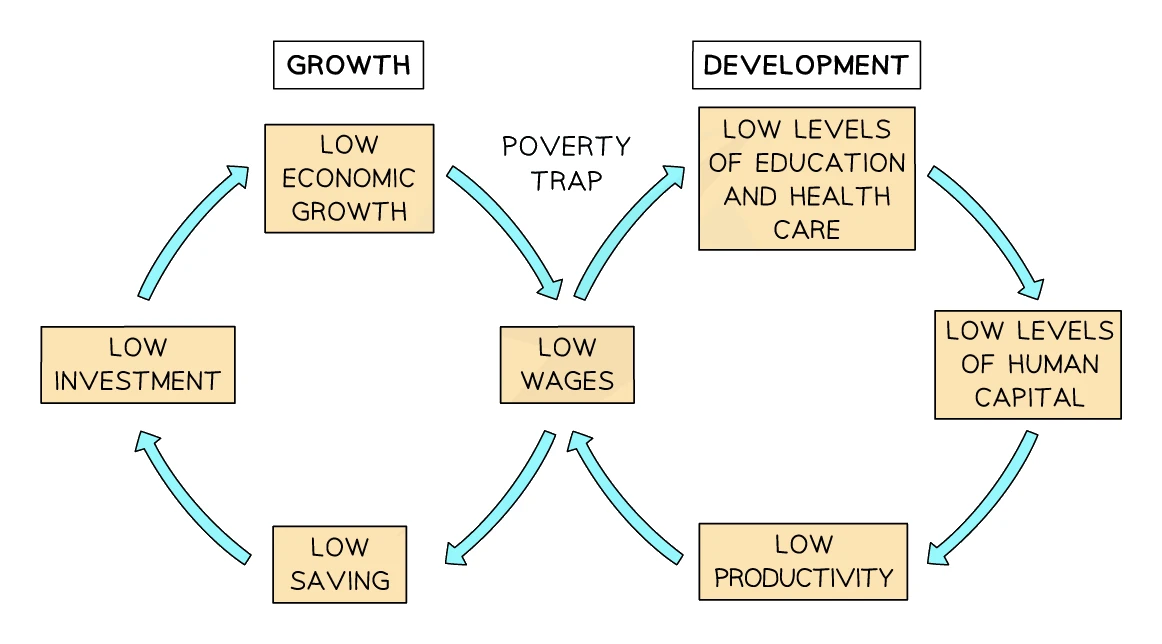
Behind several of these sits a self-reinforcing poverty trap centred on low wages. On the growth side, low wages mean low saving and low investment, which holds back economic growth; on the development side, low wages leave no money to spend on education or healthcare, so human capital and productivity stay low. Both loops feed back into low wages, keeping incomes down. A high dependency ratio (many children or elderly per worker) makes the trap harder to break.
Analyse how an event can increase poverty (6 marks)
What comes up: a 6-mark "Analyse" question linking some change (for example a fall in investment, a recession or a rise in unemployment) to a rise in poverty. Each credited chain identifies the cause, then develops the steps to higher poverty.
Write: develop two or three chains, for example: (1) a fall in investment means firms produce less output (1), so unemployment rises (1), incomes fall (1) and people struggle to afford basic necessities, increasing absolute poverty (1); (2) less investment in education, training or healthcare (1) lowers some workers' skills and productivity (1), reducing their wages (1) and widening the gap between rich and poor, increasing relative poverty (1); (3) older or less efficient equipment (1) raises firms' average costs (1), pushing up prices (1) and reducing people's real purchasing power (1).
Watch out: show each step in the chain rather than jumping straight from the cause to "poverty rises". The marks are for the linked reasoning, and naming whether absolute or relative poverty rises strengthens the answer.