Text, Sound and Images
Data Representation
Sound in the real world is an analogue signal: a continuous wave of air pressure varying in time. A microphone turns the pressure into a continuous voltage. But a computer can only store digital values (discrete binary numbers), so the analogue signal has to be sampled before it can be stored.
Analogue-to-digital conversion
The process is called A/D conversion (or A2D):
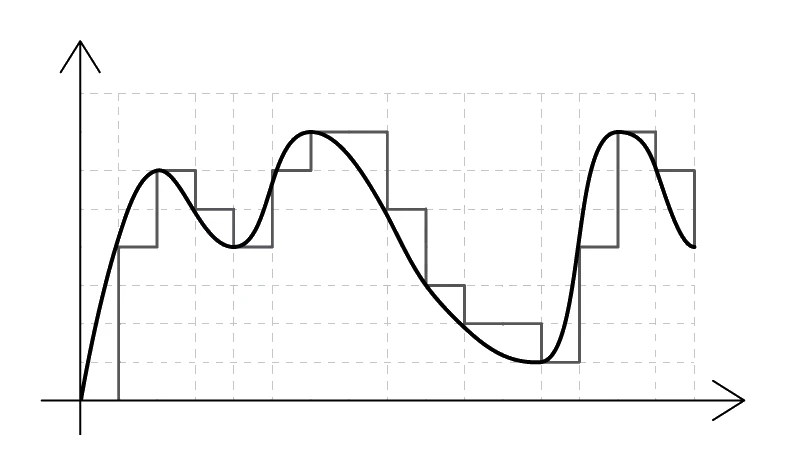
- The continuous analogue wave is measured at regular intervals. Each measurement is called a sample, and it records the wave's amplitude (height) at that moment.
- Each sample's amplitude is rounded to the nearest value that can be stored in the available number of bits. The result is a binary number.
- The binary numbers are stored on secondary storage in order.
- To play the sound back, the binary numbers are read back and used to drive a speaker.
Exam tip
Explaining analogue-to-digital sound conversion step by step
Asked to explain how an analogue sound is recorded and turned into digital (5 marks), you score any five of nine points, so write the process in order: a microphone records the sound, the wave is sampled, each sample measures the amplitude of the wave, each amplitude gets a unique binary value, and every sample is converted to binary. Four of the nine points are the two settings: the sample rate is set (how many samples are taken each second) and the sample resolution is set (how many bits each sample uses), so include both definitions.
Two parameters control the quality of the digital recording: and .
Sample rate
Sample rate is the number of samples taken per second, measured in hertz (Hz).
1 Hz means one sample per second. 1 kHz means 1000 samples per second.
Common sample rates:
- 8 kHz: telephone-quality voice. The reason phone calls used to sound thin and tinny.
- 22 kHz: low-quality compressed audio.
- 44.1 kHz: standard audio CD quality (44 100 samples per second).
- 48 kHz: standard for video soundtracks.
- 96 kHz or higher: studio recording.
The higher the sample rate, the more closely the digital version follows the original analogue wave, and the higher the maximum frequency that can be captured.
Sample resolution (bit depth)
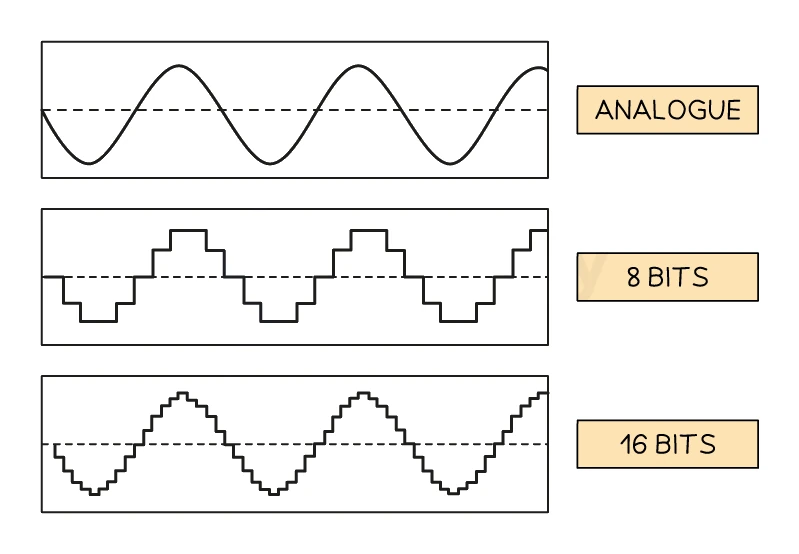
Sample (also called bit depth) is how many bits are allocated to record one sample.
With n bits per sample, there are 2ⁿ different amplitude levels that each sample can be rounded to:
- 8-bit audio has 256 amplitude levels per sample.
- 16-bit audio (the CD standard) has 65 536 levels.
- 24-bit audio (studio quality) has over 16 million levels.
A higher sample resolution means each sample is closer to the true amplitude of the original wave, so the recording sounds cleaner.
Effect on quality and file size
| Parameter | If increased | Effect on quality | Effect on file size |
|---|---|---|---|
| Sample rate | More samples per second | Higher; captures higher frequencies | Larger |
| Sample resolution | More bits per sample | Higher; finer amplitude detail | Larger |
Both improve quality but both also increase file size. Audio engineers choose the lowest values that give acceptable quality for the use case (phone calls can get away with 8 kHz; concert recordings need 44.1 kHz or higher).
Common exam question
How sample rate and sample resolution affect a recording
Question: Give a benefit and a drawback of a higher sample rate, describe sample resolution, explain why a higher sampling resolution is more accurate, or state two ways to make a recording more accurate (1–2 marks per part).
Asked in 3 of the 17 papers. Raising either setting makes the recording more accurate, closer to the original; the drawback is a larger file needing more storage space. The two ways to increase accuracy are exactly those: increase the sample rate and increase the sample resolution. Describing sample resolution earns one mark for the number of bits used per sample and a second for what that controls: how many different amplitudes can be recorded, or how quiet and loud the sounds can be (an example like 16-bit also counts).
For why higher resolution is more accurate, give two of: more bits are allocated to each amplitude, amplitudes are recorded more precisely, and a wider range of amplitudes is captured.