Database Concepts
Databases
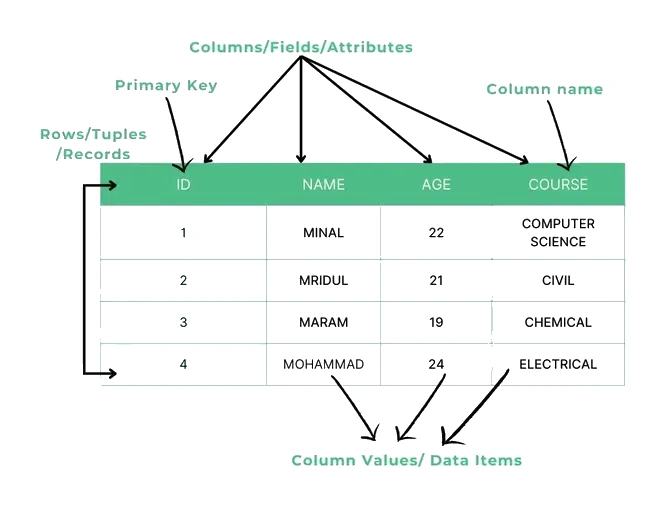
Every single-table database is made of three building blocks: , and (usually) a .
Fields
A field is one specific piece of information about each item; it appears in the table as a single column.
Examples of fields for a customer database: CustomerID, FirstName, LastName, DateOfBirth, PhoneNumber.
Records
A record is the collection of fields that all belong to one specific item; it appears in the table as a single row.
For the customers table, each customer is one record. If there are 200 customers, there are 200 records.
Easy way to remember: fields are columns, records are rows.
Primary keys
A primary key is a single field whose value is unique for every record in the table. It uniquely identifies each record so the database can tell one from another.
Examples:
StudentIDin a school students table.CarRegistrationin a vehicles table.ProductCodein a shop's products table.MemberIDin a club's members table.
A primary key cannot be left blank, and no two records can share the same primary-key value. This matters because the database needs an unambiguous way to refer to each record, especially when records are updated or deleted.
Exam tip
Defining a primary key
What comes up: "What is a primary key?" or "State the purpose of a primary key" (one mark).
Write: a primary key is a field that uniquely identifies each record in the table — every record has a different value for that field, and none can be blank.
Watch out: saying only that it is "an important field" or "the first field listed" does not earn the mark. The examiner's credited idea is the uniquely-identifies-a-record concept, so that phrase (or an equivalent) must appear in your answer.
A worked example: a students table
| StudentID | FirstName | LastName | MarkSubmitted | Percentage |
|---|---|---|---|---|
| 2014501 | Aisha | Khan | Y | 62 |
| 2014502 | Ben | Cooper | N | 18 |
| 2014503 | Chen | Wei | Y | 81 |
| 2014504 | Dara | O'Neill | Y | 73 |
| 2014505 | Emma | Foster | Y | 41 |
| 2014506 | Faisal | Ahmed | N | 55 |
In this table:
- The (columns) are
StudentID,FirstName,LastName,MarkSubmitted,Percentage. There are 5 fields. - Each row is a for one student. There are 6 records.
- The primary key is
StudentIDbecause every student has a unique seven-digit ID.