Artificial Intelligence
Automated and Emerging Technologies · 4 question types
Machine learning (ML) is a method used to build AI systems in which the machine learns from data rather than being told every rule explicitly.
The relationship between AI and machine learning matters in exam answers:
- AI is the broader goal: building machines that behave intelligently.
- Machine learning is one technique for achieving AI, where the machine improves with more data instead of being hand-programmed.
So is part of AI, not a separate thing. Be careful with this distinction: one mark scheme credits describing machine learning as a form of AI.
How machine learning works
The process at the conceptual level the exam expects:
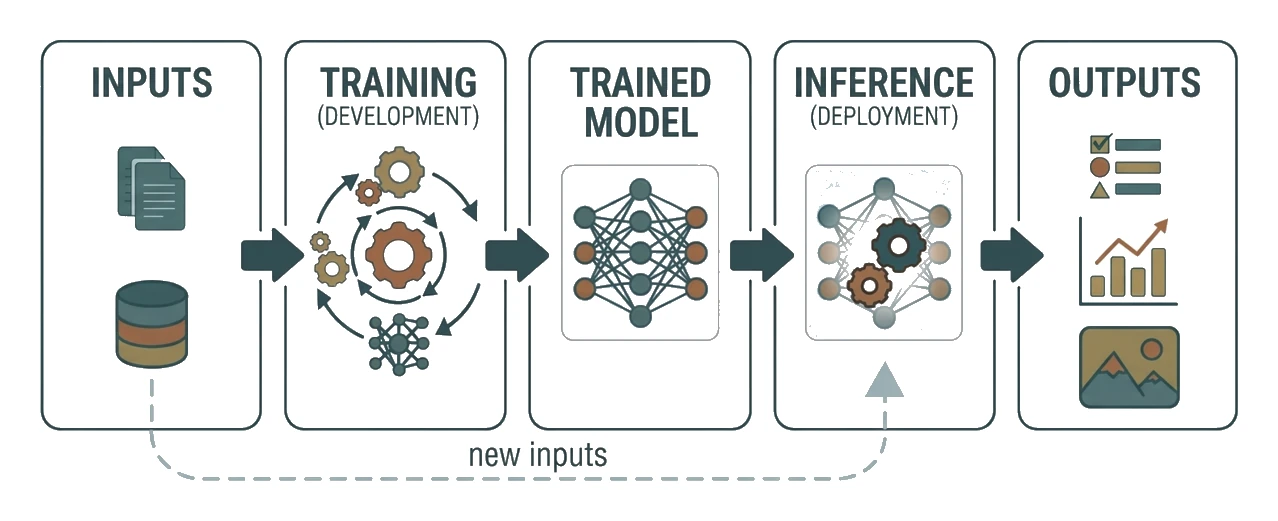
- The system is given training data: a large collection of examples, often labelled (e.g. thousands of photos tagged "cat" or "dog").
- An algorithm examines the data and looks for patterns or relationships that connect the inputs to the labels.
- The algorithm builds a that captures what it has found.
- The model can then be given new, unseen data and make a prediction about it.
- As more data is processed, the system continues to improve its accuracy.
Explaining how a device uses machine learning
Question: Explain how a device (a robot vacuum cleaner, an automated plough) makes use of machine learning or AI, or describe what machine learning capabilities means (3–4 marks).
Asked in 3 of the 17 papers. Answer as a chain, one point per link: the device gathers data while it works; it uses that data to change its own processes; so next time it performs better, making fewer mistakes, mapping the area, taking the most efficient route or avoiding known problems. Each example of data gathered (obstacles, field dimensions, dirtier areas) is a separate point, so give two or three.
Machine learning capabilities means a form of AI in which the system changes its own processes and data; it can be trained, with or without human interaction (supervised or unsupervised); it analyses patterns and keeps its results to guide future decisions. Asked to name the ability of a system that automatically adapts its own processes and data, write machine learning.
Common applications of machine learning:
- Image recognition (face unlock, photo tagging, medical scan analysis)
- Speech recognition (voice assistants, automatic captions)
- (translation, chatbots, summarisation)
- Recommendation systems (Netflix, Spotify, YouTube suggestions)
- Spam filters
- Fraud detection in banking
- Self-driving cars
Advantages of machine learning
| Advantage | Why it matters |
|---|---|
| Saves time and effort | Reduces the need for manual rule-writing, since the system learns the rules itself from data |
| Detects patterns humans miss | Can spot subtle correlations in huge datasets that no human could read through |
| Improves with more data | Performance continues to get better as more examples are seen, without needing to rewrite the program |
| Handles huge scale | Can process millions of inputs per second, far beyond human capability |
Disadvantages of machine learning
| Disadvantage | Why it matters |
|---|---|
| Needs very large amounts of high-quality data | Without enough data, or with biased or noisy data, the model performs poorly |
| Requires high processing power | Training a modern model can use vast computing resources and electricity |
| "Black box" decisions | It can be hard to explain why a learned model made a particular decision, which matters in medicine, law and finance |
| Bias from training data | If the training data reflects existing human biases, the model will reproduce them, sometimes in an amplified form |
| Vulnerable to adversarial inputs | Specially crafted inputs can trick a model into the wrong answer with high confidence |